
Smudging ceremony Myth Meaning & Symbolism
A sacred ritual where smoke from sacred herbs purifies space and spirit, carrying prayers to the Creator and restoring balance between worlds.
The Tale of the Smudging Ceremony
In the time before time, when the world was still soft with newness, the People walked in clear relationship with all things. They spoke to the stones, and the stones listened. They sang with the rivers, and the rivers echoed their song. But as the People grew in number and their thoughts became complex, a heaviness began to gather. It was a fog that could not be seen, a dust that could not be brushed away. It settled in the spaces between them, in the corners of their lodges, and most deeply, within their own hearts. This was the gathering of Wasi’chu, the clinging spirit of confusion, sickness, and disconnection.
The People grew weary. Their prayers seemed to fall to the ground before reaching the sky. Their dreams were troubled. The animals became shy, and the plants did not speak as clearly. They called out to Wakan Tanka, their voices thin with despair. “How do we cleanse this fog? How do we make our spirits light again so we may hear your voice?”
Silence was the first answer. Then, a whisper on the wind from the four sacred directions. From the East, the direction of illumination, came a vision to a Healer in a dream. She saw Unci Maka herself, breathing not air, but a fragrant, cleansing smoke. From this smoke, four sacred sisters emerged, each holding a gift.
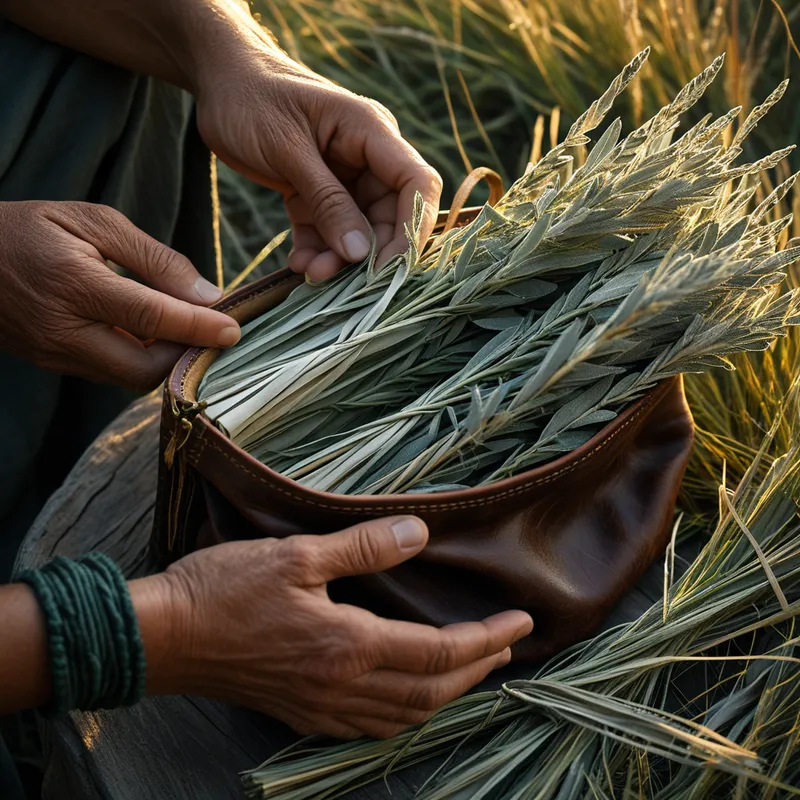
The first sister, from the rocky southern slopes, held White Sage. Her smoke was sharp and clear, a sweeping wind that cut through the densest spiritual fog. The second sister, from the riverbanks, held Sweetgrass. Her smoke was the very scent of kindness, a braided invitation for all that is good and gentle to draw near. The third sister, from the high northern forests, held Cedar. Her smoke was a strong, cleansing bath, a protective barrier that sealed the spirit after cleansing. The fourth sister, the silent one from the earth, offered her body—a shell or a clay bowl—to hold the sacred fire.
The Healer awoke with the knowledge burning in her heart. She gathered the sisters’ gifts. With a coal from the central fire, representing the eternal light of the Creator, she touched the sage. A curl of silver smoke rose. She fanned it with an Eagle Feather, and as she did, she saw the heavy fog in her lodge recoil and dissolve. She washed herself in the smoke, and the weariness lifted from her bones. She directed the smoke over her sleeping children, and their restless stirrings ceased.
She brought this ceremony to the People. They gathered in a circle. The Healer lit the sacred bundle, and the smoke began to rise. It did not rise straight to the sky, but first moved among them, touching each person, each object, each corner. As it touched the Wasi’chu, the negative energy was not destroyed, but transformed—caught by the smoke and carried upward. The Eagle Feather guided it, and the smoke became a visible prayer, a bridge between the earthly and the spiritual. The fog cleared. The air itself tasted of clarity and memory. Once more, they could hear the river’s song. The ceremony was not an ending, but a returning. A way to remember, and to begin again, clean.
Cultural Origins & Context
The practice known broadly as “smudging” is not a single, monolithic ritual but a diverse family of ceremonies central to many Indigenous Nations across North America. It is a living tradition, passed down not through written texts but through oral instruction, demonstration, and direct participation within specific cultural contexts—Lakota, Navajo, Cherokee, Cree, and countless others, each with their own protocols, prayers, and plant medicines.
The mythic understanding of the ceremony is woven into the very fabric of cosmological views where the material and spiritual worlds are intimately connected. The ceremony was traditionally conducted by designated knowledge-keepers, medicine people, or elders, often at the start of significant events: healing sessions, council meetings, seasonal celebrations, or personal rites of passage. Its societal function was multifaceted: it was a practical technology for hygiene and clearing space of insects, a spiritual technology for purification and prayer, and a social technology for marking a transition into a sacred, communal state of mind. It reaffirmed the relational worldview, acknowledging that to engage with the community, the spirits, or the self, one must first approach with a clean heart and clear intent.
Symbolic Architecture
At its core, the smudging ceremony is a profound symbolic drama of alchemical transformation. Each element is a conscious actor in a process of psychic and spiritual re-ordering.
The sacred herbs are not mere ingredients; they are plant nations offering their spirit-medicine. Sage represents the purifying power of truth, cutting through illusion and mental clutter. Sweetgrass embodies the principle of attraction, calling back harmony, kindness, and benevolent forces. Cedar signifies protection and longevity, sealing the cleansed space and spirit against renewed intrusion. Together, they model a complete process: release (sage), invite (sweetgrass), and sustain (cedar).
The smoke is the central mystery—the visible made from the consumed, the material transforming into the spiritual to carry intention between worlds.
The vessel, often an abalone shell, connects the ceremony to the waters of the earth and the feminine principle of containment. The feather, typically from an eagle, represents the highest perspective and the carrier of prayers to the Creator. The act of fanning is not passive; it is the focused application of breath and will, directing the transformative power. Psychologically, the ceremony externalizes an internal process: the identification of psychic “dirt” (negative thoughts, stagnant emotions), its conscious transformation through the “fire” of awareness, and its release, making space for new, intentional energy.

The Dreamer’s Resonance
When the motif of a smudging ceremony arises in modern dreams, it often signals a profound somatic and psychological process of cleansing and re-evaluation at an unconscious level. The dreamer may not be using sage, but perhaps a strange incense, a peculiar mist, or even a beam of light that “cleans” a space.
Somatically, this can correlate with the body attempting to “smudge” itself—a fever burning out an infection, a deep sweat during detox, or the visceral feeling of relief after a cathartic cry. Psychologically, the dream points to a pressing need to clear accumulated psychic residue: outdated beliefs, toxic emotional patterns, or the lingering energy of a difficult relationship or environment. The dream may show the smoke struggling to catch, indicating resistance to this inner cleansing. It may show the smoke turning dark or chaotic, suggesting the release is bringing shadow material to the surface. Alternatively, a dream of clear, fragrant smoke effortlessly filling a space indicates the process is underway or complete, resulting in a felt sense of lightness, clarity, and renewed spiritual connection upon waking.

Alchemical Translation
For the modern individual navigating a world saturated with information, obligation, and digital static, the myth of the smudging ceremony provides a timeless model for psychic transmutation, or individuation—the Jungian process of integrating the conscious and unconscious into a whole Self.
The first step is the Recognition of Density, akin to the People feeling the fog of Wasi’chu. This is the felt sense of being psychologically “cluttered,” anxious, or disconnected from one’s own core. The alchemical fire is then lit through Conscious Intent—the decisive act to engage in self-reflection, therapy, meditation, or any practice that generates the “heat” of awareness.
The sacred bundle is the curated contents of one’s own psyche: the sharp truth of sage (honest self-appraisal), the sweet attraction of one’s values (what do you truly wish to invite?), and the protective wisdom of boundaries (cedar).
The “smudging” is the active process of Psychic Distillation. Through the fire of attention, we do not erase our complexes or shadows; we transform our relationship to them. We observe a negative thought pattern (the fog), acknowledge it without identification, and through the breath of mindful awareness (the feather), let it be carried away, transmuted from a controlling entity into mere passing smoke. The purified space that results is not emptiness, but a Sanctuary for the Authentic Self. It is the cleared inner ground from which true prayer—deep intention, creativity, and connection—can once again rise unimpeded. The ceremony, therefore, is a map for continual renewal, teaching that cleansing is not a one-time event but a sacred practice of returning to one’s own clear and connected center.
Associated Symbols
Explore related symbols from the CaleaDream lexicon: