Smoke Signals Myth Meaning & Symbolism
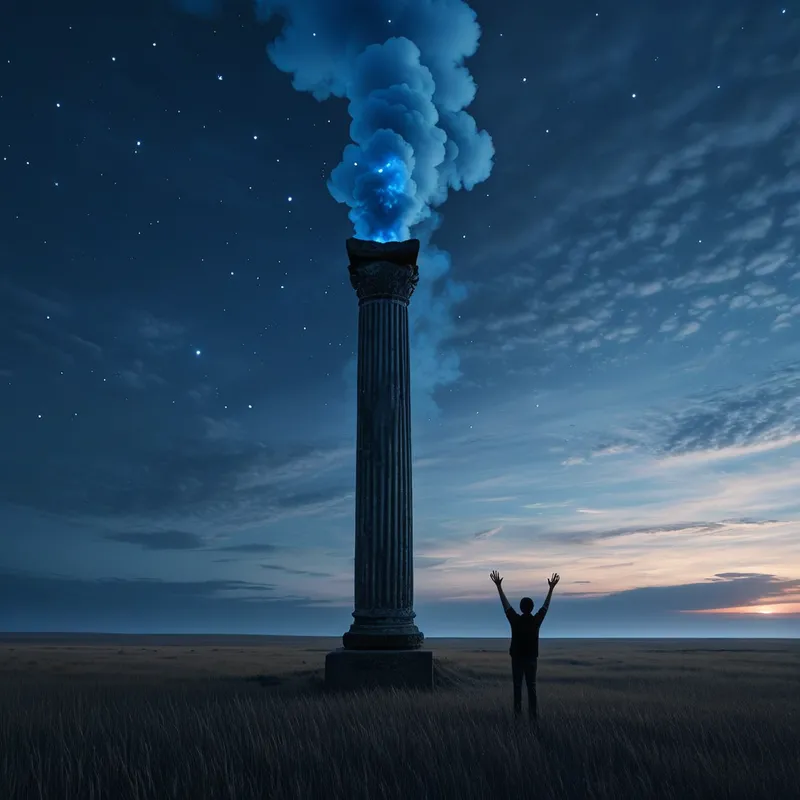
A myth of a lonely boy who learns to speak with the sky, forging a bridge of smoke and spirit to reunite with his lost father.
The Tale of Smoke Signals
Listen. The wind remembers a time when the world was wider, and the spaces between hearts were measured not in steps, but in the flight of eagles. In those days, there was a boy, Kohana, whose world was the endless, whispering grass. His father, a hunter of great renown, had followed the buffalo herds beyond the horizon, promising to return with the turning of the leaves. But the leaves turned once, then twice, and the horizon remained empty.
Kohana’s loneliness was a stone in his belly. He would climb the highest butte at dawn and stare until his eyes ached, searching for a sign. He spoke to the wind, but it only carried his words away. He cried out to Wakan Tanka, but heard only the sigh of the prairie. The distance was a silent, hungry mouth.
One evening, as the sun bled into the earth, a despair deeper than any he had known took him. He built a small fire, not for warmth, but as a companion to his solitude. He watched the flames dance and die into embers. Then, from the heart of the hot stones, a thin, grey thread began to rise. It was unsteady, a wisp. But as Kohana leaned close, his breath caught it, and the thread straightened, climbing purposefully towards the first evening star.
A thought, fragile as the smoke itself, kindled in him. He fed the embers with dry grass. The thread thickened. He added sprigs of sage, whose scent was a prayer. The smoke column grew strong and white. The wind, which had been his enemy, now caught the pillar and leaned it, with infinite gentleness, toward the distant north.
Kohana did not know what he was doing, only that he must do it. He began to use his blanket, sweeping it over the fire, not to smother it, but to shape the smoke. A long, unbroken plume. A series of quick, separate puffs. A spiral that twisted into the twilight. He was no longer speaking with his voice, but with his whole being—with fire, air, and desperate hope. He was writing on the sky itself.
Far away, across rivers and sleeping mountains, his father sat by his own fire, his heart heavy with years. He gazed south, toward a home he feared was lost. And there, on the very lip of the world, etched against the last light, he saw it: a strange, beautiful language written in cloud. It was not the pattern of weather. It was a signature of spirit. He knew, in his bones, the rhythm of that call. It was the heartbeat of his son.
He stood. He built his own fire high and hot. He answered. A dialogue of light and air began to stitch the torn land back together. Kohana, seeing the distant reply, wept into the smoke, and his tears made it shine. For three days and nights, the signals passed between them, a luminous thread guiding the father home. When they finally met in the embrace of the middle plains, the space between them was gone. They had not just found each other; they had woven a new kind of bridge, one made of watching and waiting, of fire and faith.
Cultural Origins & Context
The story of the smoke signal’s origin is not one myth from a single nation, but a profound archetypal narrative found in various forms across many First Nations cultures, particularly among Plains and Plateau tribes. It belongs to the rich oral tradition where practical technology and spiritual understanding are inseparable. These stories were not mere fables but lived teachings, passed down by elders and storytellers around winter fires or during communal gatherings.
Its societal function was multifaceted. Primarily, it was an etiological myth, explaining the genesis of a vital communication system that allowed for coordination across vast, trackless territories—for signaling hunts, warning of danger, or sending news. But more deeply, it served as a parable about community and responsibility. In a world where survival depended on the group, the myth taught that isolation is a sorrow to be remedied, and that human ingenuity, born from need and guided by spirit, can overcome the most daunting physical divides. It rooted a practical tool in a sacred narrative, ensuring that every time a signal fire was lit, it was done with an awareness of its mythic weight—a act of reconnecting the human family.
Symbolic Architecture
At its core, the myth is a masterful depiction of consciousness striving to make itself known across the void. The vast, silent prairie represents the existential loneliness of the individual psyche, the feeling of being a solitary point of awareness in an indifferent universe. The lost father is not merely a parent, but a symbol of the psychic center, one’s inner authority, or a connection to the ancestral past that feels severed.
The fire is the raw, untamed energy of emotion—grief, longing, hope. Left to itself, it is just heat and light. But consciousness (Kohana) must learn to tend it, to feed it with the sacred (the sage), and most importantly, to shape its expression.
The smoke is the sublimated message, the emotion transformed into a signal. It is the breath of the soul made visible. The act of using the blanket to create patterns is the crucial step of culture—imposing intentional form on natural expression. It is the moment instinct becomes language, and pain becomes poetry.
The answering signal from the distant father completes the symbolic circuit. It represents the universe’s, or the deeper Self’s, capacity to respond. The myth asserts that a true call, sent with enough integrity and longing, will be met. The bridge is not built by one, but by two who believe in the possibility of connection.
The Dreamer’s Resonance
When this myth pattern stirs in the modern dreamer, it often manifests as dreams of trying to send a message that won’t transmit—shouting into a void, typing on a phone with no signal, or waving at someone who never turns around. The somatic experience is one of frustration anchored in the chest and throat, a feeling of vital energy blocked and turning inwards.
Psychologically, this dream signals a profound phase of reaching out. The dreamer is in a “Kohana state”: feeling isolated, abandoned by some guiding principle (the “father”), and yearning to reconnect with a part of their life, their purpose, or a relationship that feels impossibly distant. The dream is not a diagnosis of failure, but an image of the attempt. The very act of sending the signal in the dream, however futile it seems, is the psyche beginning the work. It is practicing the shape of its longing. The dream invites the dreamer to ask: What is my unspoken message? To whom or to what part of myself am I trying to speak? And what “sacred herbs”—what authentic feelings or values—must I add to my fire to make my signal true?

Alchemical Translation
The journey of Kohana is a precise map of the alchemical process of individuation—the forging of a conscious link between the ego and the Self. The initial state is the nigredo, the blackening: the crushing loneliness, the feeling of being orphaned from meaning. The fire is the passionate, often painful, emotional heat that this darkness generates.
The alchemical work is in the shaping of the smoke. This is the albedo, the whitening, where raw passion is refined into intentional communication. The dreamer must learn to “use the blanket”—to employ discipline, patience, and art to translate inner turmoil into a coherent expression. This could be through journaling, art, therapy, or a courageous conversation. It is the process of making one’s inner state legible, first to oneself, and then to the world.
The answering signal is the rubedo, the reddening or culmination. It symbolizes the moment of psychic integration, when the outer world or the deep unconscious finally “answers.” This is not always a literal reply from another person. More often, it is an internal shift—a sudden insight, a synchronicity, a deep sense of being guided or understood. The father returning is the reclaimed wholeness, the ego now in dialogue with the Self.
The ultimate transmutation is the bridge itself. What was once a gaping wound of separation becomes the very medium of connection. The individual learns that their deepest longing, when consciously shaped and offered, does not vanish into emptiness. It becomes the thread that weaves them back into the larger tapestry of life, transforming the orphan into a messenger, and the silent void into a space alive with potential conversation.
Associated Symbols
Explore related symbols from the CaleaDream lexicon: