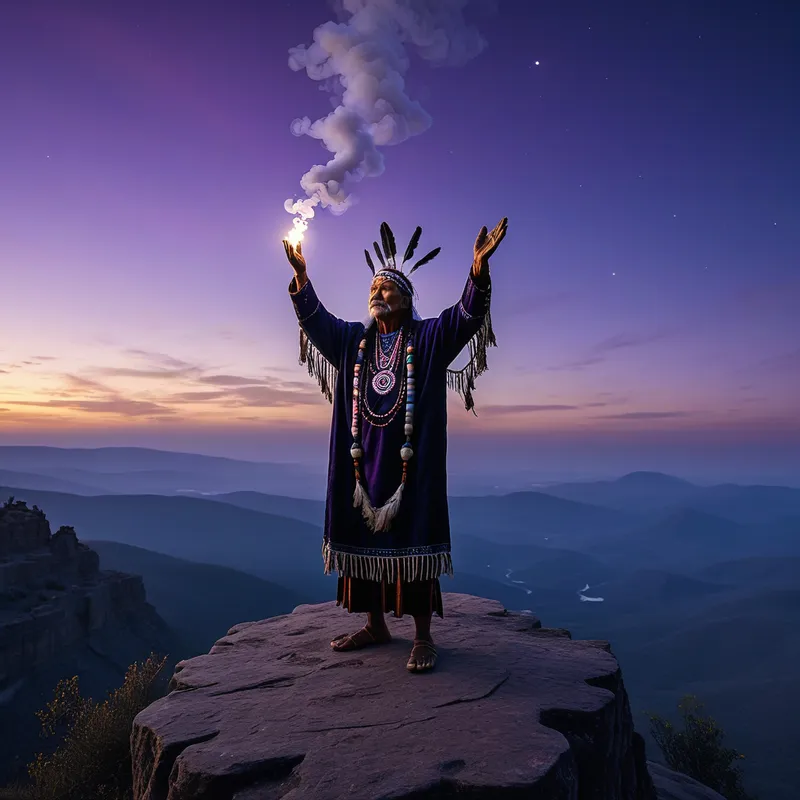
Smoke Signaling Systems Myth Meaning & Symbolism
A myth of the first smoke signals, born from a shaman's sacrifice to bridge the worlds of the living, the ancestors, and the spirit realm.
The Tale of Smoke Signaling Systems
In the time before memory, when the world was raw song and the people were new to the land, a great silence fell. It was not the silence of peace, but of separation. The villages were scattered like stars across the vast belly of the earth, divided by roaring rivers and mountains that scraped the sky. News traveled on tired feet. Warnings arrived too late, carried on the breath of the fleeing. The people felt alone, islands in a green sea, and their hearts grew heavy with the distance between them.
In one such village lived a man named Heyóka, a contrary one, a dreamer. While others looked to the earth, Heyóka spent his days watching the sky. He saw how the clouds spoke in shapes, how the wind wrote messages on the grass. But his people needed a voice faster than the wind, a sign clearer than a cloud. The burden of their isolation lived in his chest like a cold stone.
One autumn, as the geese painted arrows across the sunset, a sickness came from the north. It moved silently, a shadow without a body. Heyóka’s village was stricken. He knew a sister village, two days’ run to the east, held the cure—a certain root that grew only near their springs. But two days was a lifetime for the fevered. As he knelt by the fire that night, despair wrapping around him like a cloak, he did not see the flames. He saw only the smoke.
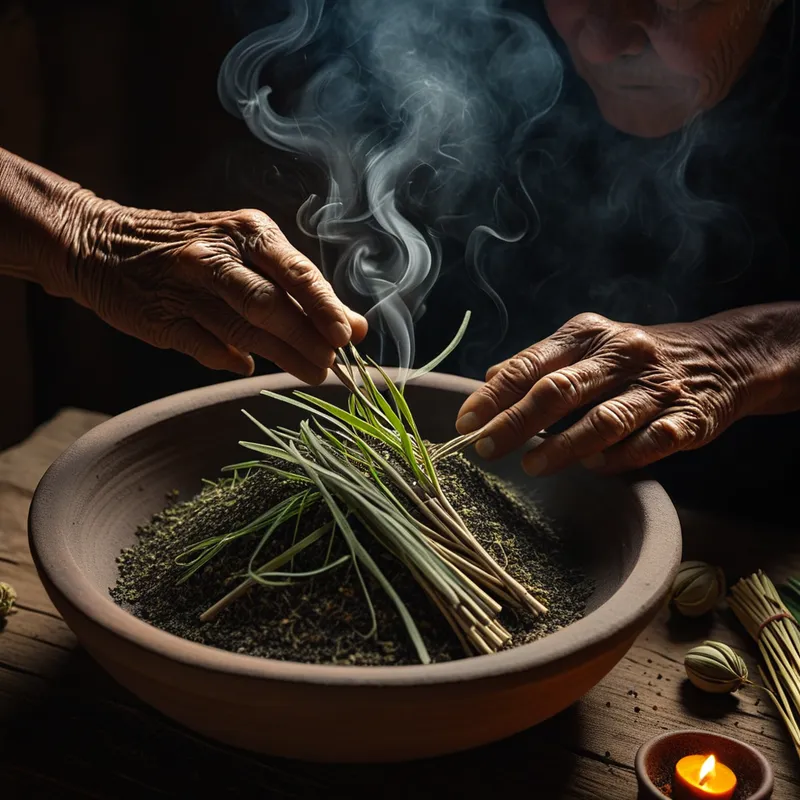
It rose in a thin, grey column, straight and true, until the high winds caught it and tore it to nothing. Why must it be so fragile? he thought. Why can it not carry a thought? In his anguish, he prayed to the Manitous of the Air and Fire. He offered his own breath, his own warmth. He took sacred herbs—sage for cleansing, cedar for protection, sweetgrass for calling—and cast them onto the coals.
A different smoke arose. It was thick, white, and purposeful. It did not scatter. It climbed in a deliberate pillar. As Heyóka focused all his will, all his need to speak across the distance, a miracle unfolded. He cupped his hands over the smoke, not to extinguish it, but to shape it. A rhythm emerged: a long release, a swift cover, another long release. The column pulsed—a visible heartbeat against the twilight.
From his high ridge, he saw a answering spark far to the east. Then, a tiny, brave thread of white smoke. They saw him. They were listening. With trembling hands, he began the first conversation. A series of short puffs: danger. A long, steady column: attend. A break, then two short puffs: sickness. He poured the story of his people into the air, and the wind, now an ally, carried it not as noise, but as a silent, urgent picture.
By dawn, runners from the eastern village were already on the path, the healing root in their packs. The village was saved. But Heyóka was not finished. The stone of isolation had cracked in his chest, and through the crack poured a vision. He taught others the language of the smoke—how different plants created different colors and densities, how blankets could shape meaning into the sky, how the lay of the land itself could be a speaking-place. The silence over the land was broken, not by a shout, but by a sign. The people were no longer islands. They were a network of watching eyes and answering fires, woven together by threads of sacred smoke.
Cultural Origins & Context
The practice of smoke signaling is not a single, unified myth from one nation, but a profound technological and spiritual reality that arose independently among many Indigenous peoples across the continents now called North and South America. For nations of the Great Plains, the Southwest, the Plateau, and beyond, high points became sacred sentinel sites. This was not mere mechanics; it was a discipline woven into the social and sacred fabric.
The knowledge was typically held and administered by designated lookouts or spiritual leaders—those trained to read the land and the sky. The “myth” of its origin, as told in various forms, serves a crucial societal function: it encodes the values of collective responsibility, vigilance, and sacred communication. The story transforms a practical tool into a gift from the spirit world, emphasizing that true connection requires both technical skill and spiritual integrity. It was passed down not just as a “how-to,” but as a foundational parable about maintaining the web of relationship across challenging geography, teaching that the community’s survival depended on its ability to send and receive truth clearly.
Symbolic Architecture
At its core, the myth of the smoke signal is about the birth of intentional connection in the face of existential separation. The smoke itself is the perfect symbol for the soul’s journey: born from the marriage of earth (herbs) and fire (spirit), it is material yet intangible, visible but untouchable, destined to transform and dissolve into the greater whole.
The signal fire is the individual consciousness; the smoke is the thought, the prayer, the cry that seeks the other. The space between is the uncertainty where all communication must risk itself.
Heyóka represents the archetypal liminal figure. His despair is the necessary precursor to innovation—the ego’s admission of its own insufficiency. His offering of sacred herbs is a ritual act, showing that effective communication is not just data transfer, but a sacrifice. It requires giving something of personal value (time, energy, vulnerability) to the transformative fire to create a message pure enough to travel the distance. The answering signal is the symbol of reciprocity, the completion of the circuit that affirms we are not speaking into a void.

The Dreamer’s Resonance
When this myth pattern arises in modern dreams, it often signals a profound somatic and psychological process related to the dreamer’s capacity for connection. To dream of trying to send a smoke signal may manifest as struggling to give form to a feeling, a creative idea, or a need for help. The smoke may be too thin, blown away instantly—reflecting a fear that one’s voice is insignificant or will be misunderstood.
Dreaming of seeing a distant smoke signal speaks to the reception side of the archetype. It indicates an intuition, a message from the deeper self (the unconscious or the “distant village”) trying to break through. The dreamer may be in a state where they know something important is being communicated—a warning, an insight—but they lack the code to decipher it. This can create anxiety, a somatic feeling of urgency just beneath the skin. The dream is highlighting the need to cultivate inner stillness (the high, watchful place) to properly receive the signals one’s own psyche is sending.

Alchemical Translation
The myth models the complete arc of psychic transmutation, or individuation. The starting condition is the “scattered villages” of the psyche—the fragmented complexes, the isolated talents, the repressed memories that do not communicate with each other. This internal silence leads to spiritual sickness.
The Heyóka within is that part of the self capable of self-observation and willing to endure the tension of despair. The “fire” is the focused energy of consciousness and emotional intensity. The “sacred herbs” are the contents of one’s life—memories, experiences, traumas, joys—that must be consciously offered into that fire of attention.
Individuation is the process of learning to send smoke signals between the island of the ego and the distant continents of the shadow, the anima/animus, and the Self. The code is the symbolic language of dreams and active imagination.
The alchemical work is in the shaping. Raw emotion (smoke) is useless if it simply dissipates. It must be formed by the rhythm of discipline (the cupped hands, the blanket) into a coherent signal. This is the translation of chaotic feeling into authentic expression—in art, in relationship, in life choices. The final stage, the answering signal, is the experience of integration. It is the moment a long-buried part of the self finally responds, providing the “healing root” of insight that alleviates the psychic sickness. The individual is no longer a collection of isolated symptoms, but a living, communicating whole—a network within, mirrored by a newfound capacity for true connection without.
Associated Symbols
Explore related symbols from the CaleaDream lexicon: