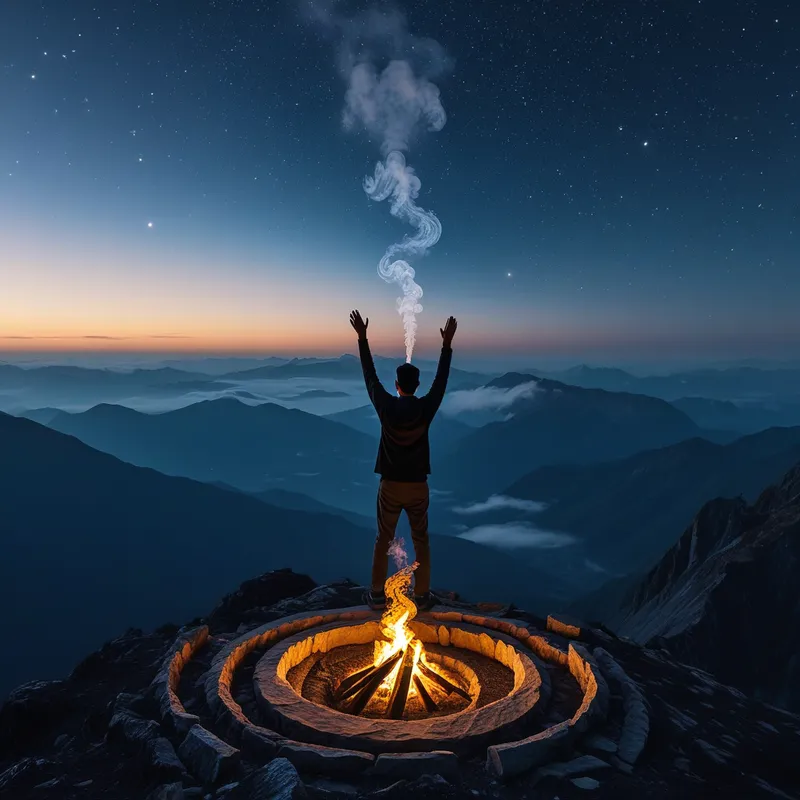
Smoke Signaling Myth Meaning & Symbolism
A myth where a solitary figure learns to transmute isolation into connection, sending messages of spirit that bind the scattered world.
The Tale of Smoke Signaling
In the time before time, when the world was young and the people were few, a great silence fell upon the land. It was not a peaceful quiet, but a hollow one. The tribes, children of the same earth, had been scattered by a great forgetting. Mountains rose between them, rivers carved deep canyons of separation, and the forests grew thick with the shadows of solitude. They lived as echoes of a forgotten song, each community a lonely note humming in the vastness, unaware of the harmony they were meant to form.
Among them was a man named Kanti. He was not a chief, nor the strongest hunter, but his spirit was restless with the silence. He would climb to the highest places, not to look down upon the world, but to listen. He listened to the wind’s lonely howl, to the distant cry of an eagle that seemed to call for a reply it never received. His heart ached with a question that had no shape: How do you speak across the impossible distance?
One bitter winter, when the silence felt heaviest, Kanti sought a vision. He fasted, he prayed, and he climbed to the vision peak, a place of sharp rock and whispering pines. For three days and nights, he endured the cold, his breath a pale ghost in the air. He cried out to the spirits of the air, to the grandfathers in the stars, for an answer. On the fourth dawn, exhausted and near despair, he saw a dying fire from his own small pit send a thin, grey thread into the still morning. As the first ray of sun touched it, the smoke turned to gold.
And then, the wind spoke. Not in words, but in a sigh that took that gilded thread and pulled it, stretching it across the valley, over the pine tops, toward the far blue horizon. In that moment, Kanti did not hear, he saw. He saw the smoke as a line of spirit, a visible breath carrying intention. He scrambled down, his mind afire. He gathered dry grasses, sweet sage, and cedar. He built a small, hot fire and, remembering the wind’s lesson, he fed it with care. As the smoke rose, he did not just watch; he spoke into it. He poured his loneliness, his longing for the far-off people, his hope for connection, into the very essence of the rising column.
He shaped the smoke with a blanket, with his hands, creating puffs and streams. A single column for “I am here.” A series of quick puffs for “Danger approaches.” A wide, rolling cloud for “Gather here.” He worked until his eyes stung and his throat was dry, but his heart was full. And then, a miracle. From a distant ridge, so far it was a smudge on the land, a thin answering thread of smoke spiraled upward. Then another, from a different direction. And another. The silent world began to whisper back. The great forgetting was ending, not with a shout, but with a signal, a sign, a breath made visible across the sacred expanse.

Cultural Origins & Context
The practice and mythology of smoke signaling are woven into the fabric of numerous Indigenous nations across North America, from the Great Plains to the Southwest and the woodlands. It was not merely a utilitarian technology but a sacred language of the landscape. This “myth” is less a single, codified story and more a living paradigm, passed down through demonstration and embedded in practical survival. Elders and scouts were the custodians of this knowledge, teaching the specific codes—puffs for numbers, columns for messages, the use of different fuels like damp grass for thick white smoke or buffalo chips for a steady signal—within the context of community responsibility.
Its societal function was profound. It connected hunting parties to the main camp, warned of enemy approach, signaled successful hunts, or called for spiritual gatherings. It transformed vast, intimidating geography into a networked, communicative space. The mythos surrounding it, as embodied in tales like that of Kanti, served to sacralize this practice. It taught that communication across distance was not just a human cleverness, but a collaboration with the elements—the fire’s transformation, the air’s carriage, the watcher’s perception. It framed the signaler not as a technician, but as a mediator between the human spirit and the spirit of the world, turning individual insight into collective lifeline.
Symbolic Architecture
At its core, the myth of smoke signaling is an alchemical drama of isolation and connection. The smoke itself is the central symbol—a substance that exists in the liminal space between solid and spirit. It is matter released from its earthly form, transformed by fire into something transient, visible yet intangible, capable of carrying meaning across realms.
The signal smoke is the soul made visible: private thought transformed into public symbol, inner fire given form to bridge the outer distance.
Kanti, the archetypal figure, represents the Senex or Sage in embryo. His initial state is one of conscious suffering—he feels the “great forgetting,” the psychic disconnection that plagues the collective. His climb is an ascent into consciousness, a move toward the symbolic perspective (the high place). The vision is not given; it is earned through endurance and a desperate plea, representing the ego’s surrender to a wisdom greater than itself. The answer comes not as a voice, but as a phenomenon to be interpreted—the smoke touched by the sun. This marks the moment of symbolic insight, where an ordinary phenomenon is suddenly seen as a vessel for transcendent meaning.
The act of signaling is then a ritual of psychic translation. Internal states (loneliness, warning, invitation) are encoded into external form. The answering signals from distant ridges symbolize the profound psychological truth: that putting one’s authentic signal into the world—one’s true voice, one’s creative act, one’s vulnerable communication—invariably resonates with and calls forth the same in others, even if they are unseen. It models the creation of a symbolic network, a psychic community, through intentional, spirit-infused action.

The Dreamer’s Resonance
When this mythic pattern stirs in the modern dreamer, it often manifests as dreams of trying to communicate across a gulf. You may dream of shouting with no sound, of sending a text message that turns to smoke in your hands, of seeing a loved one on a far shore as you struggle to light a damp fire. These are somatic dreams of isolation, where the psyche feels its separation acutely.
The psychological process here is the struggle to give form to a feeling or insight that seems ineffable. The dream ego is in the position of Kanti on his peak: aware of a need to connect, to warn, or to call, but lacking the effective medium. The frustration in the dream is the somatic echo of a psychic tension—the pressure of an unconscious content seeking conscious expression and relationship. The smoke, or the failed attempt to create it, symbolizes the nascent, unformed nature of this communication. It is the dream urging the dreamer to find their “fire” and their “code”—to discover the authentic, perhaps sacrificial, act that will translate inner reality into a signal that the outer world, or other parts of the self, can receive and understand.

Alchemical Translation
The individuation journey modeled by this myth is one of transforming the prima materia of isolation into the lapis philosophorum of conscious connection. The process follows the classic alchemical stages:
-
Nigredo (The Blackening): The “great forgetting.” This is the initial state of psychic fragmentation, where parts of the self feel lost, scattered, or out of communication with the central ego. It is a state of melancholic introspection, necessary for the work to begin.
-
Albedo (The Whitening): Kanti’s climb and vigil. This is the purification, the ascent to a higher viewpoint (conscious reflection), and the fasting from old, ego-driven ways. It is the whitening of the ash, the preparation of the vessel (the self) to receive the insight.
-
Citrinitas (The Yellowing): The dawn sun striking the smoke. This is the moment of illumination, where the mediating symbol is revealed. It is not a full revelation, but a glimpse of the method—the “yellowing” or spiritual dawn that shows the path for the next stage.
-
Rubedo (The Reddening): The lighting of the intentional fire and the creation of the signal. This is the operation itself: the application of will and spirit (the fire) to the raw material of one’s life and pain, transforming it into an act of communication. It is the red of the flame, the heat of passion and courage directed outward.
Individuation is not a solitary perfection, but the courage to send one’s unique signal into the collective air, trusting it will complete a circuit in the soul of the world.
The final stage, the answering signals, represents the culmination: the coniunctio oppositorum (union of opposites). The inner (the signaler) and the outer (the responders) are united in a shared symbolic field. The psyche moves from a monologue to a dialogue, from a closed system to an open network. For the modern individual, this translates to the act of finding one’s unique “signal”—be it through art, honest relationship, meaningful work, or spiritual practice—and offering it to the world. The myth assures us that this act of vulnerable transmission is never in vain; it is the very mechanism by which the scattered world remembers its wholeness, one answered signal at a time.
Associated Symbols
Explore related symbols from the CaleaDream lexicon: