Sleepwalking Saints Myth Meaning & Symbolism
A myth of holy figures who enact divine will while asleep, their bodies vessels for a purpose their waking minds cannot comprehend.
The Tale of Sleepwalking Saints
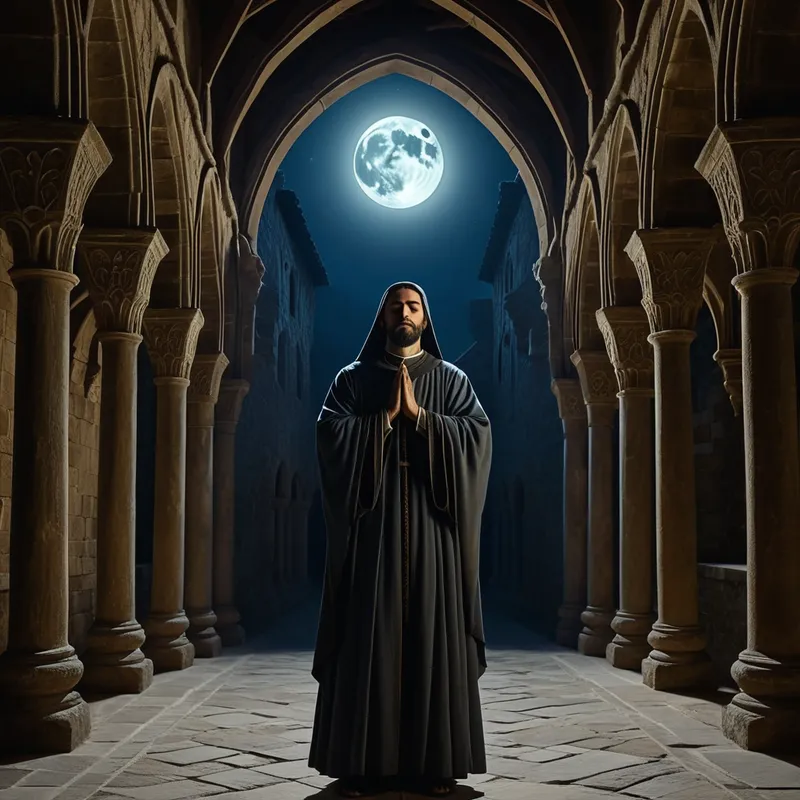
Listen, and let [the veil between worlds](/myths/the-veil-between-worlds “Myth from Celtic culture.”/) grow thin. In the time when candle smoke was prayer and stone held memory, there walked among the people figures of strange grace. They were the [saints](/myths/saints “Myth from Christian culture.”/), but of a peculiar order. By day, they were humble—bakers of bread, menders of nets, quiet scholars tracing letters on vellum. They prayed, they worked, they slept.
But when [the moon](/myths/the-moon “Myth from Tarot culture.”/) climbed high and [the world](/myths/the-world “Myth from Tarot culture.”/) of men surrendered to silence, a change would come. A breath would deepen. The sleeping form would rise. Eyes remained shut, sealed by a slumber more profound than death, yet the body moved. It was not the clumsy stumble of the ordinary sleepwalker. This was a motion of terrible grace, a purposeful pilgrimage undertaken by a soul whose waking self was left behind like an empty shell.
They would walk—through locked doors that offered no resistance, along cliff paths invisible in daylight, across rivers that parted for their sleeping feet. Their hands, in sleep, performed surgeries with uncanny skill, binding wounds with moss and moonlight. Their sleeping voices spoke in forgotten tongues, settling disputes that had festered for generations, or singing hymns that calmed storms. They built strange, perfect sections of wall in collapsing buildings, or planted a single seed in a barren spot that would, by dawn, show a green shoot.
They were servants of a will they could not name in the light. Their greatest deeds, their most profound miracles, were performed in absolute absence of their conscious selves. At dawn, they would return to their beds, or be found curled at an altar, remembering nothing but the faint, fading taste of starlight or the coolness of night stone on their feet. The people knew. They would leave their doors unlatched and their sick by the wayside, whispering, “Perhaps the Sleeper will pass this way.” The saints themselves bore the confusion of their holiness, forever haunted by the good they did not remember doing, living a life split between the humble day and the sacred, unconscious night.

Cultural Origins & Context
The motif of the Sleepwalking Saint is not the property of a single creed or geography. It is a folkloric strain that appears in the margins of hagiographies, in local village tales across Christian, Islamic, and Buddhist traditions, and in [the ancestor](/myths/the-ancestor “Myth from Global culture.”/) stories of indigenous cultures. This is a myth of the periphery, born not in theological universities but in the collective experience of communities witnessing a paradox: ultimate agency arising from total surrender.
It was passed down in whispers by [the hearth](/myths/the-hearth “Myth from Norse culture.”/), told by grandmothers to explain the inexplicable repair, the mysterious healing, the prophetic word found scrawled in dew. Its tellers were the beneficiaries of these unconscious acts—the farmer whose blighted field was blessed, [the child](/myths/the-child “Myth from Alchemy culture.”/) whose fever broke after a shadow passed the window. The myth served a crucial societal function: it democratized the mystical. Holiness was not always a conscious, ascetic struggle; it could be a state of divine instrumentality that visited the humble in their vulnerability. It offered a model of grace that operated independently of personal ambition or even awareness, comforting a world where effort often failed. It suggested that the community itself was watched over by a consciousness greater than the sum of its waking parts.
Symbolic Architecture
At its core, the myth dismantles [the ego](/myths/the-ego “Myth from Jungian culture.”/)’s claim to authorship of our deepest [purpose](/symbols/purpose “Symbol: Purpose signifies direction, meaning, and intention in life, often reflecting personal ambitions and core values.”/). The sleeping saint is the [human](/symbols/human “Symbol: The symbol of a human represents individuality, complexity of emotions, and social relationships.”/) [psyche](/myths/psyche “Myth from Greek culture.”/) in its entirety, with the waking ego merely one tenant. The miracles performed in sleep symbolize the autonomous, healing, and creative [activity](/symbols/activity “Symbol: Activity in dreams often represents the dynamic aspects of life and can indicate movement, progress, and engagement with personal or societal responsibilities.”/) of the Self, the central [archetype](/symbols/archetype “Symbol: A universal, primordial pattern or prototype in the collective unconscious that shapes human experience, behavior, and creative expression.”/) of wholeness.
The saint’s sleep is not an absence, but a deeper attendance. The conscious mind goes offline so that the transpersonal intelligence can come online.
The locked doors that open signify the [dissolution](/symbols/dissolution “Symbol: The process of breaking down, dispersing, or losing form, often representing transformation, release, or the end of a state of being.”/) of psychic barriers—repressions, complexes, and fixed identities—that the conscious mind erects. The saint’s unseeing eyes suggest a [knowledge](/symbols/knowledge “Symbol: Knowledge symbolizes learning, understanding, and wisdom, embodying the acquisition of information and enlightenment.”/) that comes not from observation, but from participation. They are guided by what the Greeks called the daimon, and what we might call the intuitive compass of the [soul](/symbols/soul “Symbol: The soul represents the essence of a person, encompassing their spirit, identity, and connection to the universe.”/). The [amnesia](/symbols/amnesia “Symbol: A dream symbol representing loss of memory, identity, or connection to one’s past, often linked to emotional trauma, avoidance, or transformation.”/) upon waking is critical: it protects the ego from [inflation](/symbols/inflation “Symbol: A dream symbol representing feelings of diminishing value, loss of control, or expansion beyond sustainable limits in one’s life or psyche.”/). To consciously claim these acts would corrupt them, turning sacred service into personal power. The myth thus presents a perfect model of enlightened [action](/symbols/action “Symbol: Action in dreams represents the drive for agency, motivation, and the ability to take control of situations in waking life.”/): work done for the whole, by the whole, with no part claiming the reward.
The Dreamer’s Resonance
When this mythic pattern stirs in the modern dreamer, it often manifests not as a dream of being a saint, but as a dream of performing a crucial, complex task while asleep or in a trance. You may dream of navigating your childhood home blindfolded, of giving a perfect speech in a language you don’t know, or of fixing the engine of a car with mystical certainty.
Somatically, this can correlate with periods of intense integration or healing that feel “automatic.” You might find yourself drawn to certain books, places, or people without a logical reason, only to later discover they held a key you needed. Psychologically, this dream pattern signals that a deep, unconscious process is reaching completion. The conscious ego is being temporarily bypassed because its doubts, analyses, and fears would hinder the operation. You are in the hands of your own inner Sage. The process underway is one of psychic re-ordering—healing old wounds, forging new neural pathways, reconciling opposites—all directed by the central organizing principle of the psyche. It is the feeling of being lived through, for a purpose that is both intimately yours and vastly beyond you.

Alchemical Translation
The alchemical journey is one of transmutation: leaden ego consciousness into golden Self-awareness. The Sleepwalking Saint myth models the critical [nigredo](/myths/nigredo “Myth from Alchemical culture.”/) and albedo stages of this work. The saint’s humble daytime life is the lead—the ordinary, imperfect human condition. The descent into sleep is the dissolution of the ego’s control. The miraculous night-walk is the purification and union: the individual becomes a clear vessel for the animating spirit of the world, the anima mundi.
For the modern individual striving toward individuation, the myth instructs: you cannot will your own wholeness. You can only create the conditions—the humility, the openness, the disciplined practice (the day’s work)—and then surrender. The transcendent function, which mediates between conscious and unconscious, often works in this “sleepwalking” manner. Insights arrive in the shower, solutions in dreams, courage emerges in a crisis from a place you didn’t know you had.
The ultimate alchemy is not of controlling the process, but of becoming a trustworthy instrument for it. The saint’s sleep is the ultimate trust-fall into the arms of the Self.
The goal is not to live perpetually in the somnambulist state—that would be psychosis. The goal is the integration hinted at by the myth’s end: to return to the waking world, bearing the faint, inexplicable trace of the sacred ([the dew](/myths/the-dew “Myth from Alchemical culture.”/), the taste of starlight), and to continue the day’s humble work, now subtly informed by the knowledge that you are, and always have been, more than your waking self knows. You are both the humble baker and the silent, night-walking vessel of a purpose that blesses the world through you.
Associated Symbols
Explore related symbols from the CaleaDream lexicon: