Siyavash the Innocent Prince Myth Meaning & Symbolism
A prince of radiant purity is destroyed by courtly envy, his innocence proven by fire, his blood seeding a flower of remembrance and justice.
The Tale of Siyavash the Innocent Prince
Hear now the tale of Siyavash, whose name means “the one with black stallions,” but whose soul was whiter than the mountain snows of Airyanem Vaejah. In the glittering court of Kai Kavus, a star was born. From the moment he drew breath, Siyavash was marked by fate. Nursed by the wise Rostam himself, the prince grew not only in strength and skill—master of the bow, the sword, the art of chogan—but in a quality more rare: a purity of heart that shone from his eyes like a clear lamp.
This light, however, cast long shadows. It fell upon Sudabeh, the young and beautiful wife of his father, the Shah. In the perfumed gardens of the palace, desire coiled like a serpent. Sudabeh, consumed by a forbidden passion, sought to ensnare the prince. When Siyavash, bound by honor and filial piety, recoiled from her advances, her desire curdled into a venomous hatred. She wove a web of lies, accusing the innocent prince of the very transgression he had refused. The court buzzed with the poison of her tale.
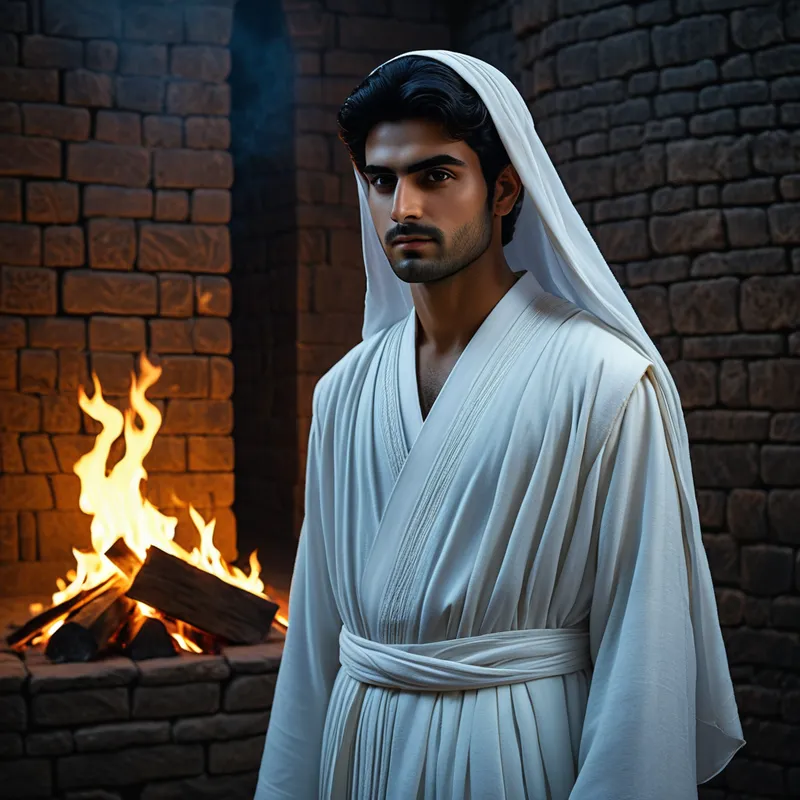
The heart of Kai Kavus was torn between love for his son and the whisperings of his court. To divine the truth, a trial of cosmic justice was decreed: the Ordeal by Fire. A great pyre was built, its trenches stretching the length of two bowshots. The flames were fed until they roared like dragons, a wall of annihilation that melted stone and turned the air to a shimmering hell. All held their breath. Siyavash, clad in white, mounted his black charger. He whispered a prayer to Aša, the cosmic order, and urged his steed forward. The crowd saw horse and rider vanish into the inferno… and then, moments that stretched into eternity, emerge unscathed on the far side. His robes were unsinged, his skin cool. The fire itself had testified to his innocence, parting for truth like water for a sacred stone.
Yet, innocence proven is not safety secured. The victory bred deeper envy. To escape the toxic court, Siyavash volunteered for a distant campaign, a self-imposed exile. He journeyed to the borderlands, to the fortress of Gonbadan, and even further, across the wide Oxus River, into the land of Turan. There, he was received with honor by the Turanian king, Afrasiab, who saw in the prince a noble soul and gave him land and his daughter in marriage. For a time, Siyavash built a city of peace, a sanctuary from the deceit of his homeland.
But the shadow of his origin stretched long. The courtiers of Turan, mirroring those of Iran, grew jealous of this foreign prince of such virtue. They whispered to Afrasiab that Siyavash was a spy, a seed of Iran planted to grow into conquest. Afrasiab’s trust, once firm, was eroded by the relentless drip of suspicion. Betrayed a second time, by a second father-figure, Siyavash was given a choice: return to Iran in chains, or face the army sent to arrest him. Choosing honor over bondage, he rode out with a handful of men to meet his fate. He was captured not in battle, but by treachery. In a barren place, under a pitiless sky, the order was given. The innocent prince was beheaded. His blood soaked into the barren earth.
And from that blood, where his head touched the ground, a miracle sprang. Overnight, a mysterious plant grew—a flower with petals dark red as clotting blood, its heart black as mourning. They called it the Shaqayeq-e-Siyavash, the “Flower of Siyavash.” His death was not an end, but a seeding. His son, Kai Khosrow, would be born from this legacy of grief, and would one day rise to reclaim the throne and exact a terrible, just vengeance upon his grandfather’s murderer. Thus, the pure light of the prince, though extinguished, became a perennial fire in the memory of the world.

Cultural Origins & Context
The myth of Siyavash is a cornerstone of the Persian epic tradition, most famously preserved in the monumental Shahnameh (The Book of Kings) composed by the poet Ferdowsi in the 10th century CE. Ferdowsi drew upon earlier Sassanian chronicles and a deep well of oral history, weaving historical fragments with mythic archetypes. The tale functions as a national allegory, reflecting the perennial tensions between Iran and its nomadic Turanian neighbors, but its core is far more universal.
Told by court minstrels and village storytellers alike, the story of Siyavash served multiple societal functions. It was a mirror for princes, illustrating the virtues of honor, justice, and martial prowess, while also warning of the corrupting influence of the court and the vulnerability of the good to envy (hasad). On a deeper, ritualistic level, scholars have linked the myth to ancient Zoroastrian themes of the struggle between truth (Aša) and falsehood (Druj). The ordeal by fire echoes Zoroastrian purification rites, and Siyavash himself can be seen as a saoshyant-like figure, a pure being whose sacrifice renews the world.
Symbolic Architecture
At its heart, Siyavash is the archetype of the Innocent confronted by the Shadow of the collective. His purity is not naivete, but an unwavering alignment with an inner truth so potent it demands a cosmic test.
The ordeal by fire is not a punishment, but a revelation. It is the moment the unconscious psyche, in its raw, elemental state, is forced to witness and validate the integrity of the conscious self.
The fire represents the transformative crucible of unjust accusation. To pass through it unscathed is the ultimate symbolic act: it proves that one’s essential being is not of the corrupt, burning world of intrigue and desire, but is forged of a different substance—Aša itself. His white robes are the symbol of this untainted selfhood.
His journey across the Oxus River is a profound crossing of a psychological threshold. He leaves the known world of the “Father” (Kai Kavus, a flawed and gullible authority) and enters the realm of the “Other” (Afrasiab, the enemy who becomes a foster-father). This represents the soul’s necessary exile from familiar complexes and identities in search of its own sovereignty. The final betrayal and beheading signify the utter destruction of the innocent persona by the cynical, pragmatic forces of the world. It is the death of the hope that purity alone can survive in a complex, shadow-filled reality.
Yet, the myth does not end in nihilism. The flowering of the red tulip from his blood is the core alchemical symbol.
The conscious ego (the prince) is sacrificed, but from its essence, a new, symbolic life blooms—an image, a memory, a legacy (his son, the flower) that contains the transformative power he embodied.
The Dreamer's Resonance
When the pattern of Siyavash stirs in the modern dreamer, it often signals a profound crisis of integrity. You may dream of being falsely accused at work or in a relationship, of walking through a hostile environment where you feel transparent yet misunderstood, or of a trial where you must prove your worth in a surreal, elemental test.
Somatically, this can feel like a tightening in the chest, a literal “heartache” of injustice, or a burning sensation—an echo of the fiery ordeal. Psychologically, you are undergoing the painful dissolution of an old self-image. The “Innocent” within—the part that believed in fairness, that trusted implicitly, that sought to be good without complication—is being confronted by the shadow aspects of your environment or your own psyche: envy, ambition, deceit, or cynical self-preservation.
The dream is not necessarily a prophecy of literal betrayal, but an internal drama. The “Sudabeh” and “courtiers” are often personifications of your own neglected or projected shadows—your repressed desires, your capacity for manipulation, your inner critic—that rise up to accuse the innocent self of being false or inadequate. The ordeal is the psyche’s brutal, authenticating process: Can this sense of self, this value, this truth, survive the full heat of confrontation?

Alchemical Translation
The myth of Siyavash provides a stark but profound map for the individuation process, specifically the stage where the conscious attitude (the innocent persona) must be sacrificed to allow for a more complete, resilient Self to emerge.
The first alchemical stage is Calcinatio—the trial by fire. This is the burning away of the ego’s attachment to being perceived as purely good, unblemished, and above reproach. The fire of scandal, failure, or betrayal forces the individual to discover if their core values are rooted in persona (how they wish to be seen) or in a genuine, unshakeable Self-principle. Passing through this fire means internalizing one’s own truth, becoming independent of external validation.
The exile across the river is the Separatio. The individual must consciously leave behind the psychic “kingdom” of parental complexes and tribal loyalties. This is a lonely, often mournful journey into the territory of the unknown Self, where old identities no longer serve.
The beheading is the ultimate Mortificatio—the death of the old heroic ego. It is the acknowledgment that the innocent, perfectible self is an illusion that must die for the soul to be reborn.
The final, crucial stage is Rubedo—the reddening, the flowering. This is where the modern alchemy occurs. The blood of the slain innocence does not simply vanish; it fertilizes the soul’s soil. The “flower” that grows is the new capacity born from the experience: perhaps a deeper compassion for human frailty (including one’s own), a more nuanced understanding of justice, or the birth of a creative purpose (the “son,” Kai Khosrow) fueled by the resolved grief. The individual no longer is the innocent prince; they become the ground from which the flower of meaning grows. Their purity is no longer a brittle, external state to be defended, but a resilient, internal truth that can withstand the cycles of death and rebirth.
Associated Symbols
Explore related symbols from the CaleaDream lexicon:
- Fire — The ultimate test of truth and the alchemical agent of purification; it consumes falsehood but reveals and refines essential integrity.
- Blood — The vital essence of life sacrificed, which does not merely signify death but becomes the potent seed for new life, memory, and legacy.
- Prince — The archetypal figure of nascent sovereignty and potential, representing the developing conscious self that must face the trials of the world.
- Innocent — The pristine, pre-conscious state of the soul that exists in alignment with truth but lacks the complexity and shadow-awareness required for full selfhood.
- Horse — The instinctual, vital force and nobility that carries the prince through his trials, representing the psyche's animal spirit allied with consciousness.
- River — The powerful boundary and threshold between known and unknown realms, symbolizing the necessary, often traumatic, crossing from one state of being to another.
- Flower — The beautiful, ephemeral, and poignant symbol of rebirth that arises from sacrifice, representing meaning, memory, and the transformation of pain into something sacred.
- Father — The ambiguous authority figure (both Kai Kavus and Afrasiab) who represents the complex world of law, power, and often-failing protection that the innocent must navigate and ultimately transcend.
- Shadow — The collective and personal darkness of envy, suspicion, and deceit that rises to meet radiant innocence, forcing a confrontation with the denied aspects of reality.
- Sacrifice — The voluntary and involuntary offering of the self, which is not a meaningless loss but the essential transaction that fuels psychological and cosmic renewal.
- Rebirth — The core promise of the myth; not a return to the old innocence, but the emergence of a new, more conscious form of life from the ashes of the old.
- Ash — The residue left after the fiery ordeal, representing what remains when all that is false is burned away—the essential, incorruptible core of the self.