Sir Lancelot Myth Meaning & Symbolism
The greatest knight's tragic love for his king's queen shatters the perfect kingdom, revealing the cost of impossible ideals and the path of atonement.
The Tale of Sir Lancelot
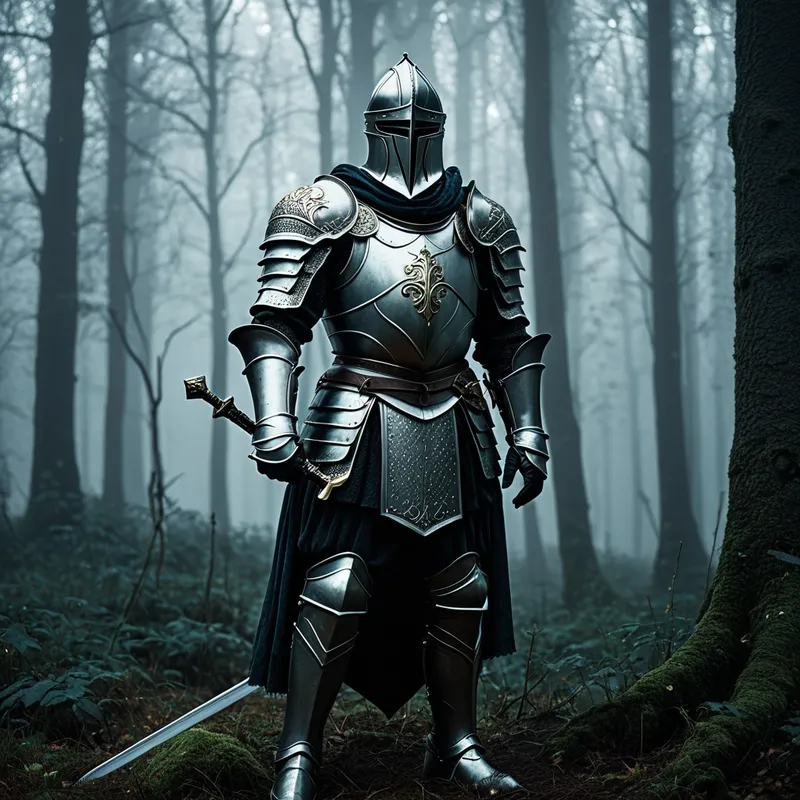
Hear now the tale of the flower of chivalry, the sword that was both the kingdom’s pillar and its ruin. From across the sea he came, a youth fostered by the Lady of the Lake in her watery, timeless realm. She named him Lancelot du Lac, and she forged him for a single purpose: to be the perfect knight for the perfect king.
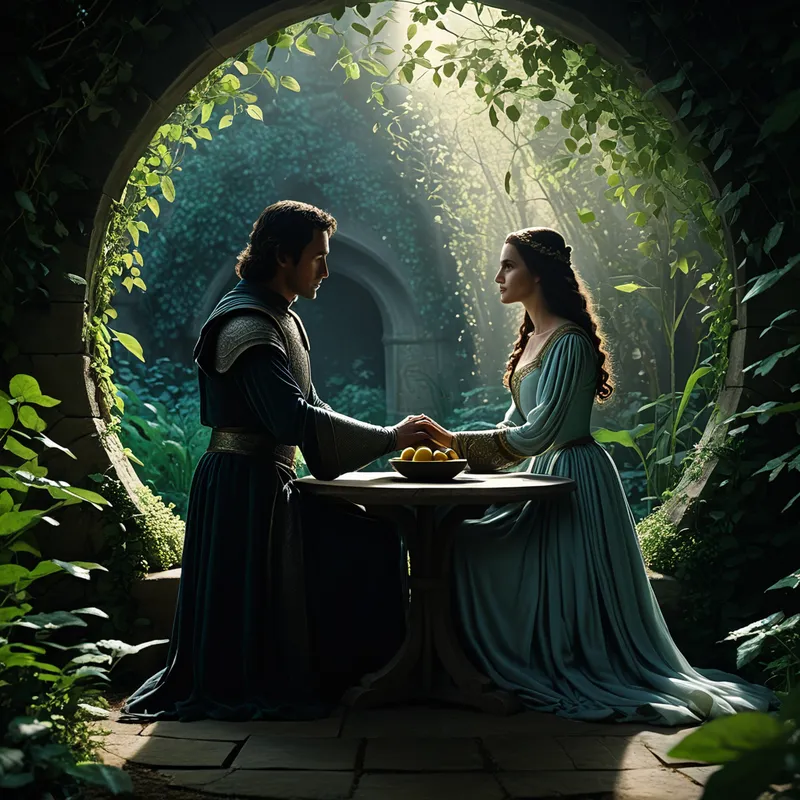
At the court of King Arthur, he was a sunburst. No man could match him in the tilt-yard or in battle. His strength was a legend, his courtesy a song. He became the first among the knights of the Round Table, Arthur’s right hand and dearest friend. And it was there his doom was woven. For upon seeing Queen Guinevere, the world contracted to the space between her eyes. Her grace was the gravity that pulled his soul from its ordained course. A love bloomed in the shadows of Camelot’s bright halls, a love as profound as it was forbidden, a secret that hummed beneath the oaths of fealty.
For a time, the dream held. Lancelot performed impossible feats in her name, rescuing her from abductors, his valor fueled by a desperate, hidden fire. He quested for the Holy Grail, but where the pure knight Galahad saw divine light, Lancelot was granted only a blinding glimpse before being cast out, his heart too divided, too human, to behold the ultimate mystery. The fracture had begun.
The secret could not hold forever. The venomous knight Mordred, with eyes like cold slate, laid the trap. The lovers were discovered. The law of Camelot was clear: treason demanded death. Arthur, his heart a kingdom crumbling, was forced to condemn his queen to the pyre.
Then came the thunder. From exile, Lancelot heard the drums of doom. He rode, a single man against an army, to the execution ground. In a storm of splintered lances and cries, he cut his way to her, a whirlwind of grief and steel, and carried her away to his castle of Joyous Gard. But in saving her, he shattered the world. Arthur, bound by kingship, besieged his greatest friend. Knights who had sworn brotherhood slew one another across the very walls they had sworn to defend together.
The final break was not of stone, but of spirit. Hearing that the Pope had intervened, Lancelot returned Guinevere to Arthur, a gesture of shattered fealty. He left Britain forever, crossing the sea to a land of perpetual penance. In his final years, they say he became a hermit, a holy man, his mighty arms that once wielded a sword now lifting only in prayer. When word came of Arthur’s fall at the Battle of Camlann, Lancelot found the king and queen’s tomb. He lived out his days in fasting and vigil, a guardian of the grave of the dream he had helped to create and was destined to destroy.
Cultural Origins & Context
The myth of Lancelot is not a relic of ancient Brythonic lore, but a later, profound flowering of the legend. He is largely absent from the earliest Welsh tales. His story was crafted in the 12th century by Chrétien de Troyes, who wove the themes of courtly love—a passionate, often adulterous, and always disciplined devotion to a lady—into the Arthurian tapestry. This was not mere romance; it was a complex social and psychological code for the feudal aristocracy.
The myth was then expanded encyclopedically in the vast 13th-century French prose cycles, the Vulgate Cycle, which gave Lancelot his biography, his lineage, and his central, tragic role in the fall of Camelot. Told in courts by troubadours and recorded by clerics, the story served multiple functions: it was a mirror for aristocratic ideals, a cautionary tale about the conflict between personal desire and public duty, and a deeply Christian narrative of sin, fall, and the elusive possibility of grace. Lancelot became the ultimate human figure in a divine drama, the man whose very excellence makes his failure cosmically significant.
Symbolic Architecture
Lancelot is the archetype of the Anima-possessed hero. Guinevere is not merely a woman; she is the symbolic embodiment of his soul’s longing, the Eternal Feminine that pulls him away from the collective ideals of the King Logos represented by Arthur. His tragedy is the collision of two sacred vows: the vow to the king (the Self as collective order) and the vow to the queen (the Self as personal, soulful connection).
The greatest shadow is cast not by failure, but by supreme excellence misaligned with its own heart.
His failure at the Grail quest is the myth’s central psychological truth. He is the knight of action, of earthly passion and prowess, but the Grail demands a spiritual wholeness he cannot muster. The Grail represents the individuated Self, a state of unity he glimpses but cannot enter because a part of him—his consuming, secret love—remains in the shadow, unintegrated with his professed identity as the perfect knight. He is duality incarnate: the champion of the realm and its destroyer, the ultimate lover and the ultimate betrayer.

The Dreamer’s Resonance
To dream of Lancelot is to feel the acute tension of an impossible choice in one’s somatic and psychological life. It may manifest as a dream of being a revered champion in one arena (work, family duty) while being irresistibly drawn to a secret passion or relationship that feels soulful but forbidden. The dreamer may experience literal torn loyalties, or a sense of living a double life.
The somatic signature is often a feeling of being split in the chest—a heart pulled in two directions with equal, devastating force. There is the exhilaration of the secret quest (the stolen moments, the private victories) coupled with a deep, gnawing guilt, the fear of a glorious structure (one’s Camelot, one’s carefully built life) collapsing because of one’s own nature. This dream pattern signals a critical confrontation with one’s personal morality, asking: What part of my soul have I exiled for the sake of an ideal, and at what cost to my wholeness?
Alchemical Translation
The Lancelot myth models the Nigredo—the blackening, the mortification—of the individuation process. His journey is not one of victorious integration but of catastrophic disintegration that makes a deeper integration possible only through utter ruin and subsequent humility. The alchemical fire is not applied to base lead, but to the purest gold of knightly perfection, to burn away the impurity of its hidden contradiction.
Redemption is not found in the glory of the sword, but in the silence that follows its laying down.
The psychic transmutation occurs in his final phase: the retreat, the hermitage, the vigil at the tomb. Having lived the ultimate expression of his dual nature (the lover-knight) to its destructive conclusion, the energy that fueled that duality exhausts itself. The active hero becomes the contemplative penitent. This is the albedo, the whitening, where the complex is dissolved. He does not reunite with Guinevere; he guards her tomb with Arthur. He integrates the opposites by becoming the guardian of their memory, holding the tension of king and queen, duty and love, within his own consciousness until it ceases to be a conflict and becomes a sacred mystery to be tended. For the modern individual, the myth suggests that our deepest betrayals of external codes may be necessary steps toward a brutal, authentic fidelity to our own complex truth, and that wholeness is often found not in choosing one side of a dichotomy, but in bearing the solemn, quiet responsibility for the entire shattered tableau of our lives.
Associated Symbols
Explore related symbols from the CaleaDream lexicon: