Siddhartha Gautama Myth Meaning & Symbolism
A sheltered prince confronts the world's suffering, renounces his throne, and discovers the path to end all suffering through profound inner awakening.
The Tale of Siddhartha Gautama
Hear now the story not of a god, but of a man who walked [the earth](/myths/the-earth “Myth from Hindu culture.”/) and saw what all see, yet understood what none had grasped.
In the foothills of the snow-crowned mountains, in the kingdom of the Shakyas, a prophecy echoed. A son was born to King Shuddhodana, and the seers proclaimed: this child, Siddhartha Gautama, would become either a universal monarch or a world-renouncing sage. The king, gripped by fear of loss, built a prison of perfection. High walls of pleasure rose around the prince. Gardens bloomed eternally, music never ceased, and every face was young, beautiful, and smiling. Siddhartha knew only the spring of life, never its winter.
But the gods of destiny are not so easily thwarted. A deep restlessness, a whispering why, grew in the prince’s heart. He commanded his charioteer, Channa, to take him beyond the gilded gates. There, in the raw, unfiltered world, the veils were torn asunder. First, he saw a man bent with age, his body a map of decay. “What is this?” asked Siddhartha. “This is old age, lord,” replied Channa, “which comes to all.” Then, a man wracked with disease, trembling in fever. “And this?” “Sickness, which spares none.” Finally, a still, cold corpse being carried to the pyre. “And this?” “Death, the end of every path.”
[The world](/myths/the-world “Myth from Tarot culture.”/) shattered. The perfume of the palace turned to ash in his mouth. The laughter of his courtiers sounded like the cries of beings drowning in a sea of suffering. A fourth vision came then: a wandering ascetic, his face calm, his eyes holding a peace that the palace had never offered. That night, as his wife Yasodhara and newborn son Rahula slept, he gazed upon them with immense tenderness and an even greater resolve. The call to find the cause of this universal anguish was a thunder in his soul. He took one last look, then stepped into the darkness, exchanging silks for simple robes, a crown for a shaved head.
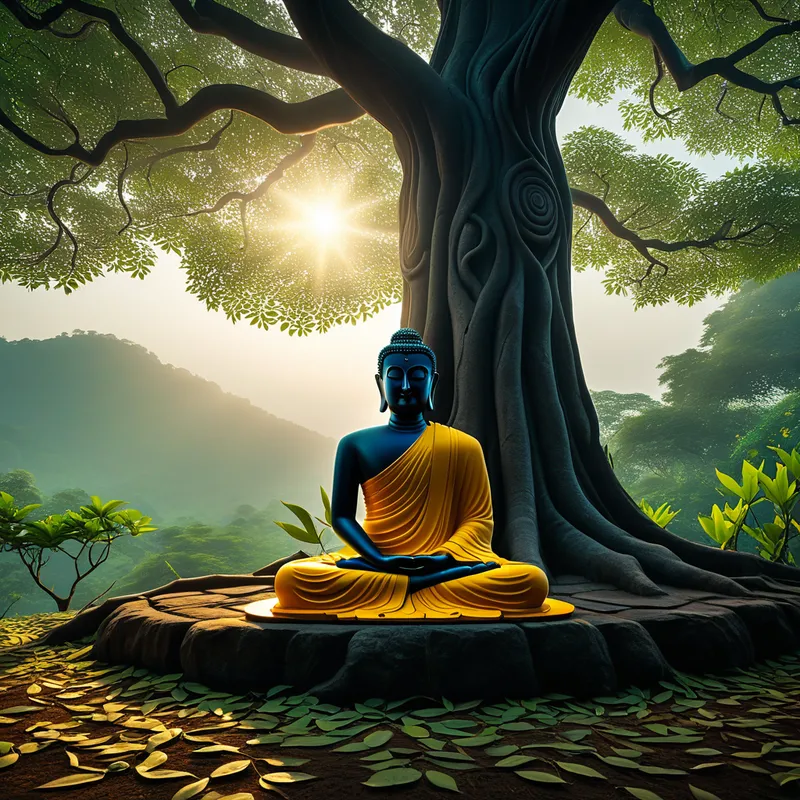
For six years, he walked the path of extreme denial. He sat with masters, learned their doctrines, and pushed his body to the brink of annihilation through fierce austerities, becoming a living skeleton. Yet liberation did not come. Realizing the futility of both indulgence and extreme penance, he accepted a simple meal of milk-rice from a village woman named Sujata. Strengthened, he seated himself on a cushion of kusha grass beneath the spreading branches of a sacred Bodhi tree at Bodh Gaya. He made a vow: “Though only my skin, sinews, and bones remain, and my blood and flesh dry up and wither away, yet will I never stir from this seat until I have attained full awakening.”
Then came the great assault. Mara, the lord of illusion and desire, unleashed his armies. Fearsome demons hurled torrents of rocks, spears, and flames, which fell at Siddhartha’s feet as flowers. Mara sent his daughters, Desire, Discontent, and Lust, to seduce him, but their charms dissolved before his unwavering mindfulness. “Who bears witness to your right to sit here?” Mara thundered. In a gesture of profound truth, Siddhartha touched the earth, calling the very world as his witness. The earth itself roared, and Mara fled.
In the deep silence of the night, his mind purified and focused, Siddhartha turned his attention inward. He saw with utter clarity the endless cycle of his own past lives, [the law](/myths/the-law “Myth from Biblical culture.”/) of [karma](/myths/karma “Myth from Hindu culture.”/), and finally, the very chain of causation that gives rise to suffering: the Twelve Nidanas. He saw its origin, and with that sight, he saw the path to its cessation. As [the morning star](/myths/the-morning-star “Myth from Astrological culture.”/) glittered in the predawn sky, ignorance dissolved. He was awake. He was the Buddha.
Cultural Origins & Context
This is the foundational narrative of Buddhism, emerging from the historical figure of Siddhartha Gautama in the 5th century BCE in the northeastern region of the Indian subcontinent. It is not a distant celestial myth but a human story set in a specific time of social [ferment](/myths/ferment “Myth from Alchemical culture.”/), alongside the teachings of the Upanishads and the rise of [the ascetic](/myths/the-ascetic “Myth from Christian culture.”/) shramana movements. The story was not written down for centuries; it was an oral tradition, meticulously preserved and recited by monastic communities. Its primary function was pedagogical and inspirational. It served as the archetypal map for the spiritual journey, legitimizing [the Buddha](/myths/the-buddha “Myth from Buddhist culture.”/)’s authority as one who had “gone and seen,” and providing a relatable, dramatic structure for the core doctrinal truths of the Four Noble Truths and the Noble Eightfold Path. It transformed philosophy into a compelling biography of awakening.
Symbolic Architecture
The myth is a perfect symbolic [blueprint](/symbols/blueprint “Symbol: A blueprint represents the foundational plan or design for something, often symbolizing potential, structure, and the mapping of one’s inner self or future.”/) for the [psyche](/myths/psyche “Myth from Greek culture.”/)’s [journey](/symbols/journey “Symbol: A journey in dreams typically signifies adventure, growth, or a significant life transition.”/) from unconscious identification to conscious liberation. The [palace](/symbols/palace “Symbol: A palace symbolizes grandeur, authority, and the pursuit of one’s ambitions or dreams, often embodying a desire for stability and wealth.”/) represents the encapsulated ego, the constructed self living in a curated [reality](/symbols/reality “Symbol: Reality signifies the state of existence and perception, often reflecting one’s understanding of truth and life experiences.”/) of pleasure and avoidance. The Four Sights are the unavoidable eruptions of the unconscious—the reality of time, fragility, and [mortality](/symbols/mortality “Symbol: The awareness of life’s finitude, often representing transitions, impermanence, or existential reflection in dreams.”/) that shatters [the ego](/myths/the-ego “Myth from Jungian culture.”/)’s defensive walls.
The Great Renunciation is not an abandonment of the world, but the ultimate commitment to it; the ego must die to its small kingdom so that the Self may be born to the cosmos.
The years of asceticism symbolize the psyche’s mistaken belief that liberation can be achieved through violent repression or heroic willpower, a spiritual ego still fighting against [nature](/symbols/nature “Symbol: Nature symbolizes growth, connectivity, and the primal forces of existence.”/). The [meal](/symbols/meal “Symbol: A meal often symbolizes nourishment, not just physically but emotionally and spiritually, representing the aspects of sharing and community.”/) from Sujata represents the essential [integration](/symbols/integration “Symbol: The process of unifying disparate parts of the self or experience into a cohesive whole, often representing psychological wholeness or resolution of internal conflict.”/) of the [body](/symbols/body “Symbol: The body in dreams often symbolizes the dreamer’s self-identity, personal health, and the relationship they have with their physical existence.”/) and the mundane, the [acceptance](/symbols/acceptance “Symbol: The experience of being welcomed, approved, or integrated into a group or situation, often involving validation of one’s identity or actions.”/) of humble nourishment as part of the [path](/symbols/path “Symbol: The ‘path’ symbolizes a journey, choices, and the direction one’s life is taking, often representing individual growth and exploration.”/). The [Bodhi tree](/symbols/bodhi-tree “Symbol: The sacred fig tree under which Siddhartha Gautama attained enlightenment, symbolizing awakening, wisdom, and the interconnectedness of all life.”/) is the [axis](/symbols/axis “Symbol: A central line or principle around which things revolve, representing stability, orientation, and the fundamental structure of reality or consciousness.”/) mundi, the still point at the center of the psychic storm. Mara’s assault is the final, desperate rebellion of the entire personal and [collective unconscious](/symbols/collective-unconscious “Symbol: The Collective Unconscious refers to the part of the unconscious mind shared among beings of the same species, embodying universal experiences and archetypes.”/)—our fears, attachments, doubts, and desires—projected [outward](/symbols/outward “Symbol: Movement or orientation away from the self or center; expansion, expression, or externalization of inner states into the world.”/) as monstrous forms. The Bhumisparsha [Mudra](/symbols/mudra “Symbol: A symbolic hand gesture used in Hindu and Buddhist traditions to channel spiritual energy, express teachings, and focus meditation.”/) ([earth](/symbols/earth “Symbol: The symbol of Earth often represents grounding, stability, and the physical realm, embodying a connection to nature and the innate support it provides.”/)-touching [gesture](/symbols/gesture “Symbol: A non-verbal bodily movement conveying meaning, emotion, or intention, often symbolic in communication and artistic expression.”/)) is the supreme [symbol](/symbols/symbol “Symbol: A symbol can represent an idea, concept, or belief, serving as a powerful tool for communication and understanding.”/) of grounded reality, of [truth](/symbols/truth “Symbol: Truth represents authenticity, honesty, and the quest for knowledge beyond mere appearances.”/) rooted in actual, embodied experience, not in abstraction or dogma.
The Dreamer’s Resonance
When this myth stirs in modern dreams, it often manifests as a profound confrontation with life’s inherent conditions. Dreaming of being trapped in a beautiful, sterile environment may reflect a life of comfort devoid of meaning. The sudden, shocking appearance of an aging parent, a sick friend, or imagery of decay in a dream can be the psyche’s own “Four Sights,” forcing a consciousness that has been asleep to its own transience to awaken. Dreams of leaving a familiar home or relationship abruptly, with a mix of grief and resolve, mirror the Renunciation. The somatic experience is often one of a deep, unsettling tension—a claustrophobia within one’s own life, followed by the anxiety and raw vulnerability of stepping into an unknown, interior wilderness. The dream-ego is undergoing the painful but necessary dissolution of its former, sheltered identity.

Alchemical Translation
Psychologically, the alchemy modeled here is the transformation of suffering into wisdom, and of ignorance into awakening. The process begins with the [nigredo](/myths/nigredo “Myth from Alchemical culture.”/), the blackening: the devastating confrontation with suffering (dukkha), which plunges the individual into a dark night of the soul. The ego’s project of perfect happiness is revealed as an illusion. The ascetic phase represents a misguided albedo, a whitening through purification by violence against [the self](/myths/the-self “Myth from Jungian culture.”/), which must fail. The true whitening is [the Middle Way](/myths/the-middle-way “Myth from Buddhist culture.”/)—the integration of opposites (pleasure and denial, self and other) symbolized by the simple meal.
Enlightenment is not an acquisition, but a recognition; not a becoming something new, but a ceasing to ignore what has always been.
The confrontation with Mara under [the Bodhi tree](/myths/the-bodhi-tree “Myth from Buddhist culture.”/) is the ultimate [rubedo](/myths/rubedo “Myth from Alchemical culture.”/), the reddening or final confrontation with [the shadow](/myths/the-shadow “Myth from Jungian culture.”/) in its most archetypal and terrifying forms. Victory is achieved not by fighting, but by witnessing and grounding—by touching the earth of one’s own authentic being. The resultant gold is not a heavenly reward, but the unshakable, compassionate awareness of how the mind creates its own reality. For the modern individual, the myth does not prescribe monasticism, but a path of radical honesty: to courageously see the “Four Sights” in one’s own life, to renounce the inner “palace” of fixed beliefs and comfortable narratives, to sit with the “Mara” of one’s personal demons without fleeing, and in that stillness, to touch the ground of one’s own deepest, awakened nature.
Associated Symbols
Explore related symbols from the CaleaDream lexicon: