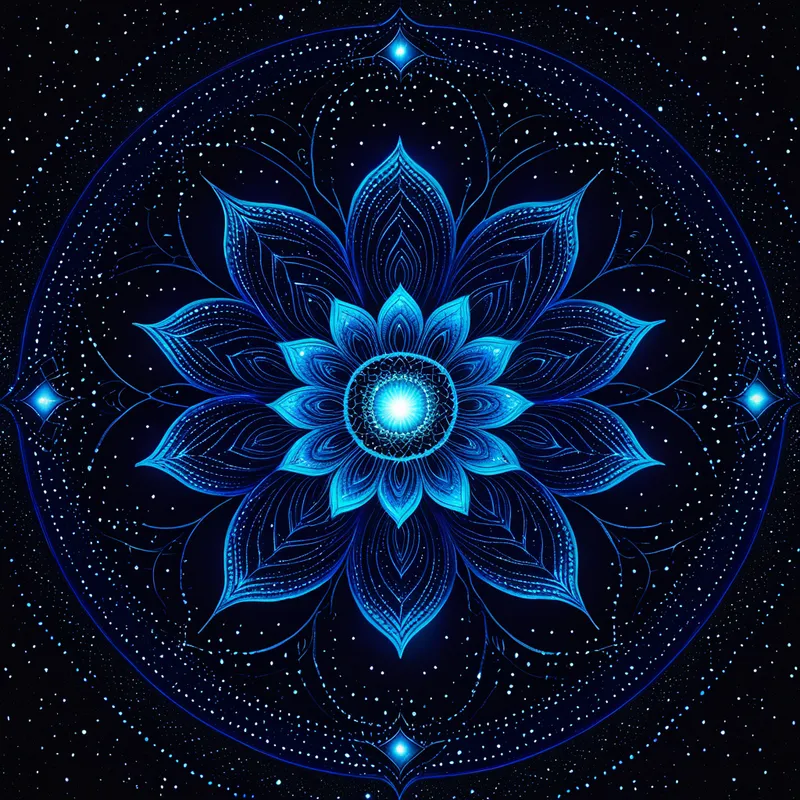
Shunyata Myth Meaning & Symbolism
The myth of the primordial void from which all creation emerges, embodying the paradox of infinite potential within absolute emptiness.
The Tale of Shunyata
Listen. Before the first note of the cosmic flute, before the first beat of the drum of time, there was… not nothing. But a profound, pregnant silence. A fullness so complete it appeared as emptiness. This was Shunyata.
In that age before ages, there was no sun to cast a shadow, no wind to stir a thought. There was only the Brahman, not as a being, but as Being itself—undifferentiated, limitless, resting in its own essence. It was a sea without shore, a sky without horizon, a mind without an object. Within this boundless expanse slept all that ever was and ever could be: the thunder of Vishnu’s conch, the dance of Shiva’s fury, the laughter of a billion stars. But they slept as seeds within the heart of a dark, cosmic fruit.
Then, a stirring. Not a sound, but the potential for sound. A desire arose in the heart of the Absolute—the first and only desire: “May I become many.” This was the Aum, not yet voiced, but felt as a tremor in the fabric of the void. The silent sea of Shunyata began to churn with unmanifest potential. From its depths, a warmth emerged, a golden glow that was the first differentiation: the principle of consciousness, Purusha. And from the cool, dark depths arose the principle of matter, Prakriti.
Their meeting was not a collision, but a recognition. In that meeting, the void exhaled. From the boundless dark, a single point of light blossomed—a lotus of pure energy unfolding on the navel of the infinite. Upon this lotus, the Brahma was born, opening his eyes to the emptiness that was his womb and his kingdom. And with his breath, the symphony of the worlds began: the elements separated, the directions were born, time uncoiled like a serpent. The void had spoken its first word, which was a universe. The fullness of emptiness had given birth to the dance of form.

Cultural Origins & Context
The concept of Shunyata finds its most profound articulations in the philosophical layers of Hindu thought, particularly within the Vedas and the Mandukya Upanishad. It is not merely a “myth” in the narrative sense, but a foundational metaphysical principle passed down by sages (Rishis) in deep states of meditation. Its primary function was not entertainment, but instruction—a map of reality itself.
It served a critical societal and spiritual purpose: to orient the human mind toward the ultimate ground of existence. In a culture deeply concerned with cosmology and the nature of the self (Atman), the myth of Shunyata provided the answer to the first and final question: “What was before creation?” It established emptiness not as a nihilistic end, but as the fertile, sacred source of all. This understanding underpinned rituals, yoga, and the quest for Moksha, guiding individuals to look beyond the manifest world to its silent, generative origin.
Symbolic Architecture
Shunyata is the ultimate symbol of potential. It represents the unformed psyche before the birth of the ego, the blank canvas before the first brushstroke, the silent mind before the first thought. It is not absence, but a plenum—a fullness that contains all opposites in perfect, undifferentiated harmony.
The void is not a lack to be filled, but a wholeness to be recognized. It is the psychological and cosmic womb.
The “desire” of Brahman to become many symbolizes the fundamental movement of consciousness into manifestation, the necessary “fall” into duality that makes experience possible. The emergence of Purusha (consciousness) and Prakriti (matter) from the void depicts the birth of the primary dichotomy—subject and object, seer and seen—from a unified field. The lotus-born Brahma represents the creative intellect itself, the first principle of order and differentiation arising from chaos. Thus, the entire myth is a symbolic map of the birth of the cosmos and the birth of individual awareness from the unified ground of the unconscious.
The Dreamer’s Resonance
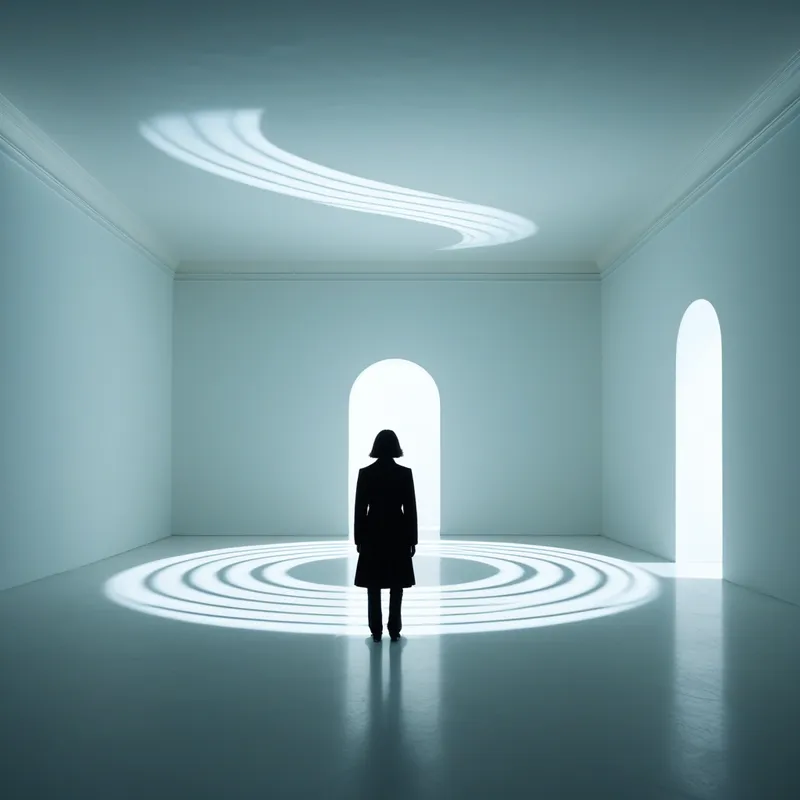
When the archetype of Shunyata stirs in the modern dreamer, it often manifests as dreams of vast, empty spaces: endless white rooms, silent deserts, starless night skies, or deep, still oceans. These are not dreams of loneliness, but of profound, sometimes terrifying, potential. The dream ego may feel suspended, weightless, or confronted with a featureless horizon.
Psychologically, this signals a process of deconstruction. The familiar structures of identity, relationship, or purpose are being dissolved back into the psychic “void.” It is a somatic experience of the ground clearing, often preceding a major life transition, creative rebirth, or spiritual awakening. The anxiety felt is the ego’s fear of annihilation, confronting the truth that it, too, emerged from and will return to this formless ground. The dream is an invitation to stop doing and simply be in the fertile silence, to encounter the self before it put on its costumes.
Alchemical Translation
The individuation process modeled by Shunyata is one of paradoxical return. It is not about building a more complex personality, but about consciously re-inhabiting the emptiness from which the personality first arose. The modern seeker’s journey mirrors the cosmic one in reverse.
First, one must experience the “churning” – the conscious de-identification from rigid roles, compulsive thoughts, and solidified self-images (the dissolution of Prakriti’s forms). This is often precipitated by crisis, loss, or deep introspection. Then, one encounters the void itself: the fear, the silence, the “dark night of the soul.” This is the alchemical nigredo, the blackening.
The alchemical gold is not found by adding light to the darkness, but by realizing the darkness itself is luminous potential.
The triumph is not escaping this void, but achieving the realization that this emptiness is one’s fundamental nature. It is the discovery that consciousness (Purusha) can rest in the void (Shunyata) and witness the perpetual birth and death of phenomena without being defined by them. From this centered void, creation becomes conscious, playful, and free—not a compulsive projection of unmet needs, but a deliberate, compassionate artistry. One becomes like Brahma seated on the lotus, creating one’s world from a place of serene, grounded emptiness, connected to the infinite source. The individual is no longer just a character in the story, but the silent space in which the entire story unfolds.
Associated Symbols
Explore related symbols from the CaleaDream lexicon: