Shiva's Tandava Myth Meaning & Symbolism
The story of Shiva's furious, world-ending dance, a primal myth of necessary destruction that clears the way for rebirth and renewal.
The Tale of Shiva’s Tandava
Listen. Before time was measured, in the aeons when the gods walked closer to the marrow of existence, there came a moment of unbearable tension. The universe had grown heavy, stagnant, clogged with the accumulated dross of ages—the arrogance of demons, the pride of sages, the inertia of matter itself. A profound lethargy, a cosmic sleep, threatened to solidify creation into a permanent, lifeless statue.
It was then that [the drum](/myths/the-drum “Myth from West African / Diasporic culture.”/) sounded. Not a gentle beat, but the first, shocking concussion of the damaru. In [the void](/myths/the-void “Myth from Buddhist culture.”/) of Kailash, a form began to move. It was [Nataraja](/myths/nataraja “Myth from Hindu culture.”/), the dancer whose stage is the cosmos.
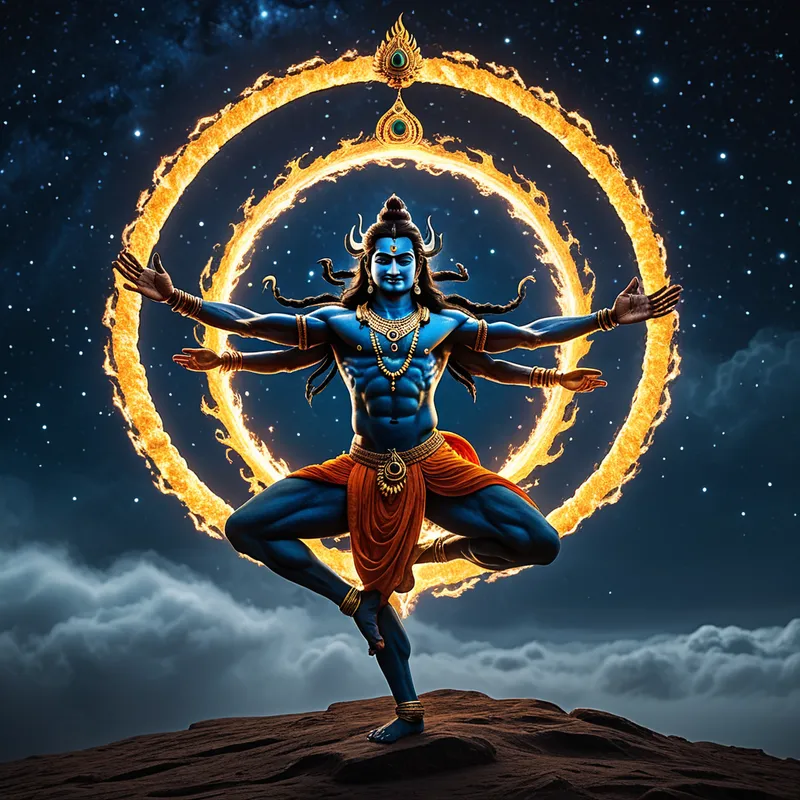
He began slowly, a ripple in the fabric of space. Then a foot stamped. [The earth](/myths/the-earth “Myth from Hindu culture.”/) shuddered. His matted locks, where the sacred [Ganga](/myths/ganga “Myth from Hindu culture.”/) flows and the crescent moon rests, whirled like dark comets. In his upper right hand, the damaru beat the frantic rhythm of dissolution—dam-dam-dam-dam—the very atoms of reality beginning to vibrate in panic. In his upper left hand, the Agni of cosmic fire blazed, a whirlwind of flame trailing his movements.
His lower right hand formed the abhaya mudra, a gesture of reassurance even in the heart of the storm. His lower left hand pointed to his raised left foot, the source of liberation. And beneath his planted right foot, crushed yet eternally present, writhed the dwarf demon Apasmara. This was the dance floor: the back of ignorance itself.
The dance accelerated. The sound became a roar. Stars shook loose from their constellations and fell like embers. Mountains powdered to dust. Oceans boiled into mist. The other gods covered their eyes, trembling at the spectacle. This was not malice. This was a terrible, necessary fury—the universe’s own immune response, a fever to burn out a terminal sickness. It was the dance of time running out, of all forms returning to the formless. It was the Tandava, the dance of dissolution.
And then, as suddenly as it began, a pause. A silence so absolute it was itself a sound. [Shiva](/myths/shiva “Myth from Hindu culture.”/) stood still, one foot eternally raised. The fire was gone, the drum silent. All was grey ash and potential. From that stillness, from the echo of the last drumbeat, a new, soft sound emerged—the sound of a single drop of [water](/myths/water “Myth from Chinese culture.”/) falling. Then another. The rhythm of the damaru had transformed into the rhythm of the first rain upon the ashes. And from that fertile, scorched earth, the first, tender green shoot pushed upward towards a newly cleared sky.
Cultural Origins & Context
The myth of Shiva’s Tandava is woven deeply into the fabric of Shaivism. Its earliest textual references shimmer in the ancient hymns of the Rig Veda, where the god [Rudra](/myths/rudra “Myth from Hindu culture.”/), the terrifying storm god, is described in furious, destructive motion. The myth crystallized in the later Puranas, such as the Shiva Purana and the Linga Purana.
It was not merely a story to be read, but a reality to be visualized and embodied. It was passed down through temple sculpture—most famously in the Chola bronze icons of Nataraja—and through sacred dance forms like Bharatanatyam, where the dancer becomes a vessel for the story’s energy. The myth served a crucial societal function: it ritualized the concept of [impermanence](/myths/impermanence “Myth from Buddhist culture.”/). It taught that destruction is not an aberration or an evil, but a sacred, integral phase of the cosmic cycle (srishti-sthiti-samhara). It provided a divine template for understanding natural disasters, the end of dynasties, and the inevitable decay of all things, framing them not as chaos, but as a divine, rhythmic process.
Symbolic Architecture
At its [heart](/symbols/heart “Symbol: The heart symbolizes love, emotion, and the core of one’s existence, representing deep connections with others and self.”/), the Tandava is the ultimate [symbol](/symbols/symbol “Symbol: A symbol can represent an idea, concept, or belief, serving as a powerful tool for communication and understanding.”/) of dynamic [equilibrium](/symbols/equilibrium “Symbol: A state of balance, stability, or harmony between opposing forces, often representing inner peace or external order.”/). It is the embodiment of the [paradox](/symbols/paradox “Symbol: A contradictory yet true concept that challenges logic and perception, often representing unresolved tensions or profound truths.”/) that [life](/symbols/life “Symbol: The symbol of ‘Life’ represents a journey of growth, interconnectedness, and existential meaning, encompassing both the joys and challenges that define human experience.”/) requires [death](/symbols/death “Symbol: Symbolizes transformation, endings, and new beginnings; often associated with fear of the unknown.”/), creation requires destruction, and wisdom requires the annihilation of ignorance.
The dance is the universe’s heartbeat: the systole of destruction followed by the diastole of creation. One cannot exist without the other.
Shiva, as the dancer, represents pure, conscious [energy](/symbols/energy “Symbol: Energy symbolizes vitality, motivation, and the drive that fuels actions and ambitions.”/) ([Purusha](/myths/purusha “Myth from Hindu culture.”/)) acting upon primal matter (Prakriti). The ring of fire (prabhamandala) is the [boundary](/symbols/boundary “Symbol: A conceptual or physical limit defining separation, protection, or identity between entities, spaces, or states of being.”/) of the manifest [universe](/symbols/universe “Symbol: The universe symbolizes vastness, interconnectedness, and the mysteries of existence beyond the individual self.”/), the limits of time and [space](/symbols/space “Symbol: Dreaming of ‘Space’ often symbolizes the vastness of potential, personal freedom, or feelings of isolation and exploration in one’s life.”/) within which the dance occurs. The crushed Apasmara is not killed, but subdued; ignorance is the necessary [platform](/symbols/platform “Symbol: A platform symbolizes a stage for expression, support, or a foundation upon which something is built.”/) for the dance of enlightenment, the inertia that must be overcome to generate [movement](/symbols/movement “Symbol: Movement symbolizes change, progress, and the dynamics of personal growth, reflecting an individual’s desire or need to transform their circumstances.”/).
Psychologically, Shiva represents [the Self](/myths/the-self “Myth from Jungian culture.”/) that can hold and integrate opposing forces. The abhaya [mudra](/symbols/mudra “Symbol: A symbolic hand gesture used in Hindu and Buddhist traditions to channel spiritual energy, express teachings, and focus meditation.”/) and the flaming hand exist simultaneously. This is the [archetype](/symbols/archetype “Symbol: A universal, primordial pattern or prototype in the collective unconscious that shapes human experience, behavior, and creative expression.”/) of the [destroyer](/symbols/destroyer “Symbol: A figure or force representing radical change through dismantling existing structures, often evoking fear and awe.”/)-[creator](/symbols/creator “Symbol: A figure representing ultimate origin, divine power, or profound authorship. Often embodies the source of existence, innovation, or personal destiny.”/), the one who must dismantle the outdated structures of the [psyche](/myths/psyche “Myth from Greek culture.”/)—rigid identities, compulsive behaviors, cherished illusions—to make space for authentic growth. The Tandava is the violent, ecstatic process of ego-death.
The Dreamer’s Resonance
When this myth stirs in the modern unconscious, it often manifests not as a literal dream of a dancing god, but as the feeling of the Tandava. One may dream of violent storms tearing through the childhood home, of earthquakes fracturing the familiar landscape of one’s life, or of a terrifying, ecstatic energy that compels the dreamer to move or dance wildly, breaking furniture and walls.
Somatically, this can correlate with periods of intense anxiety, restlessness, or fever—the body’s own “dance” to burn out illness. Psychologically, it signals a profound, non-negotiable process of deconstruction. The psyche is initiating its own Tandava because the existing psychic structure has become toxic, stagnant, or too small for the soul’s expansion. The dreamer is not being punished; they are being prepared. The dream is the drumbeat warning that a foundational clearing is underway. The key is whether the dreamer identifies with the terrified onlookers or, however fearfully, with the dancer at the center of the storm.

Alchemical Translation
The alchemical journey of individuation mirrors the Tandava precisely. [The first stage](/myths/the-first-stage “Myth from Alchemical culture.”/), [nigredo](/myths/nigredo “Myth from Alchemical culture.”/), is the dance itself—the reduction of all complex, inflated, or corrupted elements of the personality to a uniform black ash. This is the painful, necessary destruction of the [persona](/myths/persona “Myth from Greek culture.”/), the burning away of who we thought we were supposed to be.
To become oneself, one must first cease to be everything else. The Tandava is that fierce, merciful cessation.
The raised foot of Shiva points [the way](/myths/the-way “Myth from Taoist culture.”/) out: liberation ([moksha](/myths/moksha “Myth from Hindu culture.”/)) is found not by fleeing the dance, but by moving to its exact, terrible rhythm. The modern individual must learn to “dance their dissolution”—to consciously participate in the breakdown of outmoded patterns, relationships, and self-concepts. This is not passive suffering; it is an active, if agonizing, collaboration with the Self.
The final stage is the pause after the dance. The albedo is the blank, ash-covered plain, the [tabula rasa](/myths/tabula-rasa “Myth from Alchemical culture.”/). From this fertile void, the new, authentic life can emerge—not as a rebuild of the old, but as something entirely original, born from the essence that survived the fire. The individuated person carries the memory of the dance; they know their stability is not in rigid form, but in the capacity to move with the rhythmic destructions and creations of a life fully lived. They have internalized the damaru’s lesson: that every ending is the first beat of a new beginning.
Associated Symbols
Explore related symbols from the CaleaDream lexicon: