Shiva's Smile Myth Meaning & Symbolism
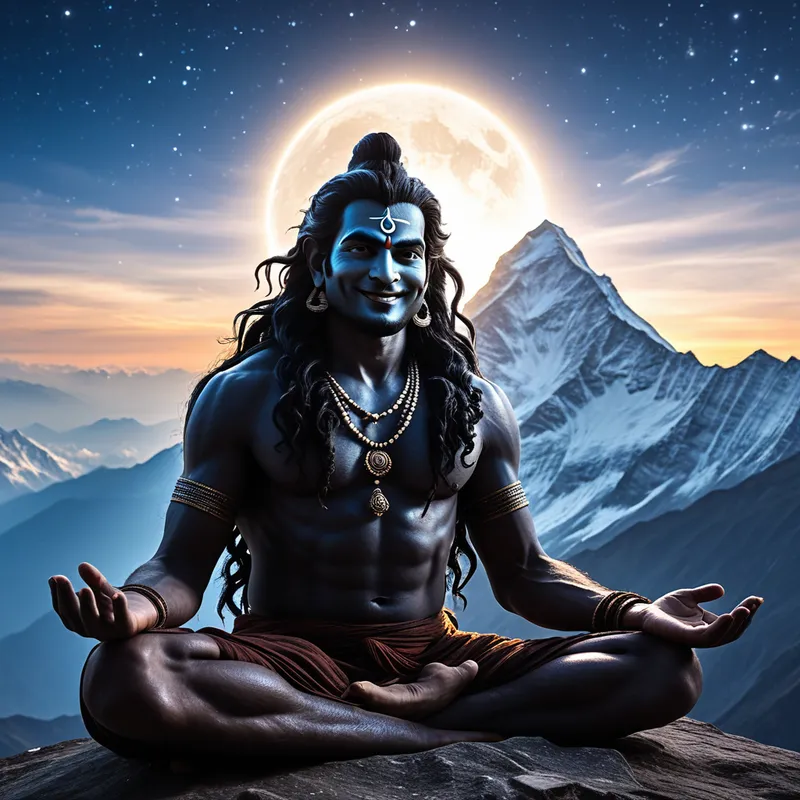
A myth where the universe's destruction is averted by the spontaneous, joyous smile of the great ascetic god, revealing creation's dance within dissolution.
The Tale of Shiva’s Smile
In the time before time, when the worlds were still young and the gods walked with the certainty of their own power, a shadow of doubt fell upon the heavens. It began not with a war, but with a whisper. Brahma and [Vishnu](/myths/vishnu “Myth from Hindu culture.”/), the great architects of reality, found themselves in a quiet, gnawing dispute. Who, truly, was the greatest? Who was the source, the ultimate, the beginning and the end?
Their debate echoed through the golden halls of [Svarga](/myths/svarga “Myth from Hindu culture.”/), troubling the sages and unsettling the very order of things. To settle it, they sought an arbiter of absolute truth. Their minds turned, inevitably, to the one who dwelled beyond all debates: [Shiva](/myths/shiva “Myth from Hindu culture.”/), the great ascetic, the lord of ghosts and of stillness, who sat in unmoving meditation upon the icy peaks of [Mount Kailash](/myths/mount-kailash “Myth from Hindu culture.”/).
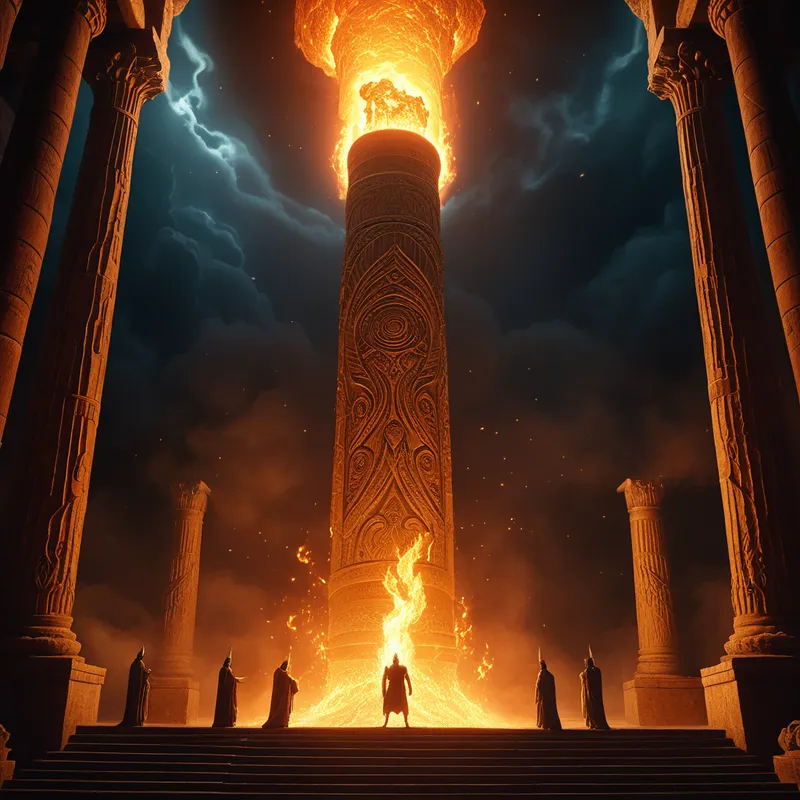
They journeyed to his silent abode, a procession of light and majesty against the stark, white mountains. They found him there, a figure of impossible calm, his body smeared with ash, his eyes closed in inward vision. Before they could utter their question, the very air shuddered. Between the two arguing gods, a pillar of fire erupted—a Lingodbhava—blazing with a light that was neither sun nor star, a column without beginning or end, filling all space with its terrifying, silent roar.
Awe turned to dread. Brahma, the creator, took the form of a swan and flew upward, seeking the pillar’s summit. Vishnu, the preserver, became a boar and burrowed downward, searching for its root. For eons they traveled, through realms of light and layers of dark earth, but found neither top nor bottom. The pillar was infinite. Exhausted and humbled, they returned to its base, their divine pride reduced to ash before this manifestation of the limitless.
It was then, in that moment of collective awe and terror, as the gods and sages trembled before the incomprehensible, that the universe held its breath. The pillar of fire did not attack; it simply was, a statement of absolute reality that rendered all claims of supremacy meaningless. And in the face of this sublime, annihilating truth, the great ascetic stirred.
Shiva opened his eyes. Not the two that see [the world](/myths/the-world “Myth from Tarot culture.”/) of form, but the third, the eye of wisdom that sees the essence of all things. He looked upon the terrified celestials, upon the infinite pillar of his own nature, and upon the fragile constructs of ego and comparison. He did not speak a word of judgment or lesson. Instead, a ripple moved across his serene face. His lips, so often set in the stern line of austerity, softened. And then, Mahadeva smiled.
It was not a smile of [triumph](/myths/triumph “Myth from Roman culture.”/) or mockery. It was a spontaneous, radiant expression of pure, uncontainable joy—the joy of the cosmos recognizing itself. It was the smile of [the void](/myths/the-void “Myth from Buddhist culture.”/) that contains all form, of the silence from which all sound springs. That smile, like the first ray of dawn on a frozen peak, melted the fear in the hearts of the gods. The terrifying pillar of fire dissolved into a soft, ambient glow, and then into nothingness. The crisis was not solved by force, but dissolved by understanding. The universe, having witnessed its own boundless nature in the smile of its source, sighed back into balance.
Cultural Origins & Context
The myth of Shiva’s Smile is woven into the fabric of Puranic literature, most notably within the Shiva Purana and the Linga Purana. These texts, composed and compiled over centuries beginning around the 4th century CE, served as encyclopedic narratives for the masses, translating Vedic philosophy into gripping stories of gods, sages, and demons.
Told by itinerant storytellers (Sūtas) and temple priests, this story functioned on multiple levels. Societally, it reinforced a core theological tenet of Shaivism: the supremacy of Shiva as the transcendent, formless absolute (Brahman) who is also the intimate, conscious source of all. It was a narrative check against sectarian pride, reminding devotees of Brahma and Vishnu of the greater, unifying reality beyond their functional roles.
On a psychological level, it was a teaching story for aspirants. It modeled the futility of theological disputation and intellectual pride (<abbr title=“The ego, the sense of “I” and “mine"">Ahamkara) when faced with direct experience of the infinite. The story was not meant to merely be heard, but to be contemplated—a meditative tool to point the mind toward the state where all conflict ends in the blissful recognition of a unified reality.
Symbolic Architecture
The myth is a masterclass in symbolic [paradox](/symbols/paradox “Symbol: A contradictory yet true concept that challenges logic and perception, often representing unresolved tensions or profound truths.”/), where every element is a [doorway](/symbols/doorway “Symbol: A doorway signifies transition, opportunities for new beginnings, and the choice to walk through into the unknown.”/) to a deeper [truth](/symbols/truth “Symbol: Truth represents authenticity, honesty, and the quest for knowledge beyond mere appearances.”/).
The Pillar of Fire (Lingodbhava) is the central [symbol](/symbols/symbol “Symbol: A symbol can represent an idea, concept, or belief, serving as a powerful tool for communication and understanding.”/). It represents the irreducible, absolute [reality](/symbols/reality “Symbol: Reality signifies the state of existence and perception, often reflecting one’s understanding of truth and life experiences.”/) that precedes and underlies all dualities—creation and preservation, top and bottom, beginning and end. It is the [psyche](/myths/psyche “Myth from Greek culture.”/)’s own core Self, impossible to fully grasp by the intellect (Brahma) or to stabilize and contain through [identity](/symbols/identity “Symbol: Identity represents the sense of self, encompassing personal beliefs, cultural background, and social roles.”/) (Vishnu).
The ultimate truth is not an answer to a question, but the dissolution of the questioner.
Brahma’s [Flight](/symbols/flight “Symbol: Flight symbolizes freedom, escape, and the pursuit of one’s aspirations, reflecting a desire to transcend limitations.”/) and Vishnu’s Descent symbolize the mind’s futile attempts to comprehend the infinite through categorization and exploration. The upward [journey](/symbols/journey “Symbol: A journey in dreams typically signifies adventure, growth, or a significant life transition.”/) is the intellect’s aspiration; the downward dive is [the ego](/myths/the-ego “Myth from Jungian culture.”/)’s attempt to find a foundational “self.” Both fail, illustrating the limits of dualistic [perception](/symbols/perception “Symbol: The process of becoming aware of something through the senses. In dreams, it often represents how one interprets reality or internal states.”/).
The [climax](/symbols/climax “Symbol: The peak moment in a narrative or musical composition, representing resolution, transformation, or ultimate expression.”/)—Shiva’s Smile—is the most potent symbol. It is not an [action](/symbols/action “Symbol: Action in dreams represents the drive for agency, motivation, and the ability to take control of situations in waking life.”/), but a [reaction](/symbols/reaction “Symbol: A reaction in a dream signifies the subconscious emotional responses to situations we face, often revealing our coping mechanisms and fears.”/); not a doing, but a being. It symbolizes the spontaneous joy (Ananda) that arises when one stops striving to find [the Self](/myths/the-self “Myth from Jungian culture.”/) and simply recognizes it as one’s own [nature](/symbols/nature “Symbol: Nature symbolizes growth, connectivity, and the primal forces of existence.”/). The smile transforms [terror](/symbols/terror “Symbol: An overwhelming, primal fear that paralyzes and signals extreme threat, often linked to survival instincts or deep psychological trauma.”/) into awe, conflict into [harmony](/symbols/harmony “Symbol: A state of balance, agreement, and pleasing combination of elements, often associated with musical consonance and visual or social unity.”/), not by changing the external pillar, but by changing the internal [perspective](/symbols/perspective “Symbol: Perspective in dreams reflects one’s viewpoints, attitudes, and how one interprets experiences.”/). It is the [moment](/symbols/moment “Symbol: The symbol of a ‘moment’ embodies the significance of transient experiences that encapsulate emotional depth or pivotal transformations in life.”/) the [dreamer](/symbols/dreamer “Symbol: The dreamer represents the self, the conscious mind engaging with subconscious thoughts and feelings during dreaming.”/) realizes they are dreaming, and the [nightmare](/symbols/nightmare “Symbol: Nightmares symbolize deep fears, unresolved anxiety, and emotional turmoil, often reflecting internal conflicts or stressors in waking life.”/) becomes a lucid play of light.

The Dreamer’s Resonance
When this myth stirs in the modern unconscious, it often manifests in dreams of profound, paradoxical resolution. One might dream of a terrifying, all-consuming force—a tidal wave, a black hole, an unstoppable machine—that is suddenly neutralized not by fight or flight, but by a simple, calm act of acceptance or laughter from the dreamer. The somatic experience is key: a sudden release of tension in the chest, a flood of warmth, a feeling of expansion where there was constriction.
Psychologically, this signals a confrontation with what Jung called the Self—the total, integrated psyche that encompasses both the conscious ego and the unconscious. The “pillar of fire” in the dream is often a core anxiety, a foundational trauma, or a life dilemma that feels infinite and insurmountable to the ego. The dreamer’s initial attempts (like Brahma and Vishnu) are to outthink it or dig into its origins, which only leads to exhaustion.
The emergence of the “smile”—the calm, joyous acceptance within the dream—marks a critical shift from ego-consciousness to Self-awareness. It is the psyche’s innate wisdom resolving a conflict not through analysis, but through a transcendent re-framing. The individual is undergoing a process where a deep-seated, terrifying complex is being integrated not as a problem to be solved, but as a part of their wholeness to be embraced.
Alchemical Translation
The alchemical process modeled here is the Individuation journey in its most refined stage: the Coniunctio that occurs not through laborious struggle, but through sudden, grace-filled recognition.
The modern individual often lives in the dispute of Brahma and Vishnu: the inner creator (ambition, plans, ideation) argues with the inner preserver (routine, identity, stability) about which is supreme. This internal civil war generates the “pillar of fire”—a crisis of meaning, a burnout, a depression, or a feeling of existential dread that seems infinite and central to one’s life.
The alchemical gold is not manufactured by the ego; it is revealed when the ego ceases its claims of ownership over the soul.
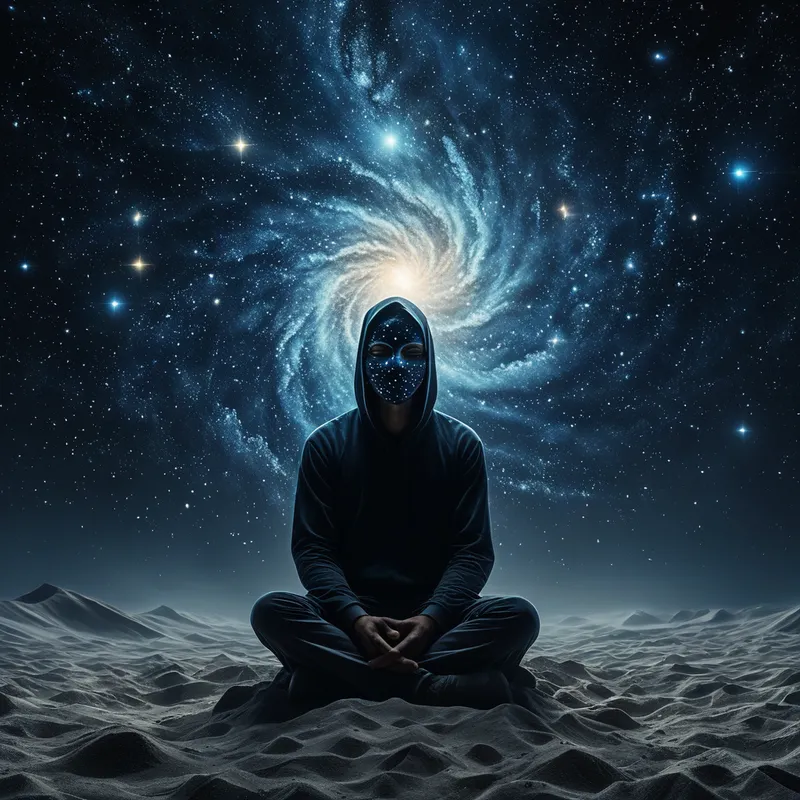
The arduous work of therapy, shadow-work, and self-inquiry represents the flights of Brahma and Vishnu. It is necessary and humbling, proving that the problem cannot be conquered by the mind or the constructed self alone. The “smile” is the transformative moment that follows this surrender. It is the unexpected insight in meditation, the profound acceptance in grief, the creative breakthrough that comes not from striving but from letting go. It is the realization that the terrifying “void” at the center of one’s crisis is not empty, but full of potential; not an end, but the source of a new, more authentic beginning.
In this alchemy, the individual transmutes the lead of existential anxiety into the gold of existential joy. They stop trying to be the author (Brahma) or the curator (Vishnu) of their life and instead become the witness (Shiva), in whose silent, smiling awareness the entire drama of creation and destruction is seen as a divine, playful dance—the Tandava of their own soul. The crisis dissolves not because it is fixed, but because it is seen in its true, vast, and ultimately benign context. One learns to smile at one’ own becoming.
Associated Symbols
Explore related symbols from the CaleaDream lexicon: