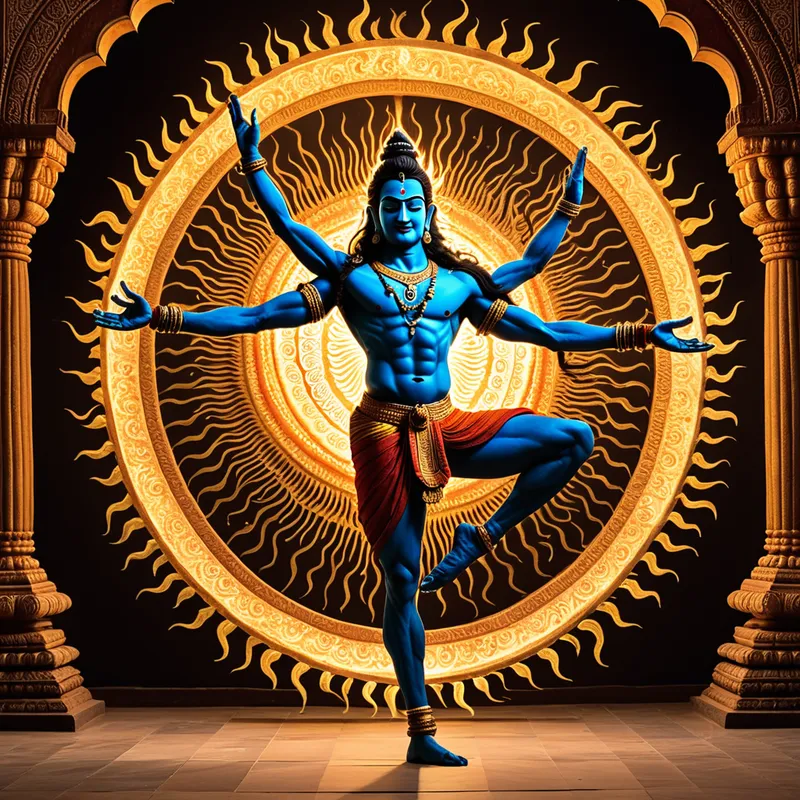
Shiva's Nataraja Myth Meaning & Symbolism
Shiva dances within a ring of fire, crushing ignorance, balancing cosmos, and embodying the eternal rhythm of creation and destruction.
The Tale of Shiva’s Nataraja
Listen. In the deep south, where the earth meets the endless sky, there stood a forest. But this was no ordinary grove. This was the Dāruvana, a place of immense power, where ten thousand sages—the Rishis—and their families had made their home. They were not simple hermits. Through fierce austerities, they had amassed knowledge like a hoard of jewels, and with it, a pride that hardened around their hearts like iron. They believed their rituals could command the cosmos itself.
Into this realm of coiled power and arrogance walked a stranger. He was a wandering mendicant, smeared with ash, clad in animal skin, his eyes holding the calm of a deep, still lake. This was Shiva, but they did not know him. They saw only a wild, unsettling ascetic, a challenge to their ordered world. His presence was a silent question their dogma could not answer. First, they tried to drive him out with curses and scorn. He smiled, absorbing their malice like a mountain absorbs rain.
Then, their fear turned to fury. They conjured a monstrous tiger from their sacrificial fires, its roar tearing the forest silence. The mendicant merely grasped its blazing form and, with effortless grace, draped its skin around his waist like a silken cloth. Next, they hurled a venomous serpent at his heart. He caught it mid-strike and coiled it as a tranquil ornament around his neck. Finally, in a crescendo of rage, they summoned a dwarf-demon, Apasmāra Purusha, the very embodiment of ignorance and heedlessness. The creature rushed to crush the stranger.
And then… he began to dance.
It started as a shift in the air, a vibration deep in the bones of the world. His right foot rose, his left planted firmly upon the squirming back of the dwarf. His arms unfurled like lotus petals opening to the dawn. In his upper right hand, the damaru began to beat—dam-dam-dam-dam—the primal pulse of creation. In his upper left, the cleansing flame of destruction flickered. One lower hand gestured abhaya, “fear not,” while the other pointed to his raised foot, the path of liberation.
Around him, a ring of fire erupted, not to consume, but to define the very circle of the cosmos. His matted locks whirled wide, and within them, one could see the celestial river Ganga flowing, and the crescent moon shining. The dance was an entire universe in motion—terrible, beautiful, and utterly complete. The sages’ pride shattered like a clay pot. Their powerful curses dissolved into nothingness before this vision. They fell prostrate, not in defeat, but in awe-struck understanding. The dance did not destroy them; it destroyed their illusion. The hall where this occurred, they understood then, was not the forest, but the Chidambaram, the space of the heart. And the dancer was Nataraja, the king of all dancers, whose performance is the eternal rhythm of existence.
Cultural Origins & Context
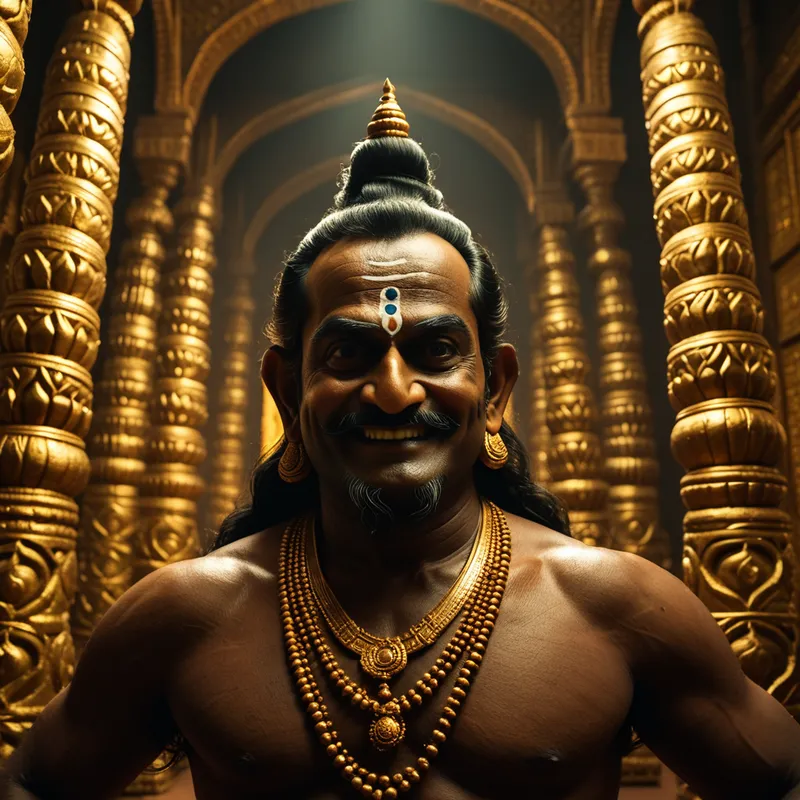
The myth of Nataraja finds its most profound roots in the devotional (bhakti) traditions of Southern India, particularly in Tamil Shaivism from around the 6th century CE onward. While Shiva as a cosmic dancer appears in earlier Sanskrit texts, it was in the fertile spiritual ground of Tamil culture that the icon and its philosophy crystallized. The story is immortalized in the hymns of the Nayanars, like the saint Appar, who sang of Shiva’s dance at Tillai (Chidambaram).
The myth was not merely a story; it was a theological argument and a societal mirror. It was passed down through temple sculpture, bronze casting (reaching an artistic zenith under the Chola dynasty), dance (Bharatanatyam), and poetic discourse. Its function was multifaceted: to illustrate the supremacy of experiential divine grace over rigid ritualistic knowledge, to explain the nature of a universe in perpetual flux, and to provide a visual and philosophical anchor for devotees. The temple of Chidambaram, claiming to be the very site of the dance, became the geographic and spiritual epicenter of this belief, housing the famous Akasha Linga alongside the iconic image of the dancing lord.
Symbolic Architecture
The Nataraja is a complete metaphysical diagram. Every element is a deliberate symbol in a dynamic equilibrium.
The dance itself is the continuous process of the universe: creation, preservation, destruction, concealment, and grace, all occurring simultaneously. The flaming circle (prabhamandala) represents the cycle of birth and death, the boundaries of time and space, and the transformative fire of consciousness. The dwarf underfoot, Apasmāra, is not evil to be hated, but ignorance to be subdued and rendered inert; it is the necessary base upon which wisdom stands.
The drum in his hand is the sound of becoming; the flame in his other is the light of unbecoming. Between these two poles, the world pulses into being.
The gesture of fearlessness (abhaya mudra) assures the devotee that this cosmic chaos has a benevolent core, while the pointing hand directs attention to the raised foot, the path out of the cyclical world. The flowing Ganga and crescent moon in his hair signify the containment and cooling of potentially overwhelming cosmic energies—the descent of grace and the rhythm of time. Psychologically, Nataraja represents the Self (Atman) in its total activity. It is the archetype of the psyche that does not shy away from its own destructive and creative capacities but holds them in a dynamic, graceful balance. The demon of ignorance is the personal and collective shadow, which must not be annihilated but mastered, integrated as the foundation for one’s stance in the world.
The Dreamer’s Resonance
When this myth stirs in the modern unconscious, it often manifests in dreams of profound personal revolution. One may dream of being in a vast, architectural space (the hall of consciousness) facing an immovable, arrogant authority (the sages/rishis), only to discover a sudden, innate capacity for transformative movement within oneself. The dance may appear as a feeling of being caught in a whirlwind of life changes—career shifts, relationship endings, creative bursts—that feel both terrifying and ecstatically necessary.
Somatically, the dreamer might report sensations of rhythmic pulsing, a feeling of being “on fire” yet unharmed, or the paradoxical feeling of being utterly grounded while in motion. Psychologically, this signals a confrontation with one’s own “sages”—the internalized, rigid structures of dogma, ego, and conditioned belief. The dance is the psyche’s instinct to break these forms apart not through violence, but through a superior, encompassing rhythm. To dream of Nataraja is to undergo the process of the old, prideful self being dissolved not by an external force, but by the revelation of a vaster, more dynamic pattern of being within.

Alchemical Translation
For the individual on the path of individuation, the Nataraja myth is a master blueprint for psychic transmutation. The alchemical work is not about achieving a static state of perfection, but about learning to dance within one’s own contradictions.
The first stage is the confrontation with the “Dāruvana”—the dense forest of one’s own accumulated knowledge, complexes, and prideful self-concepts. This is the ego’s fortified territory. The entry of the mendicant Shiva is the arrival of the Self, the transcendent function, which initially appears alien, unsettling, and disruptive to the ego’s order.
The alchemical fire is not for destruction alone, but for the separation of the rigid from the fluid, the mortal identity from the immortal pattern.
The dance is the active, lived process of integration. Raising one foot symbolizes transcendence, moving beyond identification with the phenomenal world. Planting the other on the dwarf is the equally crucial act of grounding this transcendence in the reality of one’s base nature, one’s shadows and ignorance, without being ruled by it. The simultaneous gestures of the hands—creating, destroying, protecting, and liberating—model the ability to hold opposing psychic functions in conscious tension. The modern individual must learn to beat the drum of their own creative expression while wielding the flame that burns away what is no longer true. They must offer a gesture of assurance to the frightened ego while pointing their awareness toward the path of liberation.
Ultimately, the Nataraja teaches that wholeness is a dynamic, dancing balance. The goal is not to exit the circle of life (the prabhamandala), but to become its conscious, graceful center—where creation and destruction, agony and ecstasy, are seen as the inseparable movements of a single, majestic, and eternal dance.
Associated Symbols
Explore related symbols from the CaleaDream lexicon: