Shiva's Cosmic Dance Myth Meaning & Symbolism
The supreme deity Shiva performs the Tandava, a cosmic dance that simultaneously destroys illusion and generates the rhythmic pulse of all existence.
The Tale of Shiva’s Cosmic Dance
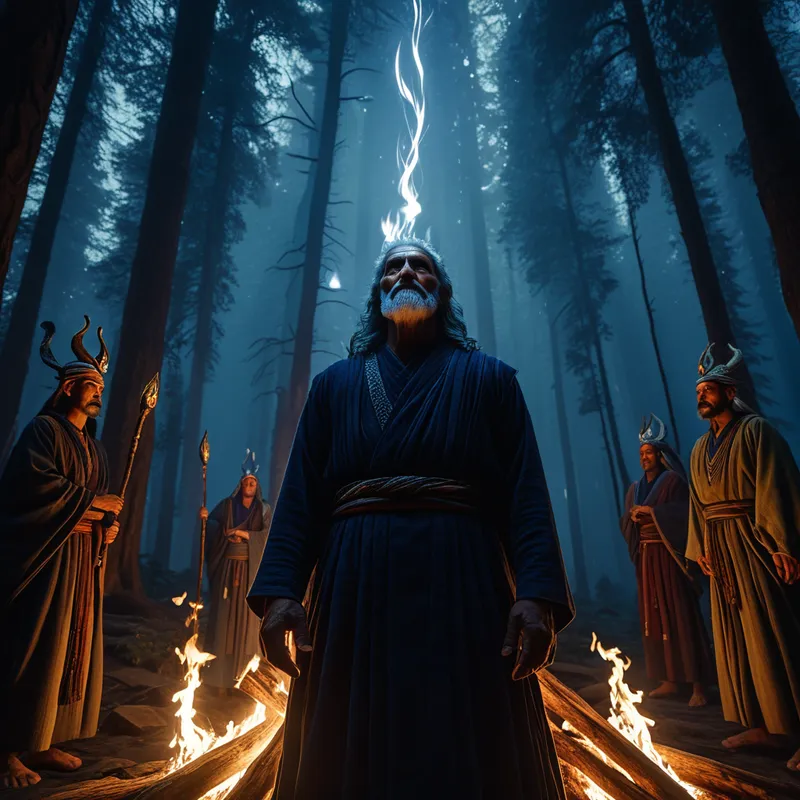
Listen. In the deep, primordial forests of Daruka, a silence had grown heavy—not a peaceful quiet, but the dense, arrogant silence of accumulated power. Ten thousand sages, the Rishis, had gathered there. Through fierce austerities, they had mastered the elements, bending reality to their will. Their pride became a fortress; their rituals, a challenge to the heavens themselves. They began to believe their [tapas](/myths/tapas “Myth from Hindu culture.”/), their fiery discipline, was the source of all order, that they could command the cosmos.
To humble them, the gods sent temptations. Kama, the god of desire, showered them with arrows of longing. They burned him to ashes with the fire of their concentration. [Lakshmi](/myths/lakshmi “Myth from Hindu culture.”/), the goddess of fortune, appeared in all her splendor. They turned their eyes away, seeing only distraction. Their wives, feeling neglected, wandered into the forest glades. There, they encountered a wandering mendicant, a beautiful ascetic with ash-smeared skin, matted locks, and eyes that held the calm of deep space. This was [Shiva](/myths/shiva “Myth from Hindu culture.”/), in disguise.
Enchanted, the women forgot their austere husbands. When [the Rishis](/myths/the-rishis “Myth from Hindu culture.”/) discovered this, their fury was cosmic. Their pride, now wounded, transformed into black magic. From their sacrificial pits, they conjured a monstrous tiger, its roar shaking the very roots of [the world](/myths/the-world “Myth from Tarot culture.”/)-trees. [The ascetic](/myths/the-ascetic “Myth from Christian culture.”/) smiled, and with the ease of plucking a flower, he stripped the skin from the beast and wore it as a loincloth. Enraged further, they manifested a venomous serpent. He caught it mid-strike and coiled it as a garland around his neck. Finally, in a last, desperate act of ego, they summoned a vicious dwarf demon, Apasmara [Purusha](/myths/purusha “Myth from Hindu culture.”/), the embodiment of ignorance and forgetfulness. The dwarf rushed at [the ascetic](/myths/the-ascetic “Myth from Christian culture.”/)‘s heart.
And then, the universe held its breath.
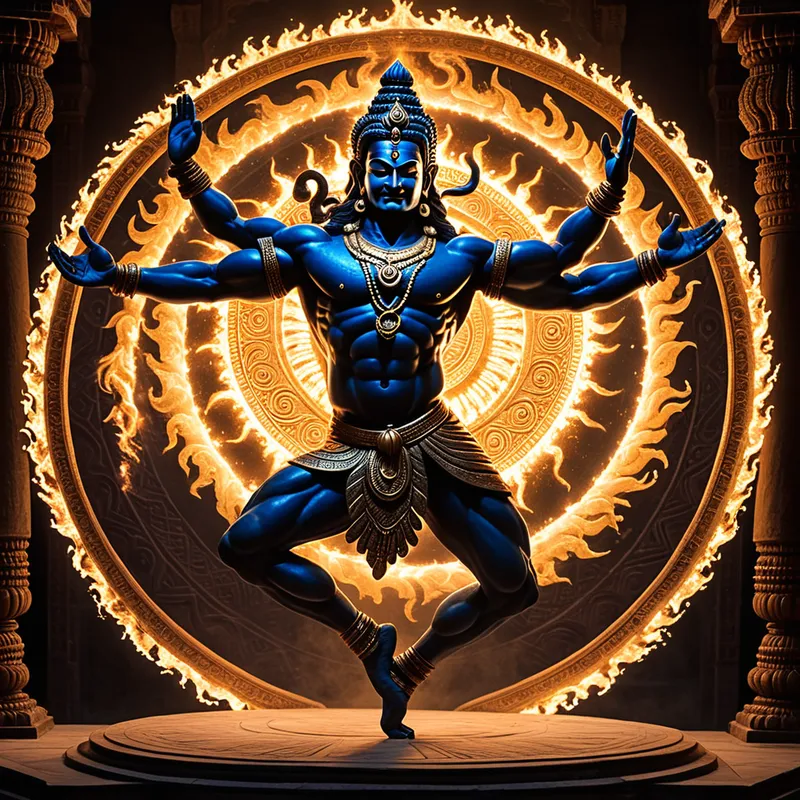
The wandering mendicant vanished. In his place, in the center of the forest clearing, stood the luminous, terrible, and glorious form of [Nataraja](/myths/nataraja “Myth from Hindu culture.”/), the King of Dancers. His right foot stamped down upon the writhing back of the dwarf demon, pinning ignorance to [the earth](/myths/the-earth “Myth from Hindu culture.”/). His left foot lifted, crossed in a gesture of transcendent liberation. In his upper right hand, the damaru began to beat—dum-dum-dum-dum—the first rhythm of creation, the pulse of atoms and galaxies. In his upper left hand, the Agni of cosmic destruction blazed. His lower right hand was raised in the Abhaya Mudra, a gesture of “fear not.” His lower left hand pointed to his raised foot, the path to salvation. His long, matted hair flew wide, capturing the [Ganga](/myths/ganga “Myth from Hindu culture.”/) and fanning out into the arcs of the cosmos itself. He began to dance.
This was the Tandava. It was not a dance of mere movement, but the very movement of existence. With each whirl, universes spun into being from the drumbeat and dissolved into the flame. The ring of fire encircling him, the Prabhamandala, was the boundary of all manifest reality. The Rishis, their power rendered dust before this vision, fell prostrate. Their pride shattered, their hearts cracked open not by force, but by awe. They saw the truth: they were not the masters of the rhythm, but notes within a divine symphony that had been playing since before time began.
Cultural Origins & Context
The myth of [Shiva Nataraja](/myths/shiva-nataraja “Myth from Hindu culture.”/) finds its most profound expression in the devotional traditions of Southern India, particularly within the Shaivism of the Tamil region. While Vedic texts hint at a dancing god, the full iconographic and narrative crystallization occurred between the 6th and 10th centuries CE. The myth was immortalized not just in scripture, but in the sublime bronze casting of the Chola dynasty—sculptures that are both theological diagrams and objects of intense devotion.
It was passed down through temple rituals, devotional hymns by the Nayanars, and the sacred dance tradition of Bharatanatyam. Its societal function was multifaceted: it was a metaphysical teaching for philosophers, a devotional focus for worshippers, and a cosmic model for artists and kings. It served to illustrate the central Hindu concept of lila, the divine play, where the universe is not a serious creation but a dynamic, rhythmic expression of the absolute.
Symbolic Architecture
The [icon](/symbols/icon “Symbol: A sacred image or revered figure representing divine presence, artistic genius, or cultural authority, often serving as a focal point for devotion or identity.”/) of Nataraja is a perfect symbolic map of [reality](/symbols/reality “Symbol: Reality signifies the state of existence and perception, often reflecting one’s understanding of truth and life experiences.”/). Every element is a profound [truth](/symbols/truth “Symbol: Truth represents authenticity, honesty, and the quest for knowledge beyond mere appearances.”/) about the [nature](/symbols/nature “Symbol: Nature symbolizes growth, connectivity, and the primal forces of existence.”/) of existence and [consciousness](/symbols/consciousness “Symbol: Consciousness represents the state of awareness and perception, encompassing thoughts, feelings, and experiences.”/).
The dance is the ongoing process of becoming; the dancer is the eternal, unchanging presence within the flux.
The [dwarf](/symbols/dwarf “Symbol: A dwarf often represents hidden potential, undervalued wisdom, or primal instincts. It can symbolize something small but powerful or foundational aspects of the self.”/), Apasmara, under Shiva’s foot is the egoic ignorance that makes us identify solely with the transient [drama](/symbols/drama “Symbol: Drama signifies narratives, emotional expression, and the exploration of human experiences.”/) of our lives. To crush it is not to destroy the personal self, but to subdue its tyranny, allowing a vaster consciousness to emerge. The drum and flame in his hands are the twin forces of creation and destruction, sound and fire, the beginning and the end of all cycles. They are not opposites, but complementary movements of the same [energy](/symbols/energy “Symbol: Energy symbolizes vitality, motivation, and the drive that fuels actions and ambitions.”/).
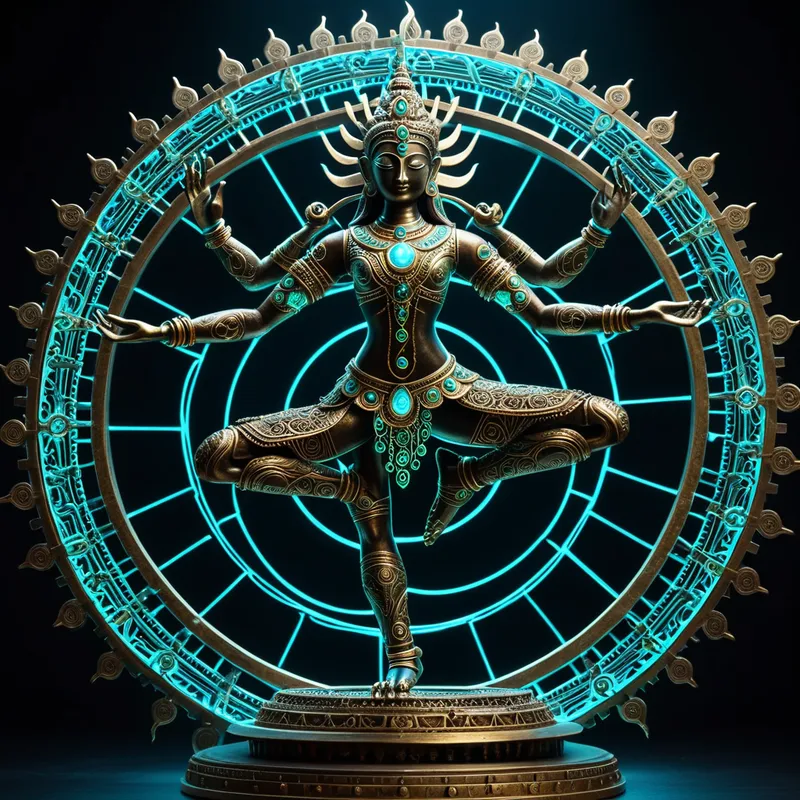
The raised foot signifies release, [moksha](/myths/moksha “Myth from Hindu culture.”/), while the planted foot signifies grounded engagement with the world. The fear-not [gesture](/symbols/gesture “Symbol: A non-verbal bodily movement conveying meaning, emotion, or intention, often symbolic in communication and artistic expression.”/) offers protection through the terrifying process of [dissolution](/symbols/dissolution “Symbol: The process of breaking down, dispersing, or losing form, often representing transformation, release, or the end of a state of being.”/), while the pointing hand directs the devotee toward the [path](/symbols/path “Symbol: The ‘path’ symbolizes a journey, choices, and the direction one’s life is taking, often representing individual growth and exploration.”/) of liberation. The flying [hair](/symbols/hair “Symbol: Hair often symbolizes identity, power, and self-expression, reflecting how we perceive ourselves and how we wish to be perceived by others.”/) and [serpent](/symbols/serpent “Symbol: A powerful symbol of transformation, wisdom, and primal energy, often representing hidden knowledge, healing, or temptation.”/) represent the harnessing of wild, primal energies—the chaotic flow of [life](/symbols/life “Symbol: The symbol of ‘Life’ represents a journey of growth, interconnectedness, and existential meaning, encompassing both the joys and challenges that define human experience.”/) and the deadly power of time—into the [harmony](/symbols/harmony “Symbol: A state of balance, agreement, and pleasing combination of elements, often associated with musical consonance and visual or social unity.”/) of the dance. The entire figure, poised within the circle of fire, depicts the individual [soul](/symbols/soul “Symbol: The soul represents the essence of a person, encompassing their spirit, identity, and connection to the universe.”/) (atman) dancing within the confines of phenomenal reality (maya), yet perpetually connected to the still center.
The Dreamer’s Resonance
When this myth stirs in the modern unconscious, it often manifests not as a clear image of Shiva, but as a dream of powerful, transformative movement. One might dream of being in a structure—a house, an office, a familiar room—that begins to tremble and dissolve to a compelling, rhythmic sound. The dreamer may find themselves dancing uncontrollably, not in joy, but in a kind of necessary, chaotic unraveling.
Somatically, this reflects a psychological process where an old, rigid structure of the [psyche](/myths/psyche “Myth from Greek culture.”/)—a long-held identity, a stubborn complex, a fortress of pride like the Rishis’—is being challenged at its foundation. The drumbeat is the insistent call of a deeper truth or a life transition that cannot be ignored. The flame is the painful but necessary dissolution of what is no longer authentic. To dream of this dance is to be in the alchemical stage of [nigredo](/myths/nigredo “Myth from Alchemical culture.”/), where the old self must break down for something new to be born. The terror in the dream is [the ego](/myths/the-ego “Myth from Jungian culture.”/)‘s resistance to its own necessary death.
Alchemical Translation
For the individual on the path of individuation, [Shiva’s Tandava](/myths/shivas-tandava “Myth from Hindu culture.”/) is the ultimate model of psychic transmutation. Our personal development is not a linear march of progress, but a rhythmic dance of creation and destruction.
Individuation requires the courage to hold the drum of new potential in one hand and the flame of conscious sacrifice in the other.
The first step is to “crush the dwarf.” This is [the shadow](/myths/the-shadow “Myth from Jungian culture.”/) work of confronting the Apasmara within—our willful ignorance, our petty arrogance, our addictive clinging to a small, safe identity. We must place our foot upon it, not to annihilate it, but to prevent it from dictating our lives.
The second step is to embrace the dual role of creator and destroyer within our own psyche. We must find the drumbeat of our own unique calling, the rhythm that gives form to our creativity and relationships (the drum). Simultaneously, we must wield the flame to consciously burn away outmoded habits, toxic attachments, and self-deceptions. This is not self-punishment, but the disciplined art of letting go.
The final alchemy is to find the still point in the center of the whirl. While life dances us—through joy, tragedy, success, and loss—the goal is to identify not with the frantic limbs of circumstance, but with the serene, smiling face of the dancer at the center. This is the integration of the Self. We become participants in our own cosmic dance, no longer victims of chaos or prisoners of rigid order, but conscious co-creators, moving in time with a rhythm that is both profoundly personal and universally sacred. The ring of fire is no longer a boundary, but the luminous outline of our own completed, dynamic being.
Associated Symbols
Explore related symbols from the CaleaDream lexicon: