Shiva-Shakti Myth Meaning & Symbolism
The primordial myth of the still, ascetic god Shiva and the dynamic, creative goddess Shakti, whose union births and sustains the entire cosmos.
The Tale of Shiva-Shakti
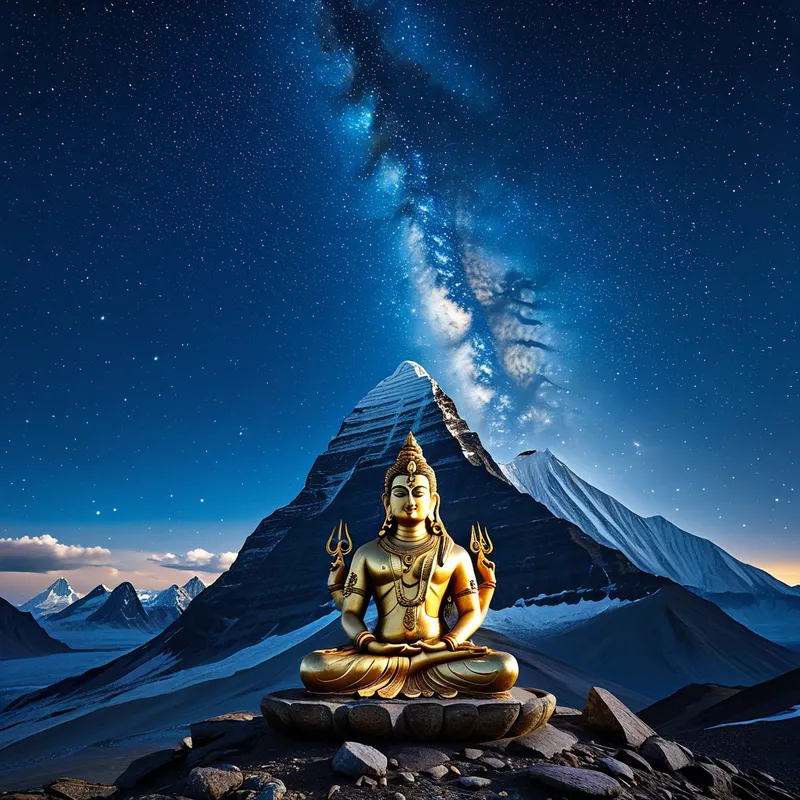
In the beginning, before time had a name, there was only the silent, boundless ocean of consciousness. Upon its shoreless surface sat [Shiva](/myths/shiva “Myth from Hindu culture.”/), the Auspicious One, in perfect, unmoving meditation. His body was the color of a twilight sky, smeared with the ash of burnt universes. His eyes were closed, seeing only the infinite within. Around his neck coiled a serpent, time itself, asleep. The cosmos was a potential, a thought frozen in the ice of pure awareness. It was still, silent, and complete—yet unborn.
Far from this frozen peak, in the realms of action and form, stirred a longing. The [Shakti](/myths/shakti “Myth from Hindu culture.”/), [the world](/myths/the-world “Myth from Tarot culture.”/)’s latent power, yearned to know itself. She took form as Sati, a goddess of fierce beauty and will, whose destiny was woven with Shiva’s. She saw him not on his mountain, but in the vision of her heart—the ultimate beloved, the still center around which all motion must dance. Defying the worldly logic of her father, the proud [prajapati](/myths/prajapati “Myth from Hindu culture.”/) Daksha, she undertook terrible austerities. For centuries, she stood on one foot, her gaze inward, until her devotion became a fire that melted the glacial indifference of the Absolute.
Shiva opened his eyes. In that glance, the universe shuddered into being. He saw Sati, and in seeing her, saw his own creative power reflected. They were wed in a ceremony that shook the stars—a marriage of the mountain’s silence and the volcano’s heart.
But the world of form thrives on conflict. Daksha, lord of ritual and social order, held a great yajna. He invited all the gods, all beings of note, but pointedly excluded Shiva, whom he saw as a wild, ash-smeared ascetic unfit for civilized company. Sati, consumed by righteous fury and a wife’s honor, went to confront her father. The air in the sacrificial hall was thick with the smell of ghee and arrogance. Daksha heaped insults upon Shiva, calling him a vagrant, a destroyer of dharma. Each word was a dagger to Sati. She realized that in this realm of petty hierarchies, the truth of her union with Shiva could not be contained. Her body could not bear the weight of this dissonance.
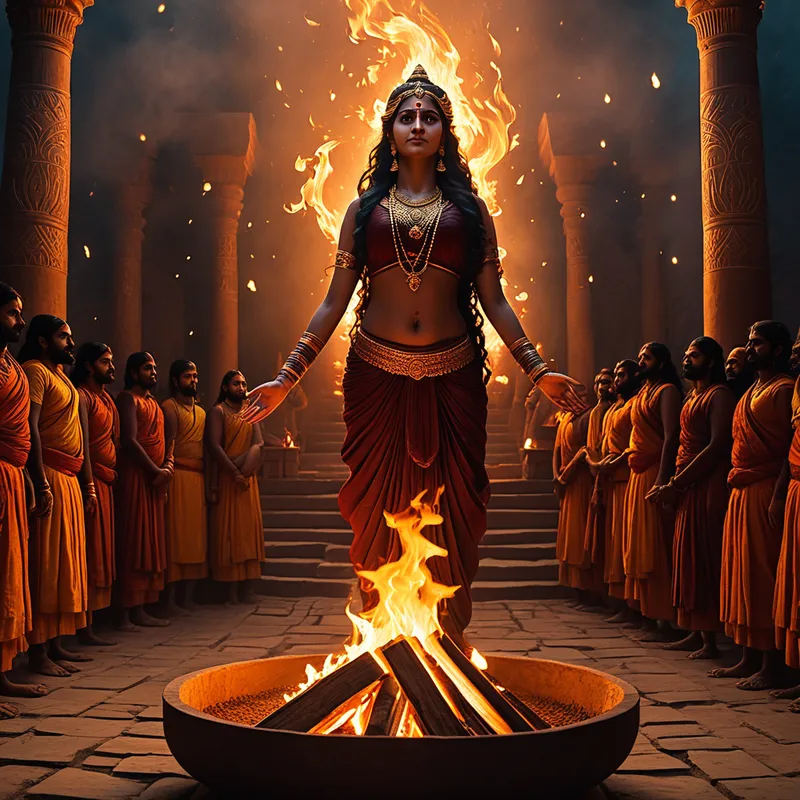
“If this is the body born from your contempt,” she declared, her voice echoing with a power that silenced the hymns, “then I return it to the fire from which all form arises.” And she sat down in [the sacred fire](/myths/the-sacred-fire “Myth from Native American culture.”/) pit of the yajna. But this was no mere suicide. It was a supreme act of [tapas](/myths/tapas “Myth from Hindu culture.”/). Her physical form dissolved not into ash, but into pure, blinding energy. The sacrificial fire roared into a column of cosmic light.
On [Mount Kailash](/myths/mount-kailash “Myth from Hindu culture.”/), Shiva’s meditation shattered. A pain, raw and world-ending, tore through his eternal calm. The divine ascetic who had remained unmoved by eons became the embodiment of grief. He rose, and in rising, became [Rudra](/myths/rudra “Myth from Hindu culture.”/), the Howler. From his matted locks, he pulled forth Virabhadra, a being of terrifying wrath, and commanded the destruction of Daksha’s sacrifice. The cosmos trembled on the brink of annihilation.
Yet, the story does not end in ruin. From the scattered ashes of the yajna and the embers of Sati’s self-sacrifice, a new possibility was seeded. Shakti would return, not as Sati, but as Parvati. She would once again perform austerities, not to win a distant god, but to remind him of his own nature. She meditated outside his cave until her devotion became a season, and the seasons turned around her. Moved by her unwavering essence, Shiva was compelled to engage. He tested her, debated her, and ultimately, recognized in her his own active, creative will. Their second union was not born of fiery tragedy, but of conscious recognition. From this union, a child of joy and integration—[Ganesha](/myths/ganesha “Myth from Hindu culture.”/)—was born. And in their most profound icon, they merged into one body: Ardhanarishvara, the Lord who is Half Woman, where stillness and motion, male and female, consciousness and energy, are revealed as inseparable halves of one sublime whole.
Cultural Origins & Context
The myth of Shiva-Shakti is not a single story but a vast, living tapestry woven across millennia. Its threads are found in the later layers of the ancient Vedas, but it finds its full, vibrant expression in the Puranas—particularly the Shiva Purana, Devi Bhagavata Purana, and [Kurma](/myths/kurma “Myth from Hindu culture.”/) Purana. These texts were the narrative vehicles of classical and medieval Hinduism, composed and recited by Brahmin scholars and itinerant storytellers (Sutas and Sadhus) in temple courtyards and village squares.
The myth served multiple societal functions. Philosophically, it provided a narrative framework for the non-dual (Advaita) and tantric schools of thought, which sought to transcend binary oppositions. Socially, it elevated the concept of the Divine Feminine to a position of absolute necessity, influencing temple worship, art, and theologies that saw the goddess as the active power of the universe. Ritually, it underpinned practices in Tantra and Hatha Yoga, where the integration of Shiva (consciousness) and Shakti ([kundalini](/myths/kundalini “Myth from Hindu culture.”/) energy) within the human body is the central goal. It was a myth that spoke equally to the philosopher seeking the nature of reality and the devotee seeking the ecstasy of divine love.
Symbolic Architecture
At its core, the myth maps the fundamental [architecture](/symbols/architecture “Symbol: Architecture in dreams often signifies structure, stability, and the framing of personal identity or life’s journey.”/) of existence and [psyche](/myths/psyche “Myth from Greek culture.”/). Shiva represents pure, undifferentiated [consciousness](/symbols/consciousness “Symbol: Consciousness represents the state of awareness and perception, encompassing thoughts, feelings, and experiences.”/)—[the witness](/symbols/the-witness “Symbol: A figure observing events without direct participation, representing conscience, memory, or societal judgment.”/), the still point, the ground of being. Shakti represents the dynamic, creative [energy](/symbols/energy “Symbol: Energy symbolizes vitality, motivation, and the drive that fuels actions and ambitions.”/) that manifests as the phenomenal world—thought, [emotion](/symbols/emotion “Symbol: Emotion symbolizes our inner feelings and responses to experiences, often guiding our actions and choices.”/), matter, and [life](/symbols/life “Symbol: The symbol of ‘Life’ represents a journey of growth, interconnectedness, and existential meaning, encompassing both the joys and challenges that define human experience.”/) itself.
Shiva without Shakti is shava—a corpse. Shakti without Shiva is chaos—energy without direction or meaning.
Their [separation](/symbols/separation “Symbol: A spiritual or mythic division between realms, states of being, or consciousness, often marking a transition or loss of connection.”/) is the state of existential alienation: the meditator lost in empty transcendence, or the activist consumed by meaningless [activity](/symbols/activity “Symbol: Activity in dreams often represents the dynamic aspects of life and can indicate movement, progress, and engagement with personal or societal responsibilities.”/). Sati’s self-immolation is the ultimate symbolic act of sacrificing the limited ego-[identity](/symbols/identity “Symbol: Identity represents the sense of self, encompassing personal beliefs, cultural background, and social roles.”/) (her form as Daksha’s [daughter](/symbols/daughter “Symbol: In dreams, a daughter symbolizes innocence, potential, and the nurturing aspects of oneself or one’s relationships.”/)) to reveal the pure energy (Shakti) beneath. It is not destruction, but deconstruction. Shiva’s ensuing rage is not merely [grief](/symbols/grief “Symbol: A profound emotional response to loss, often manifesting as deep sorrow, yearning, and a sense of emptiness.”/); it is the terrifying, necessary force of [dissolution](/symbols/dissolution “Symbol: The process of breaking down, dispersing, or losing form, often representing transformation, release, or the end of a state of being.”/) that must sweep away rigid, life-denying structures (Daksha’s arrogant [ritual](/symbols/ritual “Symbol: Rituals signify structured, meaningful actions carried out regularly, reflecting cultural beliefs and emotional needs.”/) order) so that a new, more integrated form can emerge.
The final [resolution](/symbols/resolution “Symbol: In arts and music, resolution refers to the movement from dissonance to consonance, creating a sense of completion, release, or finality in a composition.”/) in Ardhanarishvara is the [symbol](/symbols/symbol “Symbol: A symbol can represent an idea, concept, or belief, serving as a powerful tool for communication and understanding.”/) of complete psychical [integration](/symbols/integration “Symbol: The process of unifying disparate parts of the self or experience into a cohesive whole, often representing psychological wholeness or resolution of internal conflict.”/). It signifies that true wholeness is not the victory of one principle over another, but the sacred [marriage](/symbols/marriage “Symbol: Marriage symbolizes commitment, partnership, and the merging of two identities, often reflecting one’s feelings about relationships and social obligations.”/) within. The masculine and feminine here are not [gender](/symbols/gender “Symbol: Gender in arts and music represents the expression, performance, and cultural construction of identity through creative mediums.”/) roles, but universal principles present in all beings: the receptive, abiding [awareness](/symbols/awareness “Symbol: Conscious perception of self, surroundings, or internal states. Often signifies awakening, insight, or heightened sensitivity.”/) and the proactive, formative will.
The Dreamer’s Resonance
When this myth stirs in the modern dreamer, it often signals a profound somatic and psychological process of integration. To dream of a figure in deep, catatonic meditation while the world crumbles around them may reflect the “Shiva complex”—a retreat into detached intellectualization or spiritual bypassing, avoiding the messy, Shakti-like energies of emotion, relationship, and embodied life.
Conversely, to dream of uncontrollable creative explosions, chaotic emotional storms, or a relentless, driving force with no center may speak to the “uncontained Shakti”—a life ruled by compulsive doing, unchecked passion, or anxiety, lacking the stabilizing witness of consciousness.
Dreams of a [sacred marriage](/myths/sacred-marriage “Myth from Alchemy culture.”/), of two opposites merging into a single, awe-inspiring form, or of a transformative fire that consumes an old identity without causing ultimate annihilation, point directly to the alchemy of this myth at work. The dreamer is in [the crucible](/myths/the-crucible “Myth from Alchemical culture.”/), where a former way of being (a job, a relationship, a self-concept) must be “sacrificed” in a Sati-like act to release its core energy for a higher synthesis. The somatic feeling is often one of simultaneous tension and profound release—a tearing apart that is also a coming together.
Alchemical Translation
The Shiva-Shakti myth is a master blueprint for the Jungian process of individuation—the journey toward becoming an integrated, whole Self. The path it outlines is one of psychic transmutation through confrontation, dissolution, and sacred union.
[The first stage](/myths/the-first-stage “Myth from Alchemical culture.”/) is recognition of the opposites. The individual identifies with one pole: perhaps the rigid, ascetic order of Daksha (the [persona](/myths/persona “Myth from Greek culture.”/)), the detached stillness of Shiva (the spiritual ego), or the ungrounded passion of the young Shakti (the unconscious anima/animus). Life feels incomplete, polarized.
The catalytic stage is the sacrificial crisis (Sati’s tapas and self-immolation). This is [the ego](/myths/the-ego “Myth from Jungian culture.”/)’s willing or forced surrender. It is the burnout of the workaholic, the dark night of the spiritual seeker, the emotional breakdown that shatters a too-small container. It feels like annihilation, but its purpose is alchemical: to burn away the dross of conditioned identity and release the pure, potent energy of the psyche’s core.
The destruction wrought by Virabhadra is the shadow-work—the necessary, often violent, confrontation with inner and outer structures that block wholeness.
The final stage is the hieros gamos, [the sacred marriage](/myths/the-sacred-marriage “Myth from Various culture.”/). This is not a return to “normal,” but the birth of a new psychic structure. The conscious mind (Shiva) consciously weds the dynamic power of the unconscious (Shakti). The individual can now be fully present and aware (meditative) while also being fully engaged and creative (active). They become their own Ardhanarishvara. Action is infused with consciousness; consciousness is enriched by the poetry of the world. [The child](/myths/the-child “Myth from Alchemy culture.”/) of this union—a Ganesha-like wisdom—naturally arises, able to navigate obstacles with integrated grace. For the modern individual, this translates to a life where one is no longer torn between being and doing, thinking and feeling, solitude and relationship, but lives from the paradoxical, potent center where all opposites are held in creative, sacred tension.
Associated Symbols
Explore related symbols from the CaleaDream lexicon: