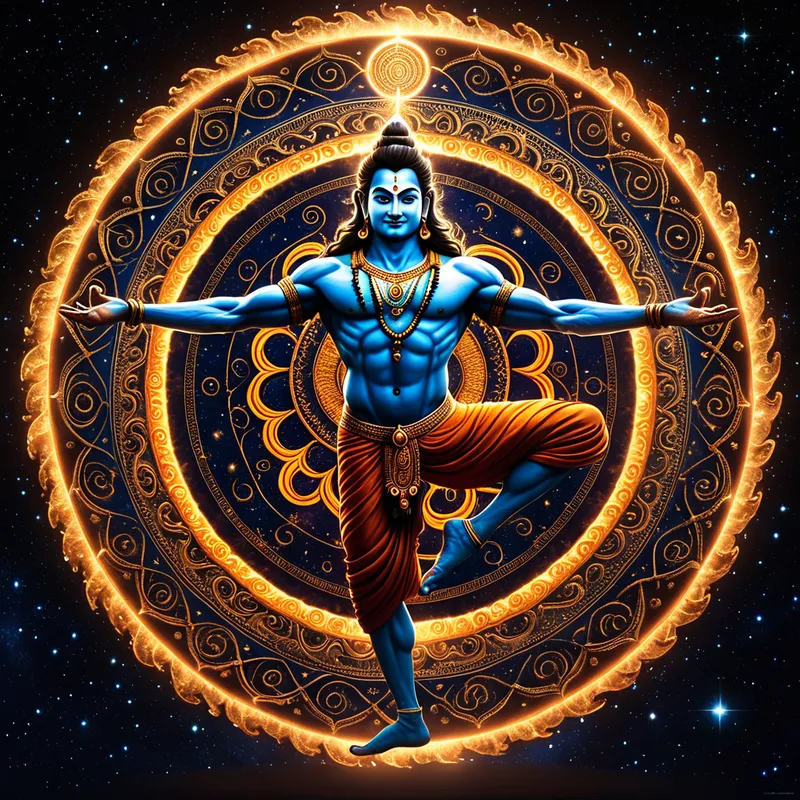
Shiva Nataraja Myth Meaning & Symbolism
The story of Shiva's cosmic dance of destruction and creation, performed to subdue ignorance and restore the rhythm of the universe.
The Tale of Shiva Nataraja
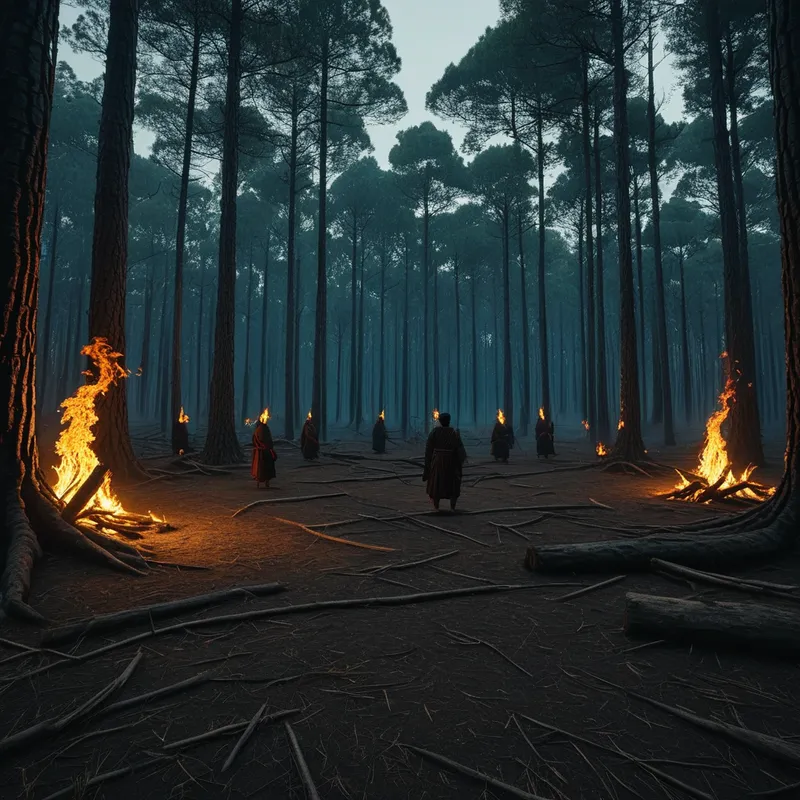
Listen, and let the story unfold in the deep, whispering heart of the Pine Forest of Taragam. Here, ten thousand sages, the Rishis of old, had gathered. Their power was immense, born of lifetimes of fierce penance and rigid ritual. But a shadow had grown in their hearts—[the shadow](/myths/the-shadow “Myth from Jungian culture.”/) of pride. Convinced their austerities granted them dominion over the cosmos itself, they began to believe they could compel the gods. To test their might, they kindled a colossal sacrificial fire, its flames licking the night sky, and through the potency of their mantras, they began to conjure.
First, from the roaring pyre, emerged a savage tiger, its stripes like burning coals, fangs bared to rend [the world](/myths/the-world “Myth from Tarot culture.”/). The sages, with a unified thought, hurled the beast towards the one being whose serene presence unsettled their certainty: a lone, ash-smeared ascetic seated beneath a tree. [The ascetic](/myths/the-ascetic “Myth from Christian culture.”/) did not flinch. With a tender, almost casual grace, he peeled the skin from the tiger and draped it around his loins like a silken cloth. A murmur of disbelief ran through the assembly.
Undeterred, [the Rishis](/myths/the-rishis “Myth from Hindu culture.”/) chanted deeper, and the fire convulsed. From its heart sprang a monstrous serpent, its hood spread wide, venom dripping like dark stars. They sent it hissing toward the ascetic. He caught it mid-strike, and with a dancer’s fluidity, coiled it around his neck as a sacred ornament. The forest air grew heavy with dread and fury.
Then came their most potent creation. From the agony of their offended pride, they manifested Apasmara [Purusha](/myths/purusha “Myth from Hindu culture.”/), the demon of forgetfulness and ignorance. A twisted, dwarf-like creature, bloated with the weight of illusion, it stumbled forth. Its very presence made knowledge slip from the mind and chaos stir in the heart. The sages commanded it to crush the silent ascetic.
It was then that the ascetic smiled. And in that smile, the universe held its breath. He rose. And as he rose, the ground itself became a stage, the canopy of stars a theater. He began to dance.
This was no mortal movement. This was the Ananda Tandava, the dance of blissful fury. His hair, usually matted, flew wide, catching the [Ganga](/myths/ganga “Myth from Hindu culture.”/) and the crescent moon in its whirl. One hand held the damaru, whose rhythm pulsed as the seed-sound of all existence. Another hand held Agni, the cleansing flame. A third hand gestured <abbr title=“A hand gesture meaning “fear not,” offering protection and peace”>Abhaya Mudra, a promise of sanctuary. The fourth pointed to his lifted foot, the path of liberation.
And his right foot, in a movement of terrible, final grace, descended upon the back of the dwarf Apasmara, pinning it to [the earth](/myths/the-earth “Myth from Hindu culture.”/)—not to destroy it, but to subdue it, to make it the foundation of his dance. The sages fell to their knees, their arrogance shattered, seeing at last the truth in the whirlwind: the ascetic was <abbr title=“A name for Shiva, meaning “The Auspicious One”>Shiva, and this was his true nature. He was Nataraja, the King of Dancers, and his performance was the eternal cycle of the cosmos itself—creation, preservation, destruction, veiling, and grace—all held in one perfect, spinning moment of balance.
Cultural Origins & Context
The iconic form of [Shiva](/myths/shiva “Myth from Hindu culture.”/) [Nataraja](/myths/nataraja “Myth from Hindu culture.”/) crystallized in the sacred soil of Tamil Nadu in Southern India, reaching its zenith during the Chola dynasty (9th-13th centuries CE). While the core narrative of subduing the sages of Taragam is found in ancient texts like the [Shiva](/myths/shiva “Myth from Hindu culture.”/) Purana, its most enduring transmission was not merely textual. It was sculptural, devotional, and philosophical.
The myth was carried in the hearts of the Nayanars, whose hymns overflow with visions of the dancing lord. It was then cast in timeless bronze by Chola artisans, creating the singular Nataraja [murti](/myths/murti “Myth from Hindu culture.”/) that would become a global symbol of Hindu thought. This was not just art for art’s sake; it was theology in metal. The statue served as a focal point for worship in temples, a visual catechism that taught complex metaphysics through sublime form. Its societal function was to model a worldview where chaos and order, destruction and creation, are not opposites but interdependent pulses of one divine reality. It offered a way to visualize the unimaginable activity of the divine and to find one’s place within that cosmic rhythm.
Symbolic Architecture
The Nataraja is a complete metaphysical diagram. Every element is a profound [symbol](/symbols/symbol “Symbol: A symbol can represent an idea, concept, or belief, serving as a powerful tool for communication and understanding.”/) in a dynamic [equilibrium](/symbols/equilibrium “Symbol: A state of balance, stability, or harmony between opposing forces, often representing inner peace or external order.”/).
The circle of flames (prabhamandala) is the [boundary](/symbols/boundary “Symbol: A conceptual or physical limit defining separation, protection, or identity between entities, spaces, or states of being.”/) of phenomenal [reality](/symbols/reality “Symbol: Reality signifies the state of existence and perception, often reflecting one’s understanding of truth and life experiences.”/), the [whirl](/symbols/whirl “Symbol: A rapid, circular motion representing transition, chaos, or being swept up in forces beyond one’s control.”/) of [space-time](/symbols/space-time “Symbol: A philosophical concept representing the fabric of reality where space and time are interwoven dimensions, often symbolizing life’s structure and possibilities.”/) and causality within which all [life](/symbols/life “Symbol: The symbol of ‘Life’ represents a journey of growth, interconnectedness, and existential meaning, encompassing both the joys and challenges that define human experience.”/) exists. Shiva dances within it, yet transcends it. The damaru in his upper right hand is the [pulse](/symbols/pulse “Symbol: Represents life force, vitality, and the rhythm of existence. It symbolizes connection to one’s own body and the passage of time.”/) of Aum, the [vibration](/symbols/vibration “Symbol: A rhythmic oscillation or resonance, often representing energy, connection, or unseen forces. In dreams, it can signal awakening, disturbance, or spiritual communication.”/) that structures matter and [consciousness](/symbols/consciousness “Symbol: Consciousness represents the state of awareness and perception, encompassing thoughts, feelings, and experiences.”/). The flame (Agni) in his upper [left hand](/symbols/left-hand “Symbol: The left hand typically symbolizes intuition, the unconscious mind, and values associated with femininity and receptiveness in dreams.”/) is the necessary force of [dissolution](/symbols/dissolution “Symbol: The process of breaking down, dispersing, or losing form, often representing transformation, release, or the end of a state of being.”/), burning away the old to make [space](/symbols/space “Symbol: Dreaming of ‘Space’ often symbolizes the vastness of potential, personal freedom, or feelings of isolation and exploration in one’s life.”/) for the new.
The dance is the universe. The dancer is the consciousness that animates it. We are the danced-upon ground and the watching sages, simultaneously.
The lower right hand offers the <abbr title=“A hand gesture meaning “fear not,” offering protection and peace”>Abhaya [Mudra](/symbols/mudra “Symbol: A symbolic hand gesture used in Hindu and Buddhist traditions to channel spiritual energy, express teachings, and focus meditation.”/), a [gesture](/symbols/gesture “Symbol: A non-verbal bodily movement conveying meaning, emotion, or intention, often symbolic in communication and artistic expression.”/) of “fear not,” assuring that within the terrifying destruction is ultimate sanctuary. The lower left hand, pointing to the raised foot, indicates the [path](/symbols/path “Symbol: The ‘path’ symbolizes a journey, choices, and the direction one’s life is taking, often representing individual growth and exploration.”/) of release from the cycle. The [dwarf](/symbols/dwarf “Symbol: A dwarf often represents hidden potential, undervalued wisdom, or primal instincts. It can symbolize something small but powerful or foundational aspects of the self.”/) Apasmara underfoot is the critical pivot. He is not slain, but subdued. He represents the inertia of ignorance, [the ego](/myths/the-ego “Myth from Jungian culture.”/)‘s [blindness](/symbols/blindness “Symbol: Represents a lack of awareness, insight, or refusal to see truth, often tied to emotional avoidance or spiritual ignorance.”/), and the passive [weight](/symbols/weight “Symbol: Weight symbolizes burdens, responsibilities, and emotional loads one carries in life.”/) of unconscious habit. By crushing it, Shiva makes it the stable base for his dynamic [activity](/symbols/activity “Symbol: Activity in dreams often represents the dynamic aspects of life and can indicate movement, progress, and engagement with personal or societal responsibilities.”/). This teaches that transcendence is not an escape from darkness, but a mastery that uses it as a [foundation](/symbols/foundation “Symbol: A foundation symbolizes the underlying support systems, values, and beliefs that shape one’s life, serving as the bedrock for growth and development.”/). The serene, meditative face of Shiva at the center of the whirling limbs is the eternal witness, the unmoved center of [the self](/myths/the-self “Myth from Jungian culture.”/) amidst the [chaos](/symbols/chaos “Symbol: In Arts & Music, chaos represents raw creative potential, uncontrolled expression, and the breakdown of order to forge new artistic forms.”/) of life.
The Dreamer’s Resonance
When this myth stirs in the modern unconscious, it often manifests in dreams of profound, chaotic motion. One may dream of being in a whirling storm, a spinning room, or a chaotic dance where the body feels both out of control and strangely precise. There may be a terrifying figure of inertia—a suffocating weight, a paralyzing presence, or a mocking dwarf-like shape—that must be confronted.
Somatically, this can correlate with feelings of vertigo, sudden energy surges, or a powerful urge for physical movement or release. Psychologically, the dreamer is at a point where long-held structures of identity, belief, or life-pattern (the “penance” of the old sages) have become rigid and prideful, generating internal monsters of anxiety, obsession, or rage (the tiger, serpent, and dwarf). The [psyche](/myths/psyche “Myth from Greek culture.”/) is initiating its own Ananda Tandava—a violent, necessary reorganization. The dream is not a call to calm the storm, but to find the still point within it, to become the dancer of one’s own disintegration and re-creation. The demon underfoot is the dreamer’s own cherished ignorance, which must be acknowledged and pinned down to become the foundation for a new way of being.
Alchemical Translation
The alchemy of Nataraja is a map for individuation. It models the psychic transmutation required to move from a ego-bound state (the arrogant sages) to a Self-aware state (the serene dancer).
[The first stage](/myths/the-first-stage “Myth from Alchemical culture.”/) is Confrontation with the Shadow. The sages within us, our disciplined personas, eventually generate their own opposites—the fierce, untamed emotions (the tiger), the poisonous deceptions (the serpent), and the dense, stupid weight of the unexamined life (the dwarf). We cannot reason with these forces; they must be met and integrated. The tiger’s ferocity becomes strength (the loincloth), the serpent’s cunning becomes wisdom (the necklace).
The flame in the dancer’s hand does not only destroy; it illuminates what must be released. The drum’s beat is not just noise; it is the rhythm of your own becoming.
The core operation is Treading on the Dwarf. This is the most difficult alchemical act: not to annihilate one’s flaws, but to subdue them and place them underfoot. One’s laziness, fear, or narcissism is not eliminated; it is pressed into service as the very ground that provides traction for growth. Without this weight, the dance would have no purchase, no tension, and no meaning. The final stage is Holding the Center. As the limbs of life—work, relationship, passion, loss—fly in all directions, the goal is to cultivate the serene face of Shiva: the witnessing consciousness that observes the dance without being shattered by it. The raised foot signifies the potential for transcendence, while the planted foot affirms grounded embodiment. This is the ultimate psychic transmutation: to become [the crucible](/myths/the-crucible “Myth from Alchemical culture.”/) where chaos and order, destruction and creation, are held in a dynamic, blissful balance. You are not the victim of the cycle; you are the dancer at its heart.
Associated Symbols
Explore related symbols from the CaleaDream lexicon:
- Activity
- Beat
- Juggling Balls
- Cosmic Dance
- Hypernova Explosion
- Caesium Flow
- Futuristic Drum Pad
- Ballet Slippers
- Quantum Artistry
- Pop Art Collage
- Samplers
- Entropy
- Quantum Entropy
- Quantum Spin
- Fourier Transform
- Space-time
- Recursion
- Verb
- Metanalysis
- Iconic
- Quantification
- Physics
- Montage
- Climax
- Mudra
- Transformer
- Magnetar