Shiva Myth Meaning & Symbolism
The story of the ascetic god whose dance of cosmic dissolution makes way for new creation, embodying the terrifying and liberating power of radical transformation.
The Tale of Shiva
In the beginning, before time was measured, there was only the sound—a deep, resonant Aum that vibrated in the infinite dark. From this sound emerged the great ocean of possibility, and upon its surface, the gods and demons danced their eternal quarrel. But this is not their story. This is the story of the one who watches, the one who is not part of the dance, but is the dance itself.
He dwells where the world ends, in the high, cold silence of Mount Kailash. His skin is gray with the ashes of burned-out universes, his hair a wild, matted river where the Ganga descends from heaven. He wears a necklace of skulls and a crescent moon, serpents for bracelets, and tigerskin for a loincloth. He is the great ascetic, Shiva, lost in a meditation so deep that all of creation is but a fleeting thought in his mind.
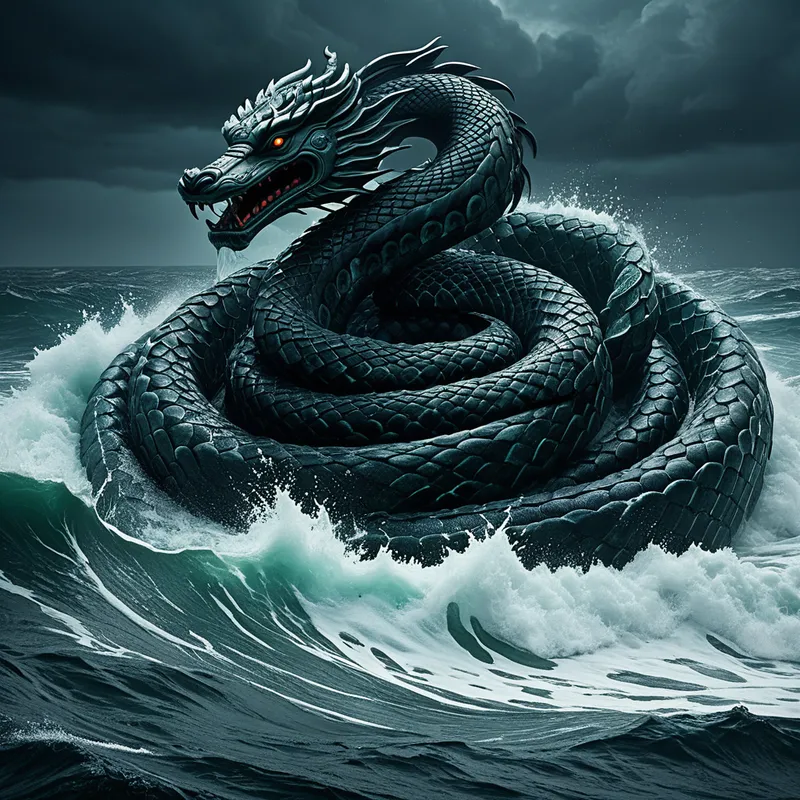
But the worlds below fell into peril. The gods and demons, in their greed, had churned the cosmic ocean for the nectar of immortality. From the depths, they pulled forth wonders and treasures, but also a seething, virulent poison—Halahala—a darkness so absolute it threatened to unmake life itself. The poison spread, a choking, burning shadow. The heavens grew sick. The earth trembled. The gods, mighty as they were, could not bear it. Their brilliance faded. In despair, they turned their eyes to the frozen peak.
They went to him, their songs of praise trembling in the thin air. “Lord,” they pleaded, “only you can contain this terror. The universe is dying.” There was no answer. Only the howl of the wind through his matted locks. They prostrated themselves, their divine forms dimming. And then, slowly, the meditator stirred. The one who had renounced all action opened his eyes. Not with anger, nor with pity, but with a calm so vast it was more terrifying than the poison.
He inclined his head. He stretched out his hand. And the demons and gods poured forth the roiling, black essence of destruction into his cupped palm. He did not flinch. He brought it to his lips and drank. He drank it all. The universe held its breath. The poison, which would annihilate any other being, began to course through his throat. But he did not allow it to descend. With a supreme act of will, he held it there, in his throat, transmuting its lethal nature. His neck turned a permanent, fierce blue. He became Neelakantha. The poison was neutralized, held in check by his boundless consciousness. The world was saved not by fighting the darkness, but by swallowing it whole.
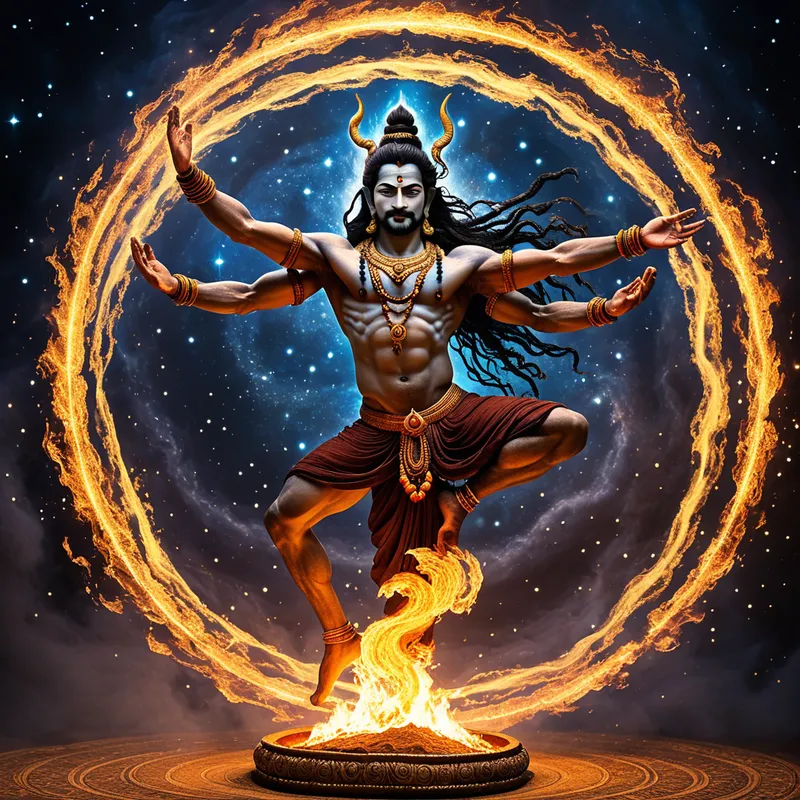
And then, in a timeless moment, he rose. In the hall of the gods at Chidambaram, he began to dance. This was the Tandava. His dance was not of joy or sorrow, but of pure, cosmic energy. With one hand he beat the drum of creation (damaru), its rhythm birthing new cycles of time. With another, he held the flame of dissolution. One hand gestured “fear not,” while another pointed to his raised foot, the path of liberation. He danced within a circle of flames, his hair flying wildly, his face serene. He danced until the old, weary cosmos dissolved into ash. And from that ash, from the silent space between his drumbeats, the new world would whisper itself into being once more.
Cultural Origins & Context
The stories of Shiva are not the product of a single author or era, but a vast, living tapestry woven over millennia. They emerge from the ancient Vedic traditions, where a god named Rudra, “the Howler,” embodied the terrifying, untamed aspects of nature. Over centuries, through the epics like the Mahabharata and the Puranas, this fierce outsider deity was synthesized with ascetic, yogic ideals and philosophical concepts of absolute reality (Brahman).
These myths were passed down orally by sages (rishis) and later by temple storytellers and performers. They functioned as more than entertainment; they were cosmological maps and psychological manuals. In a culture that perceives time as cyclical, Shiva’s role as the destroyer was not one of evil, but of necessary transformation. His myths provided a framework for understanding death, decay, and the dissolution of the ego as prerequisites for renewal. He was the god of the margins—dwelling in cremation grounds, associated with outcasts and ascetics—thus sanctifying what conventional society feared and rejected, and offering a path to liberation that bypassed social and ritual norms.
Symbolic Architecture
Shiva is the archetype of the Self that exists prior to and beyond all opposites. He is not merely a destroyer; he is the space in which creation and destruction occur. His symbols are a lexicon of profound paradoxes.
The ash smeared on his body is not a sign of death, but a reminder that all form—wealth, beauty, identity—is ultimately reducible to the same base element. It is the ultimate democratizer, the great equalizer.
The serpent around his neck represents conquered fear and the awakened, coiled spiritual energy (kundalini). The crescent moon, balancing in his hair, signifies mastery over time and the mind. The river Ganga flowing from his hair shows his capacity to bear the tremendous force of divine consciousness and channel it gently to the world. The third eye is the eye of wisdom that sees through illusion (maya); its gaze incinerates desire and falsehood.
Most pivotal is his consumption of the poison. This is the symbolic core of the mystic’s path: the voluntary confrontation with and integration of one’s own toxicity—the repressed shadows, the traumas, the venomous thoughts. Shiva does not expel it; he contains it, transforms it through conscious holding, and in doing so, turns it into a source of his power (the blue throat). The poison becomes part of the medicine.
The Dreamer’s Resonance
When the archetype of Shiva stirs in the modern dreamer’s psyche, it often heralds a profound, non-negotiable call for inner revolution. This is not the hero’s journey to conquer an external foe, but the ascetic’s path of radical inner dissolution.
To dream of a meditating figure in a desolate, high place may signal a deep psychological withdrawal. The conscious ego is being asked to step back, to cease its frantic doing, so that a more profound level of the psyche can reorganize. It can feel like depression, but in the symbolic sense, it is a necessary “entering the cave.”
Dreams of swallowing something dark, toxic, or terrifying directly mirror the Halahala myth. The dreamer is in a process of integrating a shadow element so potent that their previous identity cannot withstand it. Somatic sensations might include constriction in the throat, a feeling of being poisoned, or conversely, a sudden, cool clarity after a period of emotional turmoil. The dance of Shiva appearing in a dream—a figure whirling in chaotic, yet perfectly ordered, movement—often manifests during life transitions where everything feels like it is falling apart. The psyche is illustrating that this disintegration is not a mistake, but a sacred, if terrifying, dance of deconstruction preceding renewal.
Alchemical Translation
The myth of Shiva provides a stark, beautiful model for the alchemical process of individuation. His path is the via negativa—the way of negation.
The first step is Asceticism (Nigredo): the voluntary withdrawal from the identifications of the persona—the social masks, the material attachments, the compulsive desires. This is the application of the ash. One must become comfortable in the “cremation ground” of one’s outworn selves.
The second, critical phase is The Swallowing of the Poison (Albedo). This is the confrontation with the shadow. Modern life encourages projection—blaming external forces for our inner toxins. Shiva’s act models the ultimate responsibility: to take the poison in, to consciously contain the rage, grief, envy, or fear without being destroyed by it or acting it out. This is the “throat chakra” work of conscious expression and containment. The blue throat is the symbol of a consciousness that has been tempered and transformed by its encounter with its own darkness.
Finally, there is The Dance (Rubedo). This is the redeemed state. Having dissolved the old ego (asceticism) and integrated the shadow (poison), the individual no longer has a dance; they are the dance. Action arises not from compulsive desire or fear, but from a centered, spontaneous expression of the whole self. The liberated individual can engage fully with the world—creating, preserving, and destroying patterns in their life—all while anchored in the inner serenity of the meditator. They become the silent witness and the dynamic actor simultaneously, capable of transforming personal and collective poison into the raw material for a more conscious life.
Associated Symbols
Explore related symbols from the CaleaDream lexicon: