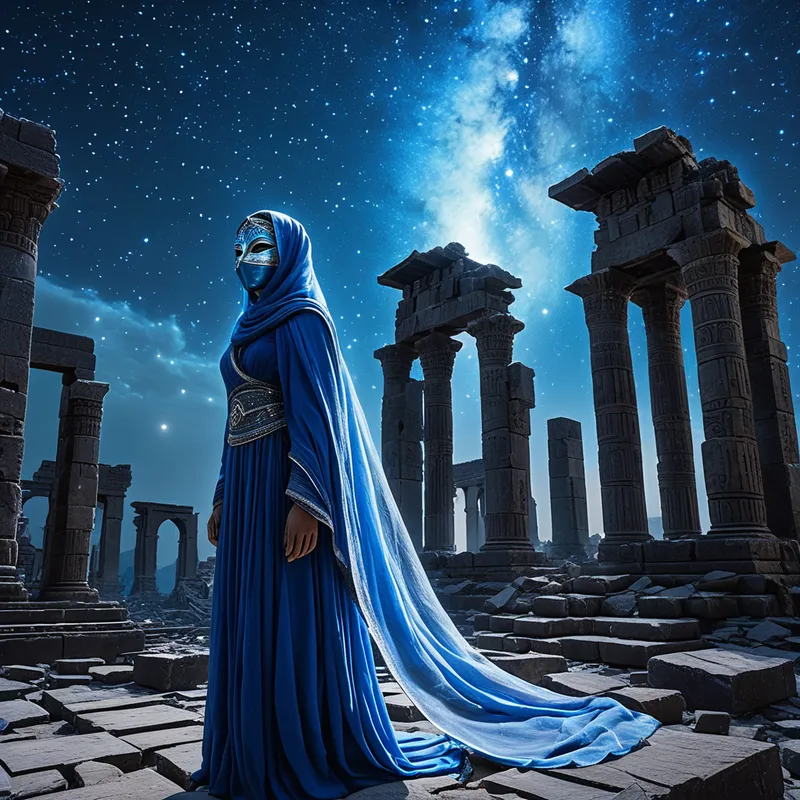
Shechinah in Exile Myth Meaning & Symbolism
The story of the divine presence, the Shechinah, cast into the world with her people, embodying the sacred wound of separation and the promise of return.
The Tale of Shechinah in Exile
Listen. Before time was counted in years, there was a Presence. Not a distant king on a throne of clouds, but an intimate, breathing nearness. She was the Shechinah, the dwelling. Her light was the warmth in the sanctuary, the whisper between the cherubim, the collective sigh of a people at peace within their land. She was the Sabbath bride, and the world was whole.
But the world cracked. A great tearing, a shattering of vessels too fragile to hold the fierce light of unity. Pride rose like a tower, and compassion fell like a discarded stone. The people turned their hearts to hollow idols, and the land itself grew sick with their forgetting. The bond, that gossamer thread of mutual faithfulness, frayed and snapped.
Then came the iron chariots, the smoke, the screams that choked the air. The Temple—that nexus where heaven leaned down to kiss earth—was thrown down. Stone by carved stone, it was dismantled. The holy vessels were plundered. And the people, the children of the covenant, were driven out, a river of grief flowing into the barren wastes of Babylon and beyond.
And She… She did not stay behind in the ruins of the holy of holies. As the first mother wept, clutching her child, the Shechinah wrapped her presence around her. As the elder’s feet stumbled on the foreign road, her unseen hand was beneath his elbow. When they sat by the rivers of a strange land and hung their harps on the willow branches, too heartsick to sing, her tears mingled with the waters.
She went into exile with them. The Queen of Heaven became a wanderer, a refugee. Her radiance was cloaked in the grey wool of diaspora. Her throne was a rock by the roadside; her palace, the four walls of a study house in a hostile kingdom. She dwelled not in gold and cedar, but in the shattered hearts of her people. The cosmic marriage was severed; Bride and Groom were parted by the cruel blade of history. The world was left orphaned, and the divine presence walked the earth, veiled in sorrow, waiting, always waiting, for the footsteps of return.
Cultural Origins & Context
This is not a myth with a single author or a definitive text. It is a story that grew in the dark, fertile soil of catastrophe. Its roots are in the biblical prophecies of destruction and the haunting imagery of Lamentations. But its full, personified flowering emerged in the rabbinic imagination of the Talmud and, most profoundly, in the esoteric world of Kabbalah, particularly the Zohar.
Following the trauma of the Second Temple’s destruction (70 CE), the rabbis grappled with theodicy—how could a benevolent God allow this? The answer was not a distant, punishing deity, but a God who suffers with the people. The Shechinah, as the immanent aspect of the divine, became the vehicle for this profound theological empathy. She was the divine counterpart to Israel’s fate. In the Zohar, this idea becomes the central drama of the cosmos: the exile of the Shechinah (Malkhut, the Kingdom) from her divine consort, Tiferet (Beauty). This myth provided a mystical framework for understanding ongoing historical suffering, not as abandonment, but as a shared, sacred grief that even encompasses the divine. It was a story told in study halls and whispered in prayers, a collective soul-story that made the unbearable meaningful.
Symbolic Architecture
At its core, the myth of the exiled Shechinah is a map of a fundamental psychic and cosmic rupture: the separation of the transcendent from the immanent, the masculine principle of structure and law from the feminine principle of presence and compassion.
The most profound wound is not that we are cast out of paradise, but that paradise goes into exile with us.
The Shechinah symbolizes the soul of the world, the anima mundi. Her exile represents the felt experience of a disenchanted universe, where the sacred is hidden, diffuse, and clothed in the ordinary and the painful. She is the connection to the numinous that we carry within, even in our most fragmented states. The Exile is not merely geographical; it is the internal condition of alienation, of feeling separated from our own source, our own center, and from meaningful connection with others and the cosmos.
Psychologically, she represents the repressed or wounded feminine aspect—not gender, but the archetypal energies of relatedness, intuition, embodiment, and nurturing containment. When this is exiled, the psyche is dominated by a harsh, disconnected rationality or a rigid, unfeeling order—a kingdom without a queen.

The Dreamer’s Resonance
When this myth stirs in the modern unconscious, it manifests as dreams of profound, existential loneliness within connection. You may dream of a magnificent, sorrowful woman in your childhood home, which is now a crumbling, public space. You may find yourself endlessly searching a vast, bureaucratic city for a lost child or a forgotten name, accompanied by a deep, somatic ache of homesickness for a place you’ve never known.
This is the psyche’s signal of a sacred dislocation. The dreamer is experiencing a rift between their spiritual or emotional essence (the Shechinah) and the structures of their daily life (the Temple). It often surfaces during life transitions, grief, or periods of burnout—when the soul feels homeless in its own biography. The somatic feeling is one of weight, a gentle but persistent melancholy, a sense of carrying something precious and wounded that no one else can see. The dream is not a pathology, but a testimony: it confirms the reality of the inner exile and, by acknowledging it, begins the work of calling the presence home.
Alchemical Translation
The individuation process modeled here is the repatriation of the sacred interior. The myth does not promise an easy return to a pristine, pre-exilic state. The Temple is destroyed. The alchemy happens in the wilderness itself.
The work is not to rebuild the old temple, but to discover that every act of kindness, every moment of true presence, is a stone in the sanctuary where the Shechinah can dwell.
The first step is recognition: seeing the exile in oneself—the places where we feel disconnected, where our inner life is neglected for outer demands. The second is companionship: like the Shechinah accompanying her people, we must learn to accompany our own wounded, exiled parts with compassion, not judgment. We sit by our own rivers of Babylon and acknowledge the grief.
The final, ongoing alchemy is sanctification of the ordinary. In Kabbalah, the ultimate redemption (tikkun olam, repair of the world) is effected through ethical acts and mindful intention. Psychologically, this translates to imbuing daily life with sacred presence. Listening deeply becomes a prayer. Creating beauty becomes a restoration. Holding space for another’s pain becomes an act of reuniting the divine fragments. By doing so, we become the agents of the Shechinah’s return. We stop looking for the divine presence out there in some perfect, lost heaven, and begin to midwife its indwelling here, in the imperfect, exiled, and glorious now.
Associated Symbols
Explore related symbols from the CaleaDream lexicon:
- Temple — The symbol of wholeness, order, and the contained sacred space; its destruction initiates the exile, representing the shattered center of the self or community.
- Exile — The core condition of displacement and alienation, representing the soul’s separation from its source and the felt experience of a fragmented world.
- Mother — The Shechinah as the divine mother who refuses to abandon her children, embodying unconditional presence and the nurturing aspect of the sacred that suffers with us.
- Wound — The sacred wound of separation that affects both the divine and the human, the necessary rupture that deepens consciousness and creates the longing for healing.
- Journey — The endless road of diaspora, representing the soul’s path through suffering, learning, and the slow, often painful, movement toward integration.
- Bridge — The longed-for connection between the exiled earthly realm and the divine, and the inner work required to rebuild the connection between the fragmented parts of the self.
- Light — The concealed radiance of the Shechinah, the divine spark hidden within the shell of exile and within every individual, awaiting revelation.
- Home — The ultimate object of longing, not merely a physical place but a state of psychic and spiritual integration where the presence can fully dwell.
- Dove — A classic symbol for the Shechinah, representing the spirit of God hovering over the chaos, a presence of peace and mourning in the midst of desolation.
- Veil — The garment of the Shechinah in exile, representing how the divine presence is hidden, obscured by grief, history, and the ordinary material world.
- Return — The dynamic, redemptive movement of teshuvah, not just a physical going-back, but a turning-toward, the healing of the rupture through conscious action and intention.