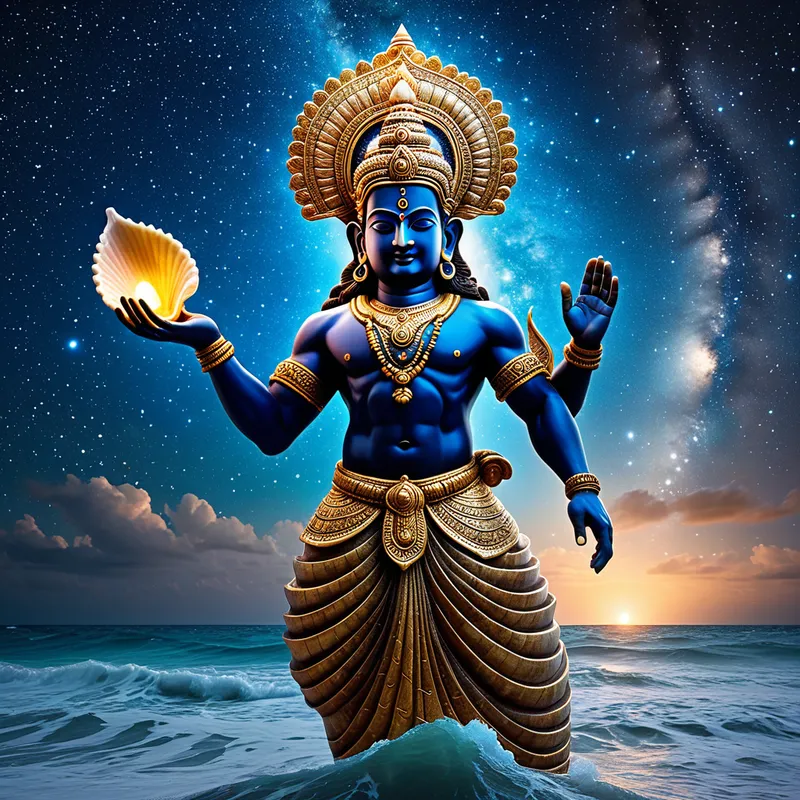
Shankha Myth Meaning & Symbolism
The divine conch, born from the churning ocean, is a weapon of cosmic sound that shatters illusion and heralds the restoration of sacred order.
The Tale of Shankha
Listen. Before the worlds were set in their rhythms, there was a stillness—a deep, primordial silence that was not peace, but potential. The gods, the Devas, were weary. Their radiance was dimmed by [the shadow](/myths/the-shadow “Myth from Jungian culture.”/) of a demon, a being of chaos and forgetfulness named Shankhasura. He had stolen the sacred Vedas, the very breath of cosmic order, and plunged them into the abyssal depths of the cosmic ocean. Law crumbled. Memory faded. The axis of [the world](/myths/the-world “Myth from Tarot culture.”/) wobbled.
In their despair, the Devas went to the preserver, [Vishnu](/myths/vishnu “Myth from Hindu culture.”/), who rests upon the coils of the endless serpent [Shesha](/myths/shesha “Myth from Hindu culture.”/). [Vishnu](/myths/vishnu “Myth from Hindu culture.”/), whose eyes are [lotus](/myths/lotus “Myth from Hindu culture.”/) petals and whose skin is the color of a rain-charged sky, spoke with a voice that vibrated in the marrow of existence. “The ocean must be churned,” he said. “For within its milky depths lie not only your lost scriptures but the nectar of immortality itself. But you cannot do this alone. You must enlist your opposites, the Asuras. Use their strength, but guard your hearts.”
And so began the great churning, [Samudra Manthan](/myths/samudra-manthan “Myth from Hindu culture.”/). They uprooted the mountain Mandara and set it upon the back of the world-turtle, [Kurma](/myths/kurma “Myth from Hindu culture.”/), an avatar of Vishnu himself. They wrapped the king of serpents, Vasuki, around the mountain. The Devas took the tail end. The Asuras, suspecting poison, took the head. And they pulled. Back and forth, in a cosmic tug-of-war that groaned through the foundations of reality.
The ocean frothed and fumed. From its agony, wonders and terrors were born. A deadly poison, Halahala, that threatened to consume all. [The moon](/myths/the-moon “Myth from Tarot culture.”/), plucked from the waves by [Shiva](/myths/shiva “Myth from Hindu culture.”/). The goddess of fortune, [Lakshmi](/myths/lakshmi “Myth from Hindu culture.”/), rising on a lotus. And then, from the very heart of the tumult, a sound began—a deep, resonant hum that grew into a clear, piercing note. It was not a sound heard by the ear, but felt in the soul. As the waves parted, there it lay: a magnificent, spiraling conch shell, white as the first dawn and luminous as a captured star. It was Shankha.
Vishnu claimed it. When the moment of final conflict came, and Shankhasura rose from the deep, Vishnu did not raise a blade. He raised [the Shankha](/myths/the-shankha “Myth from Hindu culture.”/) to his lips and blew. The sound that issued forth was the Om made manifest, a vibration so pure it had no need for meaning, only being. It was the sound of order reasserting itself. Before that sacred vibration, the demon’s form of chaos could not hold. Shankhasura dissolved, not in defeat, but in reabsorption, and the stolen Vedas were restored. The conch’s call was the first note of a universe remembering its song.

Cultural Origins & Context
The myth of the Shankha is woven into the epic fabric of Indian culture, primarily found in the Puranas, like the Vishnu Purana and the epic Mahabharata. It was not merely a priestly tale but a living symbol disseminated through temple sculpture, ritual practice, and the oral recitations of storytellers and Sutas. Its primary societal function was cosmological and normative. It explained the origin of a central ritual object and, more importantly, it modeled the eternal struggle between Dharma and Adharma. The Shankha’s birth from the cooperative, if fraught, effort of opposites (Deva and Asura) illustrated a profound truth: creation and order often require the engagement with, and transmutation of, chaotic or shadowy forces. It was a myth that sanctified the tools of kingship and priesthood, as the conch became the emblem of divine authority, blown to commence battle, coronation, and worship.
Symbolic Architecture
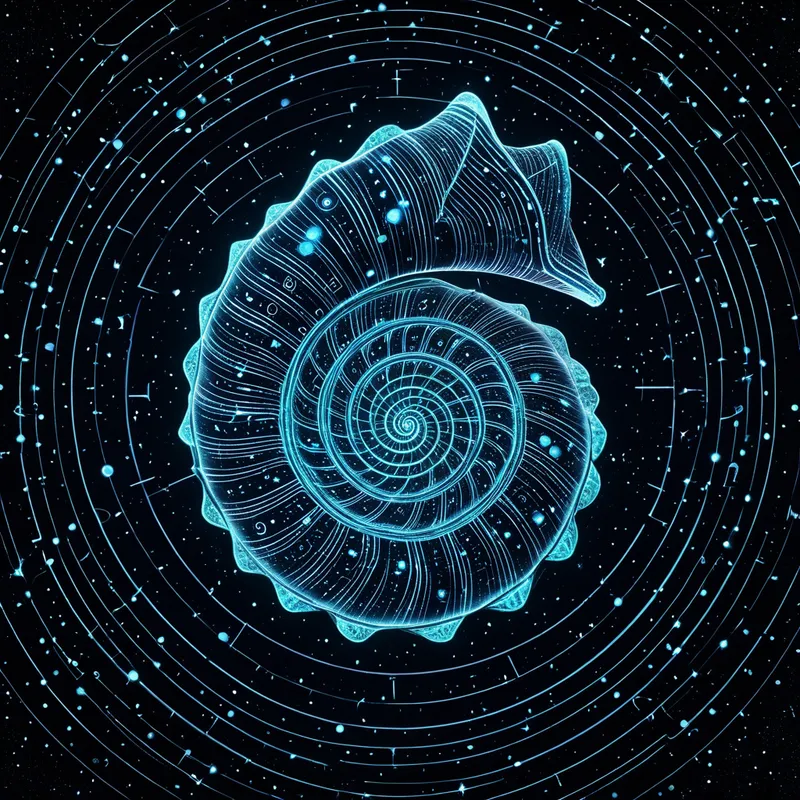
The Shankha is a [universe](/symbols/universe “Symbol: The universe symbolizes vastness, interconnectedness, and the mysteries of existence beyond the individual self.”/) in miniature, a symbolic [architecture](/symbols/architecture “Symbol: Architecture in dreams often signifies structure, stability, and the framing of personal identity or life’s journey.”/) of profound [depth](/symbols/depth “Symbol: Represents profound layers of consciousness, hidden truths, or the unknown aspects of existence, often symbolizing introspection and existential exploration.”/). Its spiral form mirrors the cosmic spiral of galaxies and the [inward](/symbols/inward “Symbol: A journey toward self-awareness, introspection, and the exploration of one’s inner world, thoughts, and unconscious mind.”/) curl of the [human](/symbols/human “Symbol: The symbol of a human represents individuality, complexity of emotions, and social relationships.”/) ear—a bridge between [macrocosm](/symbols/macrocosm “Symbol: The universe as a whole, representing the interconnectedness of all existence and the reflection of the individual within the cosmic order.”/) and [microcosm](/symbols/microcosm “Symbol: A small, self-contained system that mirrors or represents a larger, more complex whole, often reflecting the universe within an individual.”/).
The conch does not create sound; it reveals the sound that already is, giving form to the formless vibration of the cosmos.
First, it is the [Womb](/symbols/womb “Symbol: A symbol of origin, potential, and profound transformation, representing the beginning of life’s journey and the unconscious source of creation.”/) of Sacred Sound. Its hollow [interior](/symbols/interior “Symbol: The interior symbolizes one’s inner self, thoughts, and emotions, often reflecting personal growth, vulnerabilities, and secrets.”/) represents the unmanifest potential, the Brahman, while the audible blast is the manifest world, Maya, emerging from it. The sound Om it produces is considered the seed [syllable](/symbols/syllable “Symbol: A basic unit of sound in language, representing communication, rhythm, and the building blocks of expression.”/) of all creation, the first [differentiation](/symbols/differentiation “Symbol: The process of distinguishing or separating parts of the self, emotions, or identity from a whole, often marking a developmental or psychological milestone.”/) from unity.
Second, it is the Victory Over the Unconscious. Shankhasura, the [demon](/symbols/demon “Symbol: Demons often symbolize inner fears, repressed emotions, or negative aspects of oneself that the dreamer is struggling to confront.”/), represents the chaotic, forgotten, or repressed contents of the [psyche](/myths/psyche “Myth from Greek culture.”/)—the stolen [Vedas](/symbols/vedas “Symbol: Ancient Hindu scriptures representing divine knowledge, cosmic order, and ultimate spiritual truth.”/) (sacred [knowledge](/symbols/knowledge “Symbol: Knowledge symbolizes learning, understanding, and wisdom, embodying the acquisition of information and enlightenment.”/)). The battle is not fought with brute force but with [consciousness](/symbols/consciousness “Symbol: Consciousness represents the state of awareness and perception, encompassing thoughts, feelings, and experiences.”/), symbolized by sound. The Shankha’s call is the act of bringing what is hidden in the [depths](/symbols/depths “Symbol: Represents the subconscious, hidden emotions, or foundational aspects of the self, often linked to primal fears or profound truths.”/) (the oceanic unconscious) into the clear light of [awareness](/symbols/awareness “Symbol: Conscious perception of self, surroundings, or internal states. Often signifies awakening, insight, or heightened sensitivity.”/), thereby dis-arming the chaotic complex (the [demon](/symbols/demon “Symbol: Demons often symbolize inner fears, repressed emotions, or negative aspects of oneself that the dreamer is struggling to confront.”/)).
Third, its Rightward Spiral (the most common, Dakshinavarta) is a sacred map of evolution. It mirrors the [path](/symbols/path “Symbol: The ‘path’ symbolizes a journey, choices, and the direction one’s life is taking, often representing individual growth and exploration.”/) of the sun, the [movement](/symbols/movement “Symbol: Movement symbolizes change, progress, and the dynamics of personal growth, reflecting an individual’s desire or need to transform their circumstances.”/) of time, and the aspirational [journey](/symbols/journey “Symbol: A journey in dreams typically signifies adventure, growth, or a significant life transition.”/) of the [soul](/symbols/soul “Symbol: The soul represents the essence of a person, encompassing their spirit, identity, and connection to the universe.”/) from [outward](/symbols/outward “Symbol: Movement or orientation away from the self or center; expansion, expression, or externalization of inner states into the world.”/) dispersion to inward, enlightened focus. It is a natural [mandala](/symbols/mandala “Symbol: A sacred geometric circle representing wholeness, the cosmos, and the journey toward spiritual integration.”/) for contemplation.
The Dreamer’s Resonance
When the Shankha spirals into modern dreams, it signals a profound somatic and psychological process: the call to order from within chaos. The dreamer may be in a life phase of tumult, confusion, or moral ambiguity—their personal “ocean” is being churned. To dream of finding a conch, or more powerfully, of hearing its sound, is the psyche’s announcement that a clarifying principle is emerging from this turmoil.
Somatically, this can feel like a vibration in the chest or a ringing in the ears—a deep resonance. Psychologically, it is the moment when a confusing conflict suddenly crystallizes into a clear choice (Dharma vs. Adharma). The demon Shankhasura in a modern guise might be an addictive pattern, a toxic relationship, or a career that stifles the soul—something that has “stolen your voice.” The dream of the Shankha is [the Self](/myths/the-self “Myth from Jungian culture.”/)’s assurance that you possess, within the very chaos of your experience, the instrument to reclaim your authentic note and shatter the illusion holding you captive. It is an invitation to stop fighting the shadow with its own weapons and to instead sound the call of your own deeper truth.

Alchemical Translation
The myth of the Shankha is a precise alchemical manual for psychic transmutation, a model of individuation. The process begins with the [Nigredo](/myths/nigredo “Myth from Alchemical culture.”/), the blackening: the recognition of loss and chaos (the stolen Vedas, the rule of Shankhasura). [The ego](/myths/the-ego “Myth from Jungian culture.”/) feels powerless.
Then comes the Operatio, [the great work](/myths/the-great-work “Myth from Alchemical culture.”/): [the churning of the ocean](/myths/the-churning-of-the-ocean “Myth from Hindu culture.”/). This is the often-painful engagement with the unconscious, where we must enlist our own “Asuric” qualities—our rage, our lust, our ambition—not to be ruled by them, but as necessary forces for the work. We partner with our shadow. From this strenuous, honest effort, many psychic contents surface: poisons (old wounds) and treasures (new potentials like Lakshmi, or creativity like the moon).
The alchemical gold is not found by avoiding the mud of the ocean floor, but by churning it until its hidden jewels are revealed.
The emergence of the Shankha is the Albedo, the whitening—the dawn of a unifying symbol from the psyche’s depths. It represents the birth of the transcendent function, a new attitude that can hold opposites. For the modern individual, “blowing the Shankha” is the act of giving voice to this new, integrated understanding. It is speaking your truth after a period of confusion, making a life-altering decision from a place of inner clarity, or simply setting a boundary with a resonant “no.” The sound scatters the remnants of the old, rigid complex (the demon) not through destruction, but through a vibration so authentic it cannot be sustained. The final result is the restoration of inner order, [the Vedas](/myths/the-vedas “Myth from Hindu culture.”/) returned—the sacred knowledge of who you truly are, now heard in your own voice. The Shankha thus becomes the internal instrument by which the individual announces their own sovereignty and participates in the ongoing creation of their world.
Associated Symbols
Explore related symbols from the CaleaDream lexicon: