Shambhala Myth Meaning & Symbolism
A hidden kingdom of enlightened warriors awaits a future age of darkness, guiding humanity's spiritual evolution through prophecy and inner transformation.
The Tale of Shambhala
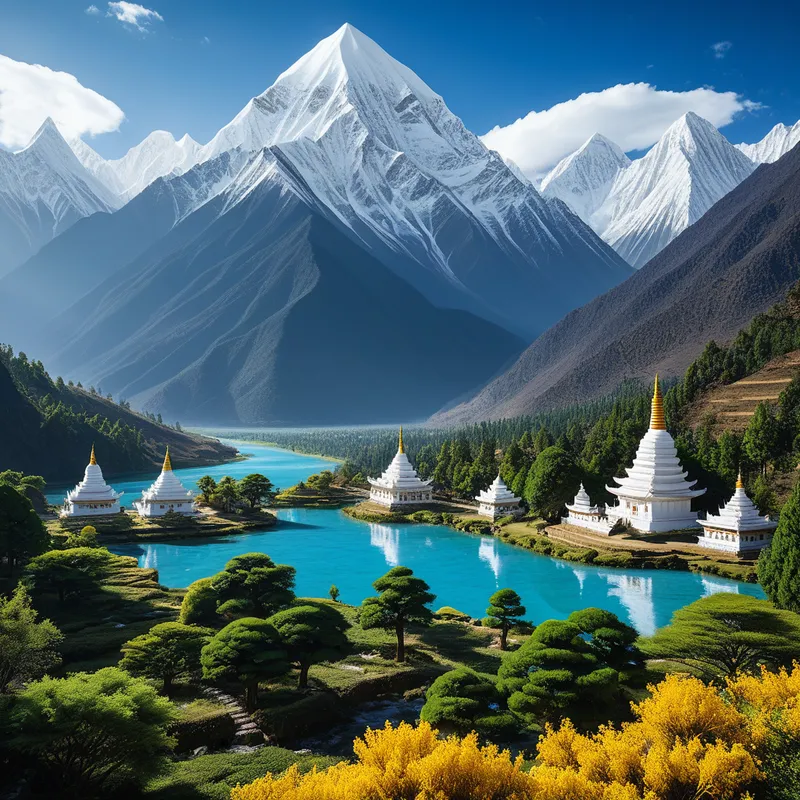
Listen, and let your mind travel beyond the highest peaks, to a place the maps do not know. It is said that in the northern reaches of this world, cradled within a ring of mountains like jagged teeth against the sky, lies a kingdom untouched by time. This is Shambhala.
Its earth is not common soil, but a substance of such purity it nourishes not just crops, but wisdom. Rivers of nectar flow from glacial hearts, watering valleys where trees bear fruit of compassion and flowers bloom with the scent of Dharma. The palaces are not built of stone and mortar, but from the living principles of the Kalachakra teachings. Here, the people are not ruled by a king of flesh, but by a lineage of enlightened monarchs, the Kulikas, whose very presence radiates peace and order. They do not age as we do; their bodies are vessels of luminous clarity.
But this paradise has a destiny written in prophecy, a shadow that falls from the future. An age will come—an age of materialism, strife, and spiritual poverty, when darkness gathers like a storm. It is foretold that a tyrant of great power, fueled by greed and hatred, will arise and seek to dominate the world. The skies will grow heavy with the smoke of conflict.
Then, from the hidden passes of the white mountains, a sound will emerge. Not the clamor of war, but the resonant hum of a million mantras. The King of Shambhala, Rigden, will emerge. He will not lead an army of conscripts, but a host of warriors whose armor is bodhicitta—the awakened heart—and whose weapons are wisdom and compassion. This will not be a war for land or wealth, but a final, definitive battle against the inner poisons that plague all beings: ignorance, aggression, and desire. The conflict will shake the foundations of illusion. And from its resolution, a new golden age will dawn, not just for Shambhala, but for all the world. The teachings will flourish once more, and a cycle of wisdom will begin anew.
Cultural Origins & Context
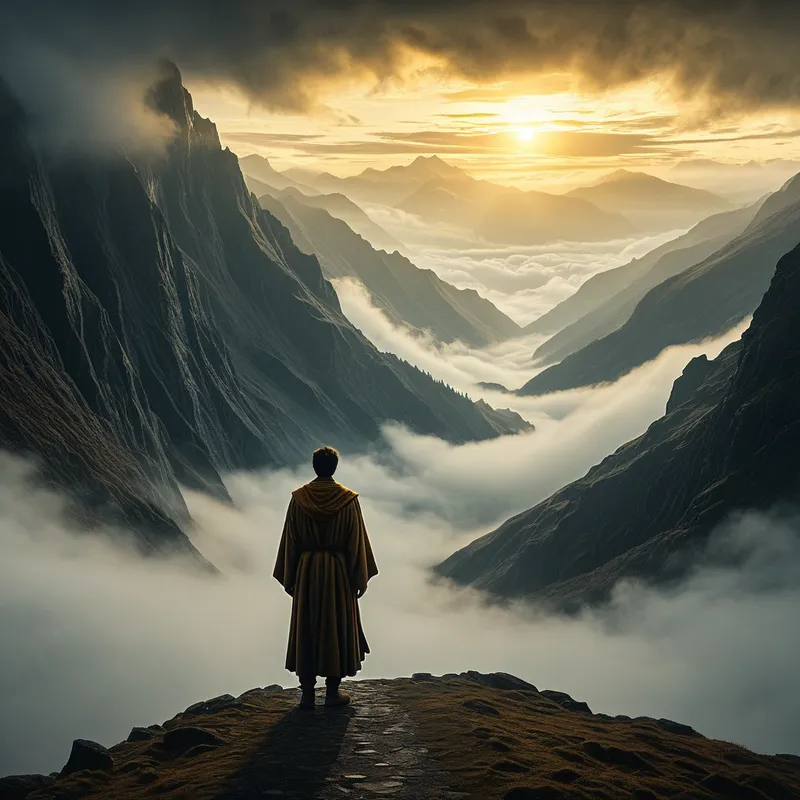
The myth of Shambhala is not a folktale but a core component of Tibetan Buddhist eschatology and tantric practice. Its most detailed scriptural source is the Kalachakra Tantra, a text believed to have been taught by the Buddha himself in southern India and later preserved in the great library-monastery of Nalanda. It entered Tibetan culture in the 11th century and became deeply woven into its spiritual and political fabric.
The myth was transmitted by lamas and scholars, not as mere story, but as a prophetic history and a sophisticated guide for inner development. It functioned as a societal lodestar—a promise that no matter how degenerate the age (Kali Yuga) might become, a pure source of wisdom and power was preserved, awaiting the right time. For centuries, explorers and pilgrims sought its physical location, but the tradition consistently emphasizes that the primary path to Shambhala is an inward one, through the rigorous meditation practices of the Kalachakra system. It is a myth that marries cosmology with psychology, offering a map for both the world’s and the individual’s transformation.
Symbolic Architecture
Shambhala is the ultimate [symbol](/symbols/symbol “Symbol: A symbol can represent an idea, concept, or belief, serving as a powerful tool for communication and understanding.”/) of the enlightened mind, hidden within the rugged [terrain](/symbols/terrain “Symbol: Terrain in dreams often represents the landscape of one’s life, including challenges, opportunities, and feelings about one’s current circumstances.”/) of our own neuroses and [confusion](/symbols/confusion “Symbol: A state of mental uncertainty or disorientation, often reflecting internal conflict, lack of clarity, or overwhelming choices in waking life.”/). The ring of impassable mountains represents the protective barriers of right view and ethical discipline that guard the nascent wisdom within from the corrosive forces of [distraction](/symbols/distraction “Symbol: A state of diverted attention from a primary focus, often representing avoidance, fragmentation, or competing priorities in consciousness.”/) and selfishness.
Shambhala is not a place to be found on a map, but a state of being to be realized: the innate, organized, and potent purity of consciousness, untouched by the chaos of afflictive emotion.
The Kulika Kings represent [the principle](/symbols/the-principle “Symbol: A fundamental truth, law, or doctrine that serves as a foundation for a system of belief, behavior, or reasoning, often representing moral or ethical standards.”/) of enlightened governance—the [aspect](/symbols/aspect “Symbol: A distinct feature, quality, or perspective of something, often representing a partial view of a larger whole.”/) of our own [awareness](/symbols/awareness “Symbol: Conscious perception of self, surroundings, or internal states. Often signifies awakening, insight, or heightened sensitivity.”/) that can wisely administer the “[kingdom](/symbols/kingdom “Symbol: A kingdom symbolizes authority, belonging, and a sense of identity within a larger context or community.”/)” of our psyche, bringing [harmony](/symbols/harmony “Symbol: A state of balance, agreement, and pleasing combination of elements, often associated with musical consonance and visual or social unity.”/) to conflicting thoughts and emotions. The prophesied war, therefore, is not an external [event](/symbols/event “Symbol: An event within dreams often signifies significant life changes, transitions, or emotional milestones.”/) but the internal, alchemical struggle of spiritual practice. The “tyrant” is the ego’s desperate, manipulative control, and Rigden’s army is the marshaling of all our latent qualities of [clarity](/symbols/clarity “Symbol: A state of mental transparency and sharp focus, often representing resolution of confusion or attainment of insight.”/), [compassion](/symbols/compassion “Symbol: A deep feeling of empathy and concern for others’ suffering, often involving a desire to help or alleviate their pain.”/), and skillful means to defeat it. The [kingdom](/symbols/kingdom “Symbol: A kingdom symbolizes authority, belonging, and a sense of identity within a larger context or community.”/)’s inaccessibility symbolizes the profound [truth](/symbols/truth “Symbol: Truth represents authenticity, honesty, and the quest for knowledge beyond mere appearances.”/) that wisdom cannot be given; it must be earned through the arduous, personal [journey](/symbols/journey “Symbol: A journey in dreams typically signifies adventure, growth, or a significant life transition.”/) of transformation.
The Dreamer’s Resonance
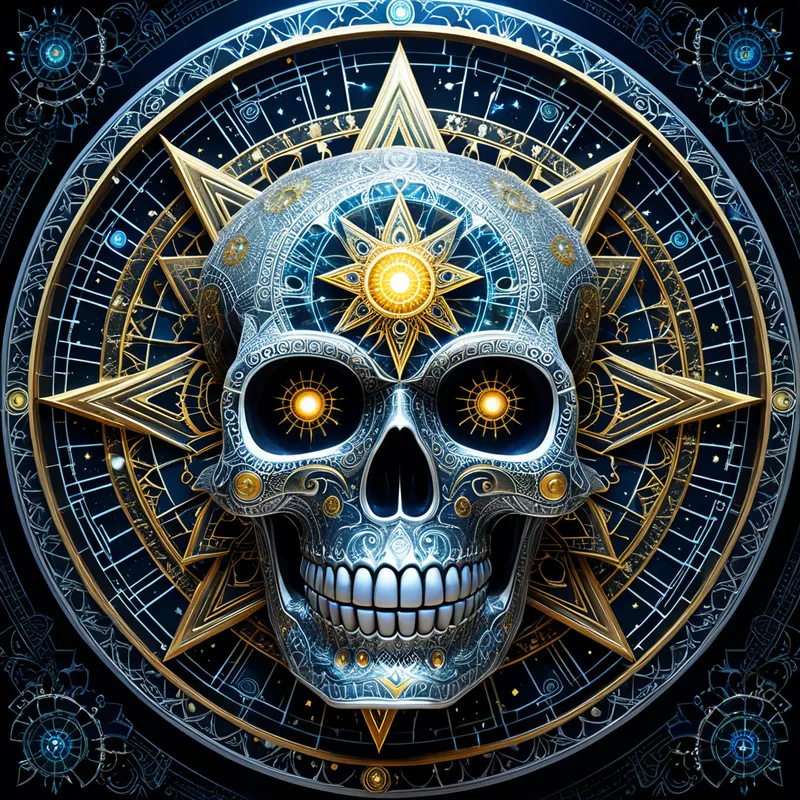
When Shambhala appears in the modern dreamscape, it rarely manifests as a literal valley. Instead, the dreamer may find themselves in a pristine, impossibly ordered library; a sanctuary room hidden behind a forgotten door in their own home; or a lucid, geometric city that operates on principles of perfect harmony. There is often a feeling of profound peace coupled with a sense of urgent purpose.
Somatically, this can correlate with a process of deep nervous system regulation and integration. The psyche is signaling that a core, organized, and healthy structure of the Self exists beneath the layers of anxiety, fragmentation, or life’s chaos. The dream is an experience of the Self archetype—the central, ordering principle of the psyche—making itself known. The conflict arises when the dreamer, having glimpsed this inner Shambhala, must navigate the “mountain passes”—the real-world resistances, old wounds, and habits—that block sustained access to this state. It is a dream of potential wholeness confronting the reality of one’s present fragmentation.

Alchemical Translation
The myth of Shambhala provides a complete model for the Jungian process of individuation—the journey toward psychic wholeness. The initial call is the nagging sense that there is more to life, a hidden order and meaning (the rumors of the kingdom). The first trials are the necessary disciplines—therapy, meditation, ethical refinement—that build the “mountains” of consciousness to protect the developing inner life from being overwhelmed by the personal and collective shadow (the materialistic age).
The long search through treacherous terrain mirrors the often-confusing middle stages of analysis, where old patterns dissolve but new integration is not yet stable. Discovering the kingdom is the profound experience of contacting the Self, the inner Kulika king or queen. But the prophecy is clear: this is not the end.
The final, most critical alchemy is the “war.” It is the conscious, daily application of this realized wholeness to engage with and transform the remaining, unintegrated shadow elements—the personal “tyrants” of fear, rage, and pride—in the field of one’s actual life and relationships.
Victory in this inner war is not annihilation, but the transmutation of base psychic material into the gold of wisdom. The resulting “golden age” is a life lived with increasing authenticity, compassion, and creative potency, where the once-hidden kingdom of the Self becomes the governing reality of one’s existence.
Associated Symbols
Explore related symbols from the CaleaDream lexicon:
- Mountain — The formidable, protective barrier that hides Shambhala, representing the necessary challenges, disciplines, and trials that guard and purify the seeker on the path to wisdom.
- Journey — The central narrative of seeking Shambhala, symbolizing the lifelong spiritual quest, the inward trek through the psyche, and the progression through stages of understanding.
- Order — The essential quality of Shambhala’s society and the Kalachakra mandala, representing the harmonious, enlightened structure of the integrated Self, in contrast to the chaos of the unexamined life.
- King — The embodiment of the Kulika lineage, symbolizing the archetype of the wise ruler within, the Self that governs the psyche with compassion, justice, and enlightened authority.
- Warrior — The enlightened host of Shambhala, representing the active, courageous, and disciplined aspects of consciousness mustered to confront and transform inner darkness and ignorance.
- Light — The luminous quality of Shambhala and its inhabitants, symbolizing the clarity, wisdom, and awakened awareness that dispels the darkness of confusion and spiritual poverty.
- Circle — The shape of Shambhala’s hidden valley and the form of the Kalachakra mandala, representing wholeness, completion, the cycle of time, and the enclosed, perfected nature of the realized mind.
- Key — The esoteric teachings, personal realization, or inner permission needed to unlock the path to Shambhala, symbolizing the crucial insight or turning point that grants access to deeper wisdom.
- Temple — The sacred architecture of Shambhala’s palaces and stupas, representing the inner sanctum of the psyche where the divine or the Self is honored and encountered.
- Mandala — Directly linked to the Kalachakra teachings, symbolizing the cosmic and psychic map of reality, a tool for meditation, and a blueprint for the ordered universe of Shambhala within.
- Buddhist Stupa — The architectural form dotting Shambhala, symbolizing the enlightened mind of the Buddha, a reliquary of sacred truth, and a marker of spiritual territory within the psyche.
- Rebirth — The promised golden age after the prophesied war, symbolizing the profound psychological renewal and the dawn of a new, integrated mode of being following the inner confrontation with the shadow.