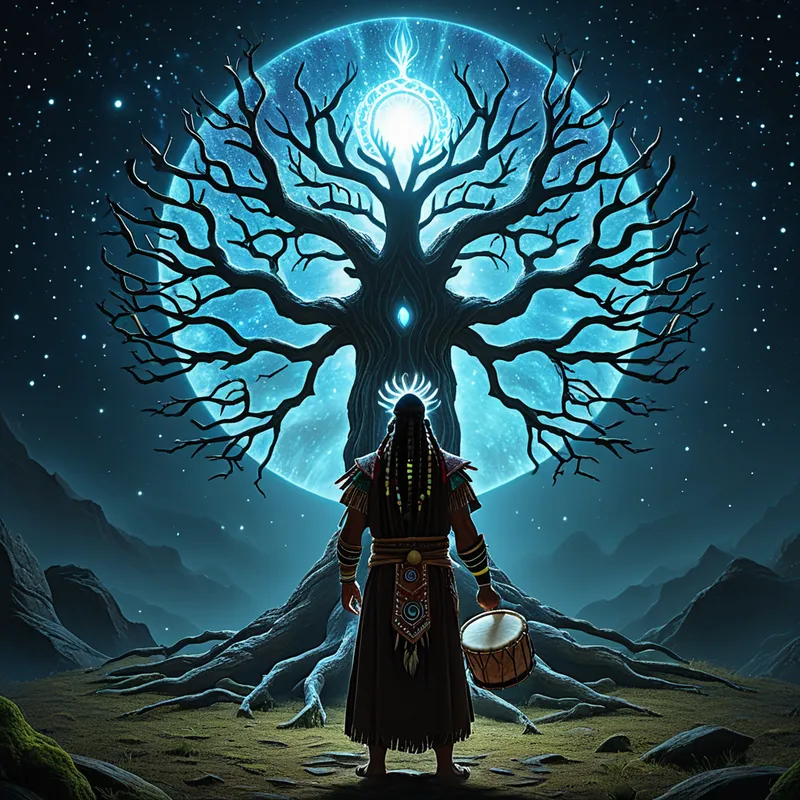
Shaman's Drum Myth Meaning & Symbolism
A myth of a primordial shaman who journeys to the World Tree, offering his bones to craft the first drum, becoming the bridge between worlds.
The Tale of Shaman’s Drum
Listen. In the time before time, when the world was still soft and the sky was close enough to touch, there was only the great silence. The people lived, but they were lost. They could hear the whisper of the wind in the pines, the chatter of the river over stones, but they could not understand. They could feel the ache of the earth and the joy of the sun, but they could not speak of it. The worlds—the Upper, the Middle, the Lower—were like islands in a vast, misty sea, with no canoe to travel between them.
In this silence lived the First One, Ancestor-Shaman. His eyes saw the spirits dancing in the aurora; his feet felt the pulse of the great beasts deep in the earth. Yet this knowing was a lonely burden, a song stuck in his throat. He watched his people stumble in the half-light, sick in soul and body, cut off from the healing and wisdom that flowed just beyond the veil.
One night, under a moon thin as a claw, the great World Tree appeared to him in a vision. Its roots plunged into the churning darkness of the Underworld, its trunk stood firm in the world of the living, and its branches cradled the glittering cities of the star-beings. A voice, not a sound but a vibration, spoke from its heartwood: “To bridge the silence, you must make a bridge of sound. To heal the fracture, you must offer a piece of your own wholeness.”
Without hesitation, the Ancestor-Shaman began the journey. He drank the bitter tea of visions and let his spirit slip from his body. He descended past the roots of the familiar trees, down into the cold, humming darkness where the ancestors dwell. He climbed, though he had no form, up the shimmering ladder of the Milky Way, where the celestial beings watched with eyes of cold fire. He saw the sickness of disconnection in all three realms.
Returning to his body by the Tree, he knew the cost. He took his stone knife, its edge honed on prayer. With a love as vast as the tundra, he cut into his own side. Not to die, but to create. From his living flesh, he drew a single, curved rib. He offered it to the Tree, and the Tree accepted, shaping it into a perfect, circular frame. Then, he called to the spirit of the Great Reindeer, the provider. In a sacred pact, the reindeer gave its skin, and the Ancestor-Shaman stretched it taut over the frame of his own bone.
He was less, and he was more. Holding the drum, he struck it once with a beater carved from a branch of the World Tree.
BOOM.
The sound was not a sound. It was the first heartbeat of the world made audible. It was a wave that rushed through the soil, startling the roots. It rippled up the trunk, shaking the leaves into a chorus. It flew into the sky, a resonant thread connecting earth to stars. The people heard it and their own hearts synchronized. The spirits heard it and drew near. The silence was shattered, replaced by a living, pulsing conversation.
The Ancestor-Shaman, now both man and instrument, began to drum. With each beat, he journeyed. He rode the sound down to wrestle illness from the shadows. He rode it up to bring down wisdom from the light. He became the hollow bone, the channel, the bridge. His sacrifice was not an end, but a beginning—the birth of the means to travel, to heal, to remember that all worlds are one.
Cultural Origins & Context
This foundational myth exists not as a single, codified text, but as a living pattern woven into the ritual practices and oral histories of Siberian Tungusic and Mongolic peoples, and resonates across global indigenous shamanic traditions. It is a myth of necessity, explaining the origin of the shaman’s primary tool of power. The story was traditionally passed down during long winter nights or in the liminal space before an initiation, told by elder shamans to their apprentices. Its function was deeply pragmatic and societal: it legitimized the shaman’s often-traumatic calling (the “shamanic sickness”), sanctified the drum as a living being rather than a mere object, and encoded the core cosmological map of the three-world universe into ritual technology. The drum was the shaman’s horse, boat, and ladder; this myth was its title deed and sacred blueprint.
Symbolic Architecture
The myth’s power lies in its stark, alchemical symbolism. The Ancestor-Shaman’s auto-sacrifice represents the ultimate act of paradoxical gain: to gain the whole, one must give a fundamental part of the self. His rib, the archetypal symbol of support and structure, becomes the frame of the cosmos—the circumference that defines sacred space.
The drum is the audible shape of the soul: a skin of experience stretched over the bones of fate, waiting for the will to strike it into music.
The reindeer skin signifies the crucial alliance with the natural and animal world; the shaman does not act alone but through a web of reciprocal relationships. The World Tree is the axis of reality itself, the central pillar around which all transformation revolves. The resulting drum is thus a microcosm: wood (Tree) from the Upper World, skin (Animal) from the Middle World, and the driving intent (the Shaman’s sacrifice) forged in the ordeal of the Lower World. It is a portable cosmos, a battery for spiritual voltage.
Psychologically, the shaman represents the emerging Self, the part of the psyche that can mediate between the conscious ego (Middle World), the personal and collective unconscious (Lower World), and the higher ideals or spiritual intuitions (Upper World). The initial “silence” is the state of psychic disconnection, where inner and outer realities feel meaningless and split.
The Dreamer’s Resonance
When this mythic pattern stirs in the modern dreamer, it often manifests as dreams of profound somatic transformation or resonant discovery. You may dream of a hollow bone in your chest through which wind whistles a haunting tune. You may find a simple drum in a dream attic, and upon striking it, see the entire room warp and vibrate, revealing hidden doors. You may dream of voluntarily surrendering a prized possession or even a body part, not with horror, but with solemn purpose, knowing it is necessary to craft a tool.
These dreams signal a psyche ready to build its own temenos—a sacred container. The somatic process is one of resonance: the dream-ego is learning to “vibrate” at a different frequency, to sense connections that logical thought cannot grasp. It is the psychological equivalent of the shaman’s dismemberment and reassembly; old, rigid structures of identity (the rib) are being offered up to be refashioned into a framework for a more expansive, connected Self. The conflict is the ache of disconnection; the rising action is the courageous decision to pay the cost of connection.
Alchemical Translation
For the individual on the path of individuation, the myth of the Shaman’s Drum models the ultimate act of psychic transmutation: turning the lead of suffering and isolation into the gold of conscious connection.
The first step is acknowledging the “great silence”—the feeling of being cut off from one’s own depths, instincts, and higher meaning. The modern “World Tree” journey is the descent into the shadow and the ascent to explore ideals, often facilitated by therapy, creative work, or spiritual practice. The core alchemical operation, however, is the sacrifice.
Individuation requires the sacrifice of the simple, solid self to create the instrument of the complex, resonant Self.
We must offer up a “rib”—a foundational belief, a cherished identity, a long-held grievance—that structures our current, limited world. This is the bone that becomes the frame. We must then integrate the “reindeer skin”—our animal nature, our instincts, our embodied passions—not as enemies, but as the vital membrane that translates spirit into action. The act of drumming is the disciplined practice of attention and intention: the steady, rhythmic work of bringing consciousness to bear on the unconscious, of holding the tension between opposites until a transcendent third—the healing insight, the creative solution, the connecting beat—emerges.
The finished “drum” is the individuated personality itself: a resilient, resonant structure capable of navigating between inner and outer, conscious and unconscious, personal and transpersonal. One does not become the all-powerful shaman; one becomes the hollow bone, the willing instrument through which the music of the larger life can flow. The myth teaches that our deepest wounds and most profound offerings are not the end of us, but the very materials from which we craft the tool to find our way home.
Associated Symbols
Explore related symbols from the CaleaDream lexicon: