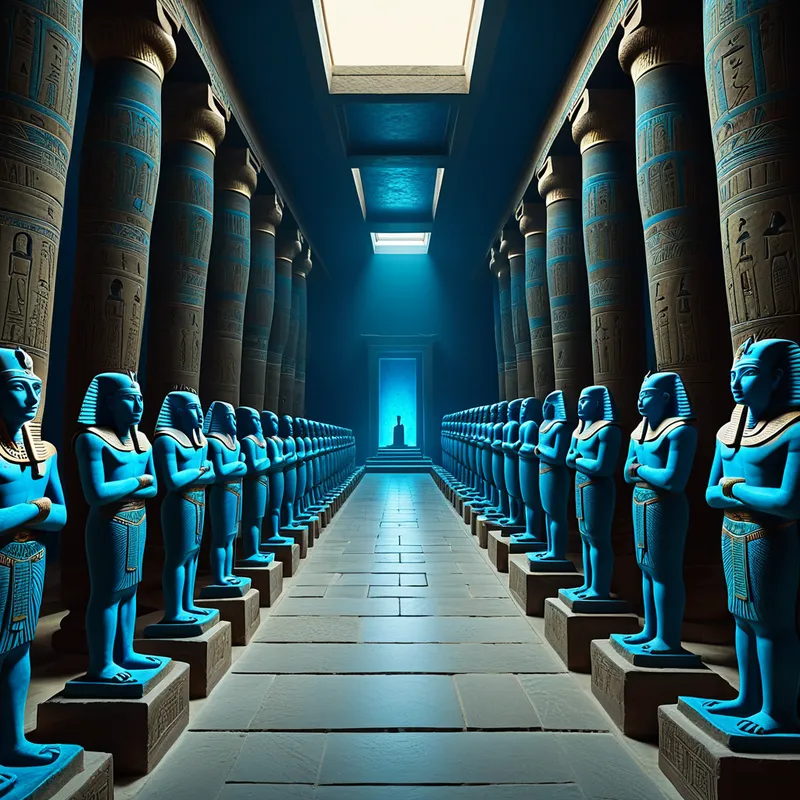
Shabtis Myth Meaning & Symbolism
Magical figurines buried with the dead, sworn to answer the call and perform labor in the afterlife on behalf of their master.
The Tale of the Shabtis
In the silent, sun-baked realm of the living, a great one prepares for the final journey. The air is thick with myrrh and the whispered prayers of priests. But his thoughts are not on the splendors of his palace or the battles he has won. His gaze is turned inward, toward the horizon of the West, toward the Duat.
For he has heard the tales. He knows that beyond the setting sun lies not an eternity of rest, but the Sekhet-Aaru, the Field of Reeds—a mirror of the blessed Nile valley, but one that demands toil. The gods, in their wisdom, decree that even the justified dead must labor: to irrigate the celestial fields, to cultivate the grain that never withers, to ferry sand from east to west. It is the price of eternity.
A shadow of dread, unspoken but profound, falls upon the king’s heart. To have escaped the thousand deaths of mortal life, only to become a slave for all time? This is a fate worse than oblivion. He confides in his chief ritualist, a man whose eyes have seen the patterns in the stars and the secrets in the sacred texts.
The ritualist does not offer empty comfort. Instead, he brings forth a box of pale, unbaked clay. From it, he lifts a small, perfect figure—a man, shaped in the likeness of the king himself, with a serene face and hands crossed over his chest, holding tiny implements: a hoe, a basket for grain. “This,” the ritualist says, his voice a low river, “is your answer. This is your ushabti—the one who answers.”
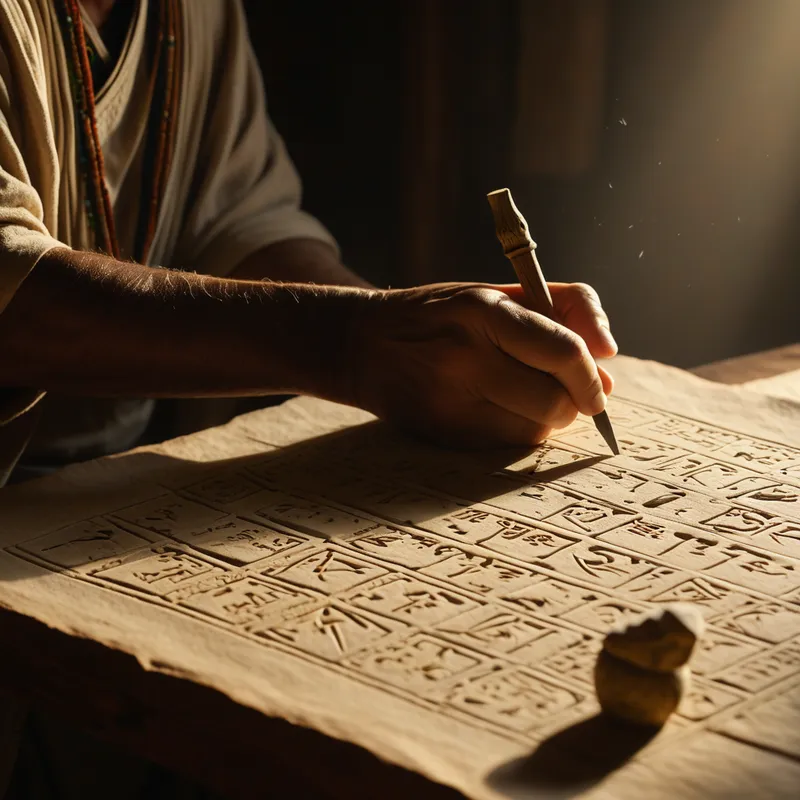
Under the flickering lamplight, the ritualist begins the work of magic. With a reed pen and ink as dark as the night sky, he inscribes the figure with words of power—Chapter Six of the Book of the Dead. The spell is not a plea, but a command, a legal contract etched in divine language:
“O Shabti, allotted to me, if I am summoned, if I am detailed to do any work which is done in the realm of the dead… you shall detail yourself for me on every occasion of making arable the fields, of flooding the banks, of ferrying sand of the east to the west. Say you: ‘Here I am!’”
One figure becomes ten. Ten become four hundred and one—one for each day of the Egyptian year, and a foreman for each ten. They are painted the color of life-giving water and precious lapis lazuli. They are given names. They are placed in their own model granaries and boats, a miniature army of service at the foot of the great sarcophagus.
When the king’s Ka finally stands before Osiris in the Hall of Two Truths and his heart is found lighter than the feather of Maat, he is led into the Field of Reeds. And when the call for labor comes, as it must, he does not reach for a hoe. He speaks the spell. From the shadows of his tomb, from the folds of his bandages, a voice echoes—not one, but hundreds: “Here I am!” The legion of shabtis steps forward, their tiny tools ready, and the master watches, free, as his own image tends the eternal fields on his behalf.
Cultural Origins & Context
The myth and practice of the shabti (or ushabti) emerged from the deep, pragmatic spirituality of ancient Egypt, evolving over nearly two millennia from the Middle Kingdom (c. 2055–1650 BCE) through the Ptolemaic Period. Initially, simple servant figurines were placed in the tombs of elites, but the concept crystallized with the democratization of the afterlife during the New Kingdom. No longer the sole privilege of pharaohs, the hope of the Sekhet-Aaru extended to any who could afford the proper rites and spells.
The myth was not a single narrative told in temples but a functional, operative truth embedded in funerary religion. It was passed down and elaborated by scribes and priests, the architects of the mortuary cult. The “story” was enacted through ritual and artifact. The shabti was a physical contract, a magical insurance policy against divine corvée labor. Their societal function was profound: they alleviated the ultimate existential anxiety—that death was not an end to suffering, but a change in its form. They ensured that the blessed dead could enjoy an eternity of leisure, a state mirroring the ideal Egyptian life of abundance and order (Maat), sustained by proxy.
Symbolic Architecture
At its core, the shabti myth is a profound allegory of identity, delegation, and the nature of the self. The shabti is the double, the other self. It represents the part of the psyche that can be tasked, programmed, and sent to do necessary but burdensome work.
The shabti is the embodied spell that transforms fate from a sentence of labor into a command of sovereignty.
The figurine symbolizes the magical power of naming and command. By inscribing the spell and naming the shabti, the individual exercises creative will over their own destiny. The labor of the Duat symbolizes the inescapable, repetitive tasks of existence—not just physical toil, but the psychological and spiritual maintenance required to sustain one’s being. The shabti system proposes that consciousness need not be fully consumed by this maintenance; a portion of the self can be automated, freeing the essential “I” for higher pursuits or pure being.
Furthermore, the overseer shabtis introduce a hierarchy within the self—a managerial consciousness that directs the worker-selves. This reflects an intricate understanding of the psyche as a complex society, not a monolithic entity.
The Dreamer’s Resonance
When the pattern of the shabti arises in modern dreams, it seldom appears as an Egyptian artifact. Instead, one may dream of clones, robots, doppelgängers, or an endless line of identical workers performing a monotonous task. The dreamer might feel they are watching themselves work, or hear a chorus of their own voice saying, “I will do it.”
This is the psyche signaling a state of over-identification with the “worker” archetype. The somatic feeling is often one of heaviness, automation, or being trapped in a loop. Psychologically, the dreamer is likely experiencing life as a series of obligations with no sense of authentic agency or freedom. The shabtis represent the compartmentalized, functional parts of the self that have been conscripted into endless service—the professional persona, the domestic manager, the social performer.
The dream is a call from the Ka, the vital force, which feels buried alive by these obligations. It asks: What part of you is truly the master, and what part have you turned into a servant? Who answers when your life calls you to labor?

Alchemical Translation
The shabti myth provides a stunning model for psychic transmutation, a map for the modern journey of individuation. The process begins with the honest confrontation of the “afterlife labor”—the shadow work, the repetitive psychological patterns, and the mundane tasks that feel like an eternal sentence. The first step is to see this labor as a system, not an identity.
The alchemical act is the creation of the “inner shabti.” This is the conscious differentiation of self from function. It is the act of inscribing the spell—through journaling, therapy, ritual, or creative expression—that clearly defines and names an aspect of the psyche that handles specific duties. This is not dissociation, but conscious delegation. It is saying to the part of you that holds anxiety: “You are tasked with vigilance,” or to the part that manages schedules: “You are tasked with order.”
Individuation is the process of moving from being the laborer in the field to being the scribe who inscribes the command and the master who speaks the word.
The ultimate triumph is the realization of the “Overseer” consciousness—the integrated Self (The Self) that can coordinate these inner workers without being enslaved by any one of them. The goal is not to avoid all work, but to transform compulsory labor into commanded service. The freed essence—the true “I”—gains the sovereignty to walk the fields of its own existence as a witness, a creator, and a ruler, no longer bent double under the hoe, but upright, speaking the words of power that shape its own reality. The shabti, therefore, is not a relic of superstition, but an ancient, elegant blueprint for psychological liberation.
Associated Symbols
Explore related symbols from the CaleaDream lexicon: