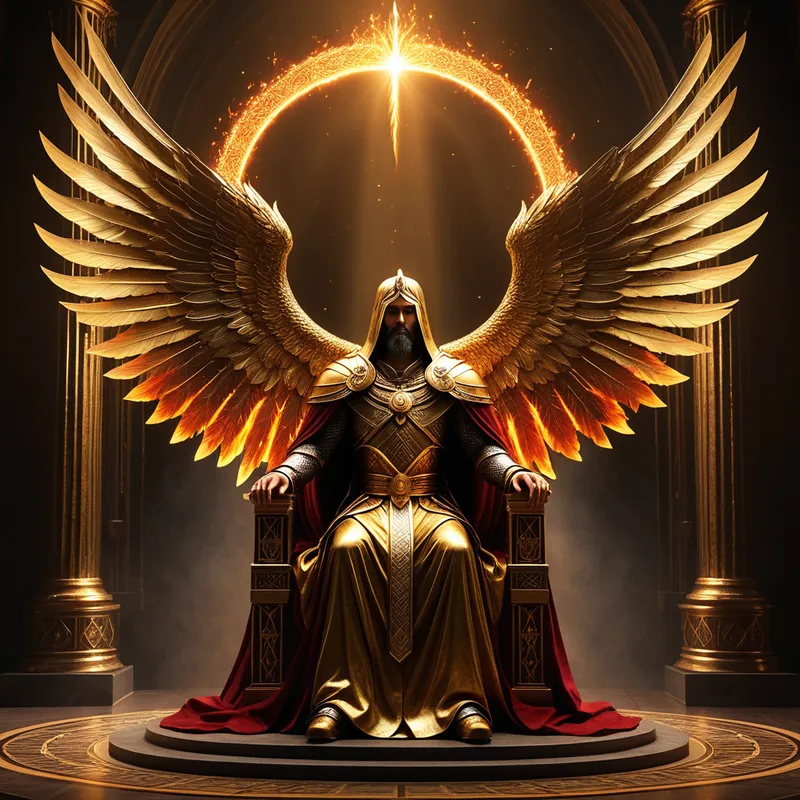
Seraphim Myth Meaning & Symbolism
The six-winged, fiery angels who surround the divine throne, embodying the terrifying and purifying fire of ultimate love and consciousness.
The Tale of Seraphim
In the beginning, before time was measured, in the uncreated light that knows no shadow, there was a sound that was not a sound—a vibration of pure being. And in that resonance, the first movements of consciousness stirred. Not upon the earth, for there was none, but in the courts of the unimaginable. Here, in the Heavenly Temple, reality was woven from song and fire.
They were there from the first note. Not shaped as men, but as concentrations of holy dread and adoration—the Seraphim. Six wings crowned each being of living flame. With two they covered their faces, for to gaze directly upon the source of all faces is to be undone. With two they covered their feet, the symbols of movement and will, for in that presence all motion is surrendered to a greater current. And with two they flew, not to travel, but to be instruments of the perpetual wind of spirit that flows from the throne.
Their cry was the foundation of the world: “Kadosh, Kadosh, Kadosh!” Holy, holy, holy. The pillars of the temple trembled at the sound, and the air thickened with incense-smoke that was the very breath of their praise. The one seated on the throne was a form of consuming fire and bottomless sapphire, and the Seraphim were the fire that burns because it loves the fire.
Then came a mortal, a man of the dust named Isaiah. He stood in the earthly temple, a place of stone and ritual, and saw the veil tear. The ceiling became as nothing, and he was thrust, soul-naked, into the heavenly court. The sight was terror. He did not see beauty first; he saw the immensity, the absolute otherness, and the Seraphim whose love was a conflagration. “Woe is me!” he cried, his voice a whisper against the cosmic chant. “I am a man of unclean lips, and I dwell among a people of unclean lips!”
For in that light, every hidden fracture, every whispered lie, every unacknowledged shadow within him stood revealed as a stark dissonance against the holy song. He was not being judged; he was being seen. And to be fully seen by that which is wholly true is to feel the falseness within oneself burn.
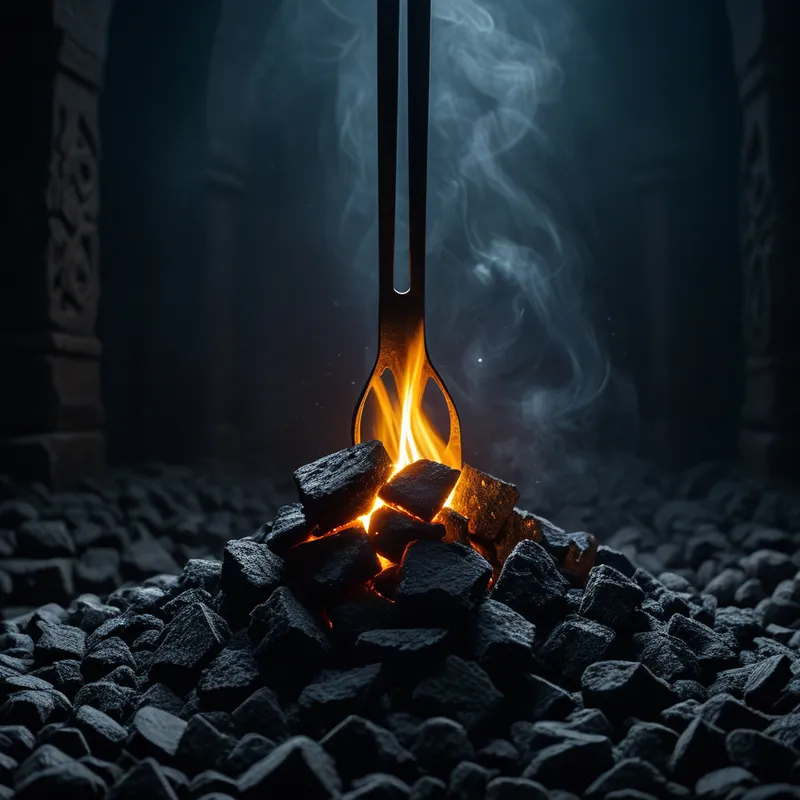
Then, a movement. One of the Seraphim flew to the altar—not with wings of flight, but with purpose. From the blaze of the altar, it took a glowing coal with a pair of tongs. The coal pulsed with the same fire that composed the angel, a fragment of purifying reality. The Seraphim approached the trembling prophet. There was no gentleness in the act, only a terrible, necessary precision. “Behold,” the voice was like the forge of stars, “this has touched your lips; your iniquity is taken away, and your sin purged.”
The coal touched his mouth. There was searing pain, the pain of truth cauterizing falsehood. It was not destruction, but a fierce, merciful surgery. The cry of “Woe!” was silenced, not by command, but because its cause was burned away. When the coal withdrew, Isaiah was not merely forgiven; he was made fit. His lips, once declaring his impurity, were now aligned with the fire. And a voice echoed from the throne, not to the Seraphim, but through the space they had opened: “Whom shall I send? Who will go for us?”
From a mouth still humming with sacred heat, the answer came, clear and whole: “Here I am. Send me.” The vision faded, the temple walls solidified, but the man was forever changed. He carried a spark of the Seraph’s fire in his soul, a burning coal of purpose where once there had only been dust and fear.
Cultural Origins & Context
The myth of the Seraphim emerges from the profound visionary experience recorded in the sixth chapter of the Book of Isaiah, a text central to both Jewish and Christian scripture. This is not a folk tale passed down by campfires, but a recorded theophany—a direct, destabilizing encounter with the divine, set within the formalized, priestly context of the Jerusalem Temple. The prophet Isaiah, likely a figure of the 8th century BCE, served in a time of political crisis and spiritual corruption. His vision functions as a divine commissioning, authorizing his often-unwelcome prophecies.
The telling is sparse, terrifying, and liturgical. It was preserved by scribal tradition, read aloud in synagogues, and later fervently adopted by early Christian mystics who saw in Isaiah’s vision a prefiguration of Christ’s glory. The Seraphim became embedded in the developing Christian angelology, most notably in the work of Pseudo-Dionysius the Areopagite. He placed them at the apex of the first hierarchy of angels, closest to God, defining their essence as “the fiery ones” (from the Hebrew root saraph, to burn). Their primary societal function was dual: to inspire ultimate awe and to model the process of purification necessary for any approach to the sacred. They were the guardians of the mystery, the living flame of the boundary between the human and the utterly transcendent.
Symbolic Architecture
The Seraphim are not characters in a story but symbolic personifications of a fundamental psychic and cosmic principle: the transformative fire of absolute consciousness. Their six wings are a masterful symbol of containment and function in the face of the numinous.
The face must be covered, for the ego cannot comprehend the Self. The feet must be covered, for personal will must be suspended. Only then can the wings of service move in harmony with a will greater than its own.
Their eternal cry of “Holy” represents the universe’s inherent orientation toward meaning, value, and distinction—the separation of the sacred from the profane. They are the archetypal reality of Awe itself. The coal from the altar is the critical symbol. The altar is the place of sacrifice, where something is given over to be transformed. The coal is a concentrated essence of that transformative fire.
The purifying coal is not gentle therapy; it is the searing truth that annihilates our self-deceptions. It does not punish the sinner; it burns away the sin, which is the illusion of separation, so the true self beneath can speak.
Isaiah’s “unclean lips” symbolize the flawed instrument of human expression—our capacity for deceit, complaint, and triviality. The burning coal is the archetype of the initiatory wound, a sacred trauma that does not destroy but initiates, forging a vessel capable of bearing and transmitting a truth too heavy for the unprepared psyche.
The Dreamer’s Resonance
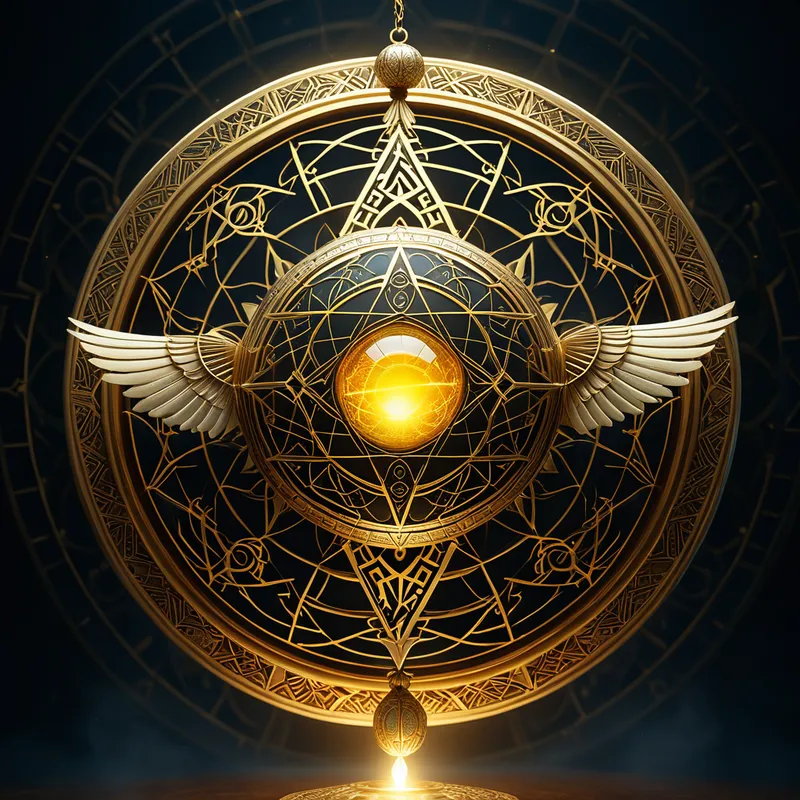
When the Seraphim pattern erupts in the modern dreamscape, it seldom appears as a biblical angel. The dreamer may find themselves in a vast, awe-inspiring structure—a cathedral, a data center, a cosmic observatory—where a overwhelming presence is felt. There may be rings of light, spinning wheels of fire, or a terrifying yet beautiful sound that vibrates through their very bones.
Somatically, the dreamer often reports a feeling of intense heat, trembling, or a sense of being “seen through” completely, accompanied by profound shame or unworthiness (“Woe is me”). This is the psyche’s confrontation with the Self, the inner divine center. The ego, like Isaiah, stands exposed before its own highest potential and sees all the compromises, falsities, and “unclean” adaptations that have allowed it to function in the world.
The psychological process is one of critical discernment. The fiery presence does not attack; it illuminates. It forces a reckoning with the gap between who we pretend to be and who we are summoned to become. The dream may culminate in a moment of searing pain or intense light applied to a specific area (often the mouth, the hands, or the heart), symbolizing the specific psychic function that requires purification and empowerment to serve the emerging wholeness.
Alchemical Translation
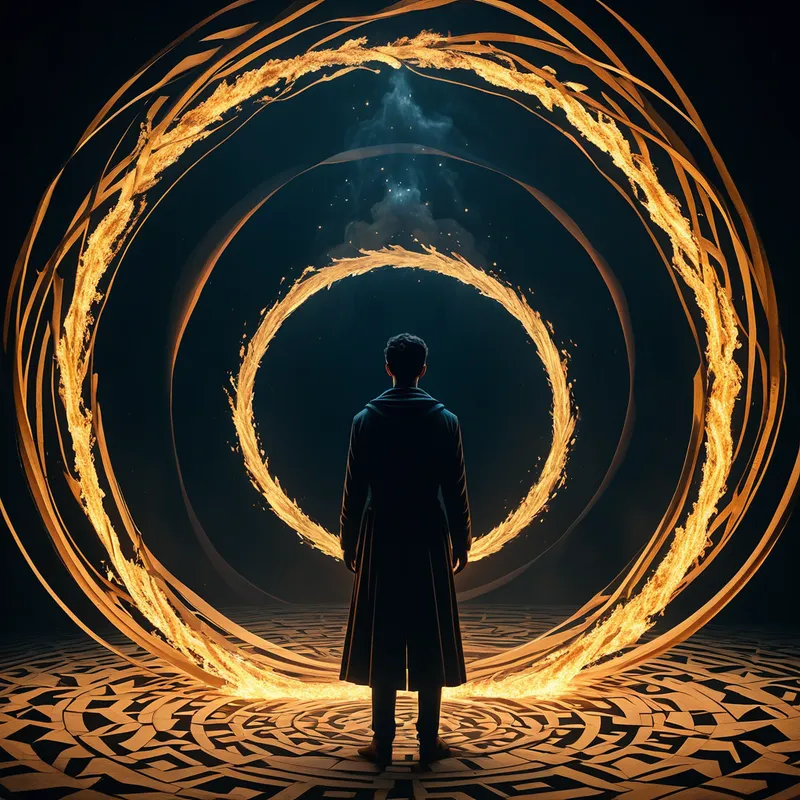
The myth of the Seraphim is a precise blueprint for the alchemical stage of Calcinatio—burning to ash. In the individuation process, this is the necessary, fiery confrontation with one’s own shadow and persona. The heavenly throne room is the inner sanctum of the psyche, the seat of the Self. The ego’s journey there is the beginning of the work.
The initial cry of “Woe!” represents the nigerdo, the dark night, the realization of one’s own leaden, imperfect state. The Seraphim, as agents of the Self, do not console the ego; they present it with the purifying fire. The ego must consent to its own burning—the surrender of its cherished self-images, its defensive narratives, its “unclean lips” of complaint and blame.
Individuation is not self-improvement; it is the ego’s sacrificial offering of its own impurities to the inner fire, so it may be remade as a vessel for the Self.
The tongs are crucial. The fire does not consume indiscriminately; it is applied with precision. This symbolizes the discerning, focused work of consciousness—therapy, introspection, creative askesis—that directs the transformative energy to the specific complexes that need transmutation. The result is not annihilation, but empowerment. The purified ego, like Isaiah, is not made perfect, but it is made authentic and aligned. Its voice (“Here I am”) now comes from a center that has integrated a measure of the divine fire. It can speak and act with an authority that is no longer personal, but transpersonal, serving the totality of the psyche and, by extension, the world. The Seraphim myth thus maps the terrifying, glorious passage from being a creature of dust and fear to becoming a conscious, burning coal in the service of the whole.
Associated Symbols
Explore related symbols from the CaleaDream lexicon: