Separatio Myth Meaning & Symbolism
The alchemical myth of the primal division, where the One becomes Two, creating the tension necessary for all transformation and the birth of consciousness.
The Tale of Separatio
In the beginning, there was the [Prima Materia](/myths/prima-materia “Myth from Alchemical culture.”/). It was not light, nor dark. It was not hot, nor cold. It was not spirit, nor substance. It was the All-Nothing, a perfect, silent, dreaming egg of potential. Within its boundless womb, all opposites slept in a blissful, unknowing embrace. There was no tension, no desire, no time—only the hum of latent being.
Then, from the very heart of this stillness, a longing was born. A question without words echoed in [the void](/myths/the-void “Myth from Buddhist culture.”/): “What am I?” This yearning grew, a subtle vibration that became a tremor, then a great, silent cry for definition. The Prima Materia could no longer bear the weight of its own unity. It needed to know itself, and to know, it must first become two.
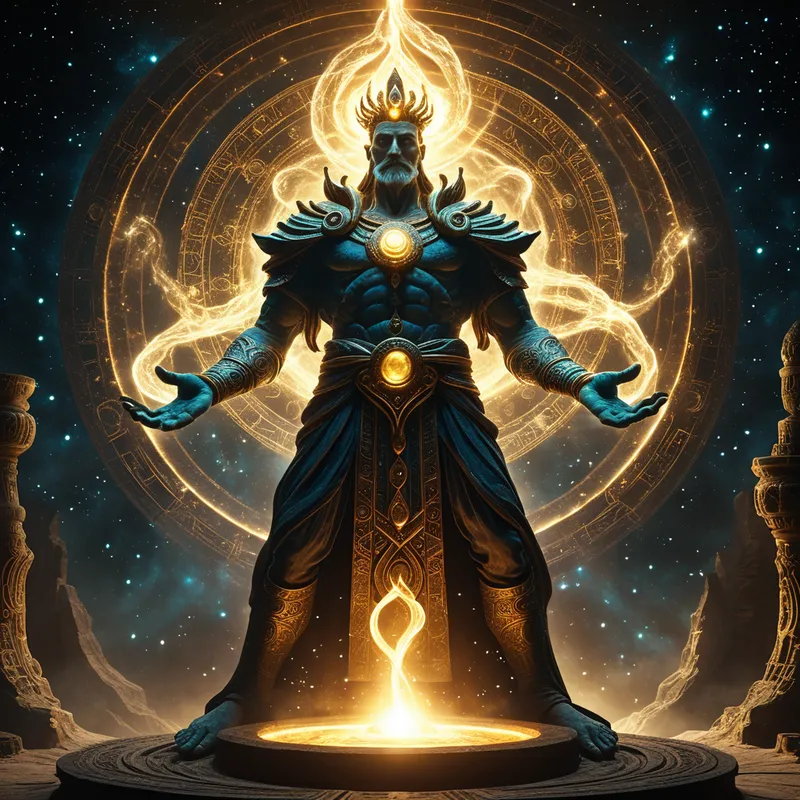
Thus began the Great Sigh. The egg did not crack with violence, but with a profound, cosmic sorrow, as a mother must release her child into [the world](/myths/the-world “Myth from Tarot culture.”/). From its center, a figure emerged—not a creator god, but the [Spiritus](/myths/spiritus “Myth from Alchemical culture.”/) Separator. Its form was androgynous and severe, robed in the grey of dawn and dusk. In its hands, it held not a tool, but an intention.
The Spiritus Separator reached into the heart of the One. With a gesture of infinite gentleness and irrevocable finality, it began to pull. A soundless scream filled the cosmos as light was drawn from shadow, heat from cold, the volatile from the fixed. The air, once thick with potential, now thinned into breathable atmosphere above and heavy, churning waters below. The fiery spirit soared upward, yearning for the stars; the dense, salty soul sank downward, longing for the deep earth.
Where there had been seamless unity, a chasm opened—the Abyssus. Across this new emptiness, the separated halves gazed upon one another for the first time. In that gaze was recognition, longing, and a terrible, homesick loneliness. The work was done. The One had become Two: [Sulfur](/myths/sulfur “Myth from Alchemical culture.”/) and [Mercury](/myths/mercury “Myth from Roman culture.”/), King and Queen, Spirit and Soul. The universe wept its first tears, which fell as rain, and sighed its first breath, which became [the wind](/myths/the-wind “Myth from Various culture.”/). The stage was set. The long journey back to wholeness—now conscious, now chosen—could begin.
Cultural Origins & Context
The myth of Separatio is not a singular story with a fixed [pantheon](/myths/pantheon “Myth from Roman culture.”/), but a foundational operation woven into the very fabric of Western alchemical tradition, spanning from Hellenistic Egypt through the Islamic [Golden Age](/myths/golden-age “Myth from Universal culture.”/) to the Renaissance laboratories of Europe. It was passed down not by bards, but by adepts in cryptic texts, encoded emblems, and the whispered oral teachings of the [Magnum Opus](/myths/magnum-opus “Myth from Alchemical culture.”/).
Its primary “tellers” were the alchemists themselves, who saw in their practical laboratory work—distilling, calcining, dissolving—a mirror of divine and psychological processes. The myth functioned as a sacred map. For society at large, alchemy was often viewed as proto-chemistry or mere charlatanism. But within the sealed fraternities, the story of Separatio served a profound societal function: it was a guide for navigating inner chaos. It taught that before any creation or healing, a necessary, often painful, division must occur. It provided a cosmological justification for the inner turmoil of the seeker, framing personal crisis not as a failure, but as the first, crucial step on the path to [the philosopher’s stone](/myths/the-philosophers-stone “Myth from Alchemical culture.”/).
Symbolic Architecture
At its core, Separatio represents the [birth](/symbols/birth “Symbol: Birth symbolizes new beginnings, transformation, and the potential for growth and development.”/) of [consciousness](/symbols/consciousness “Symbol: Consciousness represents the state of awareness and perception, encompassing thoughts, feelings, and experiences.”/) through distinction. The undifferentiated Prima Materia symbolizes the unconscious [psyche](/myths/psyche “Myth from Greek culture.”/) in its primal state—a state of potential, but also of ignorance. The act of [separation](/symbols/separation “Symbol: A spiritual or mythic division between realms, states of being, or consciousness, often marking a transition or loss of connection.”/) is the [dawn](/symbols/dawn “Symbol: The first light of day, symbolizing new beginnings, hope, and the transition from darkness to illumination.”/) of [awareness](/symbols/awareness “Symbol: Conscious perception of self, surroundings, or internal states. Often signifies awakening, insight, or heightened sensitivity.”/), where the [psyche](/myths/psyche “Myth from Greek culture.”/) begins to discriminate between self and other, good and bad, thought and feeling.
Consciousness cannot exist without separation. To know the light, we must first cast a shadow.
The resulting opposites—Sulfur (will, [passion](/symbols/passion “Symbol: Intense emotional or physical desire, often linked to love, creativity, or purpose. Represents life force and deep engagement.”/), dynamism) and [Mercury](/symbols/mercury “Symbol: Mercury symbolizes communication, intellect, and swift movement, often representing the messenger between realms in spiritual and mythological contexts.”/) (intellect, adaptability, [soul](/symbols/soul “Symbol: The soul represents the essence of a person, encompassing their spirit, identity, and connection to the universe.”/))—are not enemies, but estranged partners. The Abyssus between them is the [space](/symbols/space “Symbol: Dreaming of ‘Space’ often symbolizes the vastness of potential, personal freedom, or feelings of isolation and exploration in one’s life.”/) of [tension](/symbols/tension “Symbol: A state of mental or emotional strain, often manifesting physically as tightness, pressure, or unease, signaling unresolved conflict or anticipation.”/), conflict, and longing where all psychological and creative work takes place. This is not a myth of evil or [punishment](/symbols/punishment “Symbol: A dream symbol representing consequences for actions, often tied to guilt, societal rules, or internal moral conflicts.”/), but of a sacred, necessary schism that creates the conditions for [relationship](/symbols/relationship “Symbol: A representation of connections we have with others in our lives, often reflecting our emotional state.”/), desire, and ultimately, a more sophisticated unity. The Spiritus Separator is thus not a [villain](/symbols/villain “Symbol: A character representing opposition, moral corruption, or suppressed aspects of self, often embodying fears, conflicts, or societal threats.”/), but the archetypal principle of discernment itself, the inner function that allows us to analyze, critique, and differentiate.
The Dreamer’s Resonance
When the archetype of Separatio stirs in the modern unconscious, it manifests in dreams of profound division. One may dream of a house split down the middle, of a river suddenly dividing a familiar path, or of watching oneself from across an impassable gap. These are not dreams of simple conflict, but of foundational cleaving.
Somnatically, the dreamer may be processing a life stage where a previously cohesive identity is breaking apart: the end of a defining relationship, the loss of a career, or the shattering of a long-held belief system. The psyche is performing its own Separatio, distinguishing what was once fused. The emotional tone is often one of deep loneliness, anxiety, and disorientation—the psychic equivalent of the cosmic homesickness felt by the separated opposites. The dream is a signal that the psyche is in the volatile first stage of a transformation, dissolving an old, outworn unity to make way for a new composition.

Alchemical Translation
For the individual, the myth of Separatio models the indispensable first phase of psychic transmutation, or Individuation. We all begin in a state of unconscious identification—with our family, our culture, our [persona](/myths/persona “Myth from Greek culture.”/). To become who we truly are, this unconscious mass must be broken down.
The alchemical translation is this: we must become our own Spiritus Separator. This means courageously distinguishing our authentic feelings from internalized expectations, our own voice from [the chorus](/myths/the-chorus “Myth from Theater culture.”/) of others, our shadow from our idealized self-image. It is the painful but vital work of saying, “This is me, and that is not.” It involves “distilling” our chaotic emotions to understand their pure components, or “calcining” an old identity to burn away its false attachments.
The goal is not to live in the divided state, but to pass through it. The agony of the Abyssus is the birth pang of a more conscious self.
This process creates immense inner tension—the Abyssus. Yet, as the alchemists knew, this tension is the engine of all transformation. It generates the heat and the longing that will eventually drive the separated parts to seek reunion on a higher level, leading to the next alchemical stage: Albedo, the whitening, and the eventual [sacred marriage](/myths/sacred-marriage “Myth from Alchemy culture.”/), Coniunctio. Thus, Separatio teaches that our moments of deepest fracture are not the end of our story, but the necessary, sacred beginning of the work of becoming whole.
Associated Symbols
Explore related symbols from the CaleaDream lexicon: