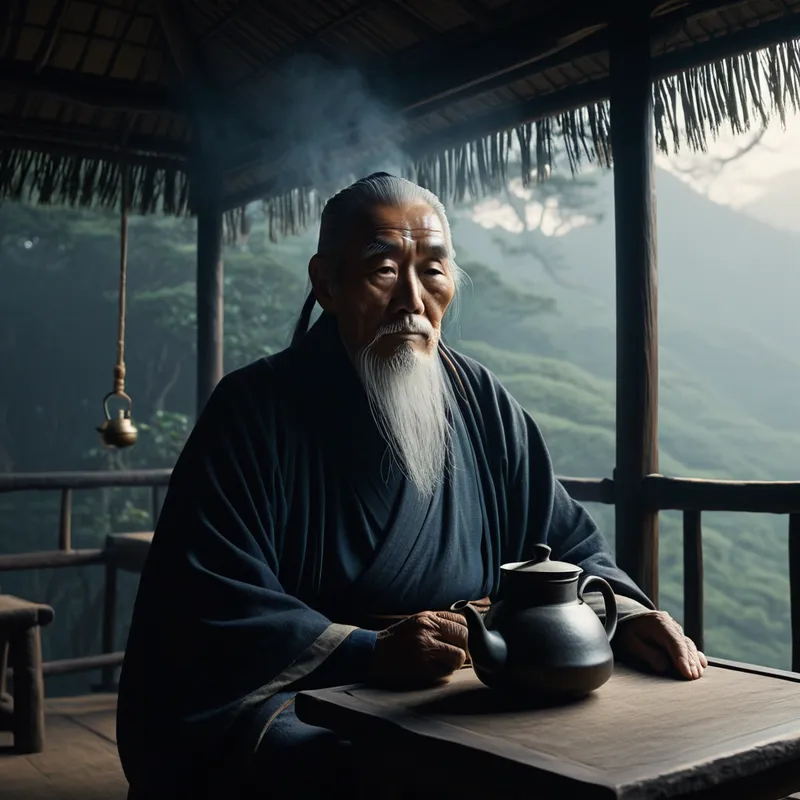
Sen no Rikyū Myth Meaning & Symbolism
The story of the tea master who forged a philosophy of austere beauty, served two rulers, and was ordered to die by the one he helped create.
The Tale of Sen no Rikyū
Listen. There is a story whispered in the hiss of the iron kettle, etched into the grain of the unvarnished wood, waiting in the silence between the first sip and the last. It is the story of the man who shaped emptiness into a cup and filled it with the whole, trembling world.
In an age of blood and ambition, when warlords carved the land with sword and fire, there lived a man named Sen no Rikyū. He was not a general, yet he commanded a deeper realm. His battlefield was a space of four and a half tatami mats. His weapon was a bamboo whisk. His art was chadō, and he sought within it not ornament, but essence—the stark, beautiful truth of a single moment, alone together.
He entered the service of the most powerful man in the land, Toyotomi Hideyoshi, a ruler sprung from the soil, who hungered to possess all things, even tranquility. For years, Rikyū was his guide into the soul of things. He built for the ruler a tea hut of gold, a gilded cave of wonder. But in his own heart, he built another hut, of mud wall and thatch, where the wind sighed through the bamboo and the light fell as if by accident. Here was wabi-sabi made flesh: the beauty of the irregular, the weathered, the quietly impermanent.
The ruler’s love was a possessive thing. He demanded the ultimate honor: that Rikyū’s daughter become his concubine. The tea master, whose entire life was a study of pure intention, refused. The refusal was a crack in a perfect bowl. The ruler’s favor, once a warm sun, turned cold and sharp. Whispers of treason were sown like poisoned seeds. The man who had taught the ruler to see the universe in a dew drop on a mossy stone was accused of plotting against him.
The decree came. There would be no trial, only sentence. The master of the chashitsu was to die by his own hand. On a spring morning, with the cherry blossoms beginning to scatter like first snow, Rikyū prepared his final tea. He gathered his closest disciples. The utensils were chosen with more care than ever: the kettle, the water jar, the humble bowl. Each movement was a poem of farewell, each sound—the ladle against the rim, the pour of hot water—a note in a requiem. He served each guest. He drank himself. Then, he broke the bowl, so that no lesser hand would ever defile this last, perfect gathering.
He composed his death poem. He entered the inner room. The blade flashed, not in anger, but as the final, definitive cut of a flower arrangement. The story says that as his spirit departed, it stained the tatami. And from that stain, a phantom hagi bush is said to bloom in the temple where he died, a beauty born from a final, profound act of integrity.
Cultural Origins & Context
This is not a myth of the Kami, but a legend born from history, refined into cultural scripture. Sen no Rikyū (1522-1591) was a historical figure, the supreme tea master who systematized the chadō we know today under the patronage of first Oda Nobunaga and then Toyotomi Hideyoshi. His forced suicide is a documented historical event, a collision of absolute aesthetic principle and absolute political power.
The tale was passed down not by bards, but by tea schools—the San-Senke—and through Kōan-like narratives. It functions as a foundational martyr story for the world of Japanese aesthetics. It answers the question: how deep does one’s commitment to truth-in-beauty go? The answer, etched in blood, gives the practice of tea its immense gravity. It transformed Rikyū from a master into a kami of the tearoom, a saint of asymmetry and silence. His death is the ultimate seal of authenticity on the philosophy of wabi-sabi, proving it was not a mere style, but a stance toward existence worth dying for.
Symbolic Architecture
Rikyū is the archetype of the Sage who is destroyed by the Ruler* he helped create. He represents the soul of an art form, the inner, guiding principle that is inevitably at odds with the outer, institutionalized power that seeks to own it.
The tearoom is the temenos, the sacred precinct of the psyche where the raw materials of existence—water, fire, leaf, clay—are ritually composed into a moment of shared consciousness. Rikyū’s two huts are the central symbol: the golden hut for Hideyoshi represents the ego’s desire to possess and glorify the spiritual; the humble, thatched hut is the Self, the authentic, unadorned core that exists beyond status and spectacle.
The ultimate act of creation is to impose a limit so absolute it becomes a form of freedom. Rikyū’s wabi was not poverty, but the radical choice to find totality within restraint.
His refusal to give his daughter is the symbolic refusal of the Sage to let the Ruler consume his entire lineage—his spiritual progeny and his literal flesh and blood. His seppuku, then, is not a defeat, but the final, masterful stroke of his life’s work. It is the ultimate expression of mujō, impermanence, enacted not as passive acceptance, but as conscious, artistic agency. He authored his own end, making his death the most profound tea ceremony of all.
The Dreamer’s Resonance
To dream of Rikyū is to dream of a profound internal conflict between one’s authentic nature and the demands of an internal or external “ruler.” This ruler may be a job, a social role, a family expectation, or the inner critic.
You may dream of preparing a meticulous ceremony in a place that feels utterly your own, only to have a faceless authority figure burst in, demanding you use gaudy, wrong utensils. Or you may dream of holding a beautifully imperfect, cracked bowl, feeling deep peace, while a voice commands you to smash it. The somatic feeling is often one of deep, resonant calm in the heart center, clashing with a tense, knotted pressure in the solar plexus—the seat of will and power.
This dream signals a psyche at a crossroads of integrity. The dream-ego is being asked: where have you sold your authenticity for gold? What humble, essential part of your soul have you locked away to please the inner Hideyoshi? The process is one of somatic discernment: learning to feel the difference between the anxiety of external compliance and the grounded, often lonely, peace of internal truth.
Alchemical Translation
The alchemy of the Rikyū myth is the transmutation of forced termination into conscious, meaningful closure. In the individuation process, we all face the “Hideyoshi” within—the part that builds empires of the persona, that seeks to own and control all aspects of the psyche for the sake of security and prestige. The “Rikyū” within is the Self’s quiet, uncompromising voice that values essence over appearance, connection over conquest.
The myth models a supreme act of psychic integration: the conscious sacrifice of the ego’s grand project to the demands of the deeper Self. It is not about literal death, but about the ego death required to live authentically.
The nigredo, the blackening, is the moment of the decree—the crushing realization that the old pact between your soul and your worldly role is broken. The albedo, the whitening, is the final tea ceremony—the conscious, ritualized gathering and acceptance of all parts of the self before the transition. The rubedo, the reddening, is not a return, but the birth of the phantom hagi bush—the new, enduring beauty that can only grow from the fertile ground of that sacrifice.
For the modern individual, the alchemical act is to “perform one’s seppuku” on the inauthentic life. It is to decisively cut away the role, relationship, or pursuit that, however golden, forces you to betray your own inner tearoom. It is to find the profound, wabi-sabi freedom in that limitation, understanding that in sacrificing the gilded castle of the false self, you finally inherit the whole, weathered, breathtaking world. You become, at last, the host of your own existence.
Associated Symbols
Explore related symbols from the CaleaDream lexicon: