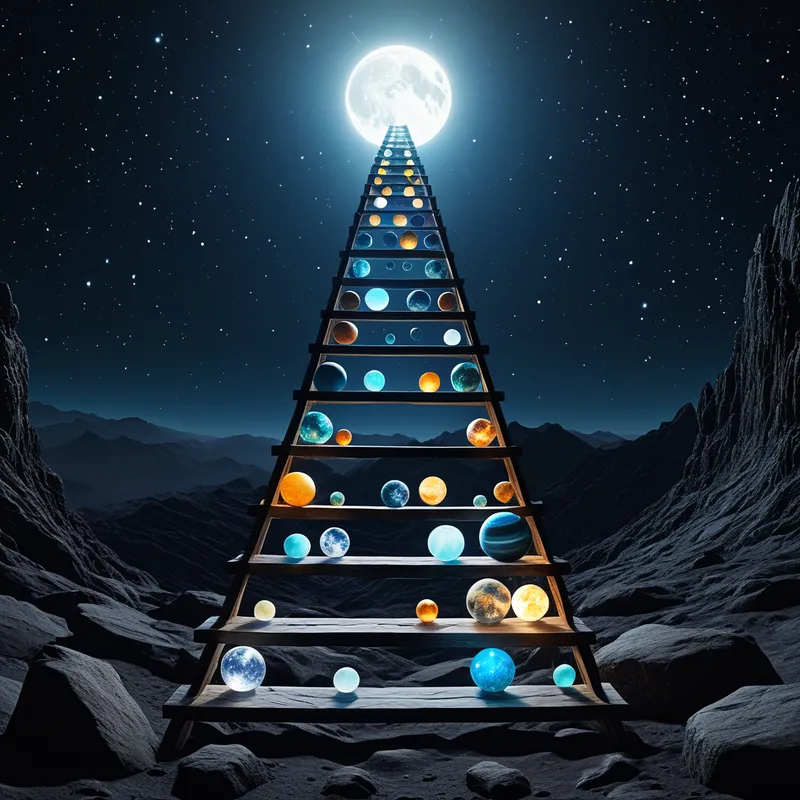
Scala Philosophorum Myth Meaning & Symbolism
The myth of the celestial ladder, a perilous ascent through planetary spheres where the soul is purified, forging the philosopher's stone within.
The Tale of Scala Philosophorum
Hear now the tale of the Ladder, not of wood or rope, but of spirit and ordeal. In the beginning, there was only the Massa Confusa—a swirling, leaden darkness of unformed potential, a world-soul asleep in its own density. From this gloom, a longing was born, a whisper that became a call: a call upward.
And the call was answered not by a god, but by a possibility. From the heart of the Firmament, a vision descended—a shaft of pure, geometric intention. It was the Scala Philosophorum, a staircase of seven thresholds, each a gateway to a sphere of being. Its base was rooted in the black, cold earth of Saturn, its first step a trial of weight and patience. Its summit was lost in the blinding, white-gold fire of the Sol.
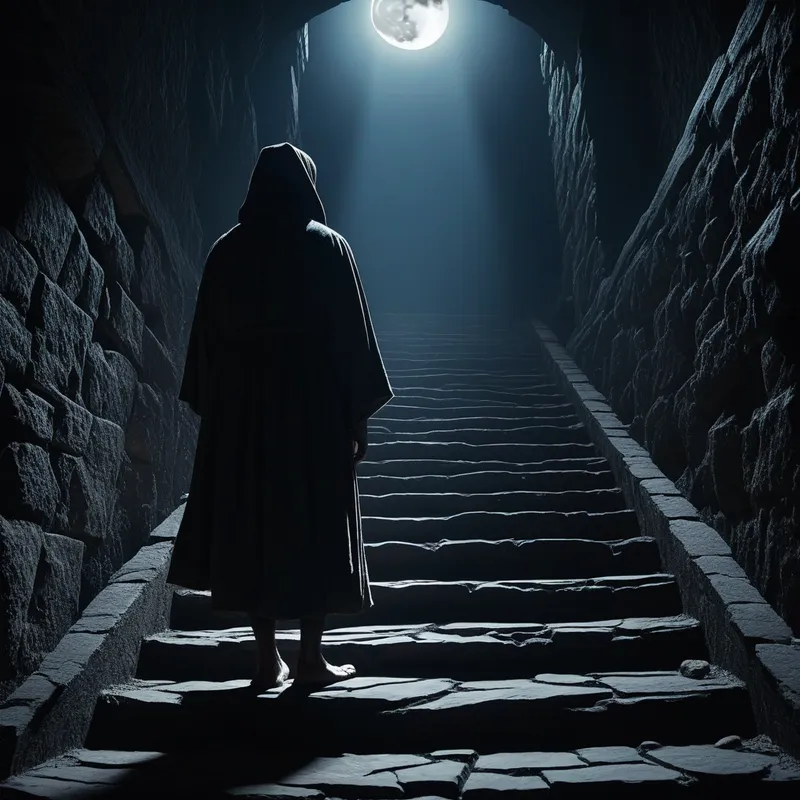
The first to answer was the Adept. Clad in the rough robes of humility, bearing only the lantern of their own questioning mind, they stood before the first step. It was not a climb of the body, but of the essence. To place a foot upon Saturn’s step was to feel the crushing weight of time, of mortality, of all that is heavy and slow. The Adept’s breath turned to lead in their chest, and shadows of all they had failed to be clung to their ankles like chains.
But with the agony came the first purification. The lead within them did not vanish; it became foundation. And so, step by torturous step, they ascended.
Next was the sphere of Jupiter, a vast, azure expanse. Here, the chains fell away, and in their place came a dizzying, intoxicating expansion. The Adept felt their consciousness swell, embracing philosophies and visions without limit. It was a step of grandeur, but its danger was inflation—to become so vast one forgets one’s humble earth. The Adept had to contract their spirit, to find the precise point between empire and essence.
Then came the red, forge-like heat of Mars. This was the step of division, of the sword. Every unresolved conflict, every buried rage, every passive aggression within the Adept’s soul rose as a spectral warrior to meet them. They did not fight these phantoms; they had to recognize them as their own, to take the sword in hand and consciously, deliberately, cut away illusion from truth. It was a bloody, psychic surgery upon the self.
Having survived the division, they entered the golden, gentle light of the Sol. This was not the summit, but the heart. Here, at the central step, the Adept found not a king, but a radiant center of equilibrium. The conflicts of Mars were harmonized; the expansions of Jupiter were focused. A warm, sovereign peace emanated from within. For a moment, they were whole.
But the Ladder demanded more. The ascent continued into the green, copper embrace of Venus. This was the step of fusion, of erotic and creative union. The Adept was dissolved in a tide of longing—not for another, but for the lost halves of their own soul. They had to love the shadow they cut away at Mars, to woo the intellect they tempered at Jupiter. It was a dangerous, beautiful melting.
From that melting, they crystallized in the quick, silver intellect of Mercury. Thought became a fluid, mercurial river. The Adept saw the connections between all things, but the vision was unstable, flickering, prone to deception and cleverness for its own sake. The test was to hold the fluid knowledge without drowning in it, to give the quicksilver a form.
Finally, bathed in the silver, reflective glow of the Luna, the Adept faced their final phantom: their own reflection. Not the face they knew, but the sum total of all they had been—the leaden child, the grandiose youth, the wrathful warrior, the loving partner, the cunning thinker. They had to embrace this entire reflection, to say “This too is me,” and in that acceptance, the lunar sphere became a mirror that did not reflect, but transmitted.
And then, there was no step left, only a doorway of pure, incandescent fire: the true Sol. The Adept did not walk into the sun. They realized, in a final, silent revelation, that the sun had been burning at their core all along. The long, spiraling ascent of the Scala Philosophorum was the process of removing the seven-fold veil that hid it. With a sound like a sigh of release, the Ladder itself dissolved. The Adept remained, not at a height, but at a center. The Philosophers’ Stone was not found. It was forged, step by step, in the vessel of their own being.
Cultural Origins & Context
The myth of the Scala Philosophorum is not a folktale with a single origin, but a sophisticated metaphysical map that coalesced in the late medieval and Renaissance alchemical tradition. It emerged from the synthesis of Hellenistic astrology, Neoplatonic emanation theory, Christian mysticism, and practical laboratory work. This myth was not told around fires but encoded in dense, emblematic texts and intricate illustrations, such as those in Atalanta Fugiens or the scrolls of the Emerald Tablet.
Its primary tellers were the alchemists themselves, who saw their “Great Work” as a three-fold process: the chemical transformation of matter (opus), the spiritual transformation of the soul (theosis), and the decoding of divine secrets in nature (gnosis). The Scala served as the central allegory unifying these pursuits. It was passed down through cryptic manuscripts, often prefaced with warnings to the “profane” and promises of illumination to the “worthy.” Its societal function was esoteric—it created an initiatory framework for a spiritual elite, offering a symbolic language to describe the terrifying and sublime process of inner transformation that paralleled the outer work of turning lead into gold.
Symbolic Architecture
The Scala is a master symbol of structured, conscious evolution. It represents the soul’s necessary, sequential journey through the layers of its own cosmology.
The ladder is not climbed by escaping the self, but by descending fully into each chamber of the self, until the core is revealed.
The seven planetary spheres are not literal heavens but psychological dominions. Saturn symbolizes the Nigredo—the blackening, the confrontation with limitation, depression, and the reality principle. Jupiter is the first expansion, the Albedo or whitening, where insight dawns. Mars is the necessary violence of differentiation, the burning away of false unities. The central Sol represents the heart, the citadel of the Self where the warring opposites are held in balance. Venus is the green stage of connection and love, the Coniunctio or sacred marriage. Mercury is the fluid intelligence that can navigate complexity. Luna is the final purification, the reflection that must be integrated before the ultimate, solar reality can be embodied.
The hero, the Adept, is the ego-consciousness undertaking the perilous task of engaging with these archetypal powers, not as external forces, but as fundamental structures of the psyche.
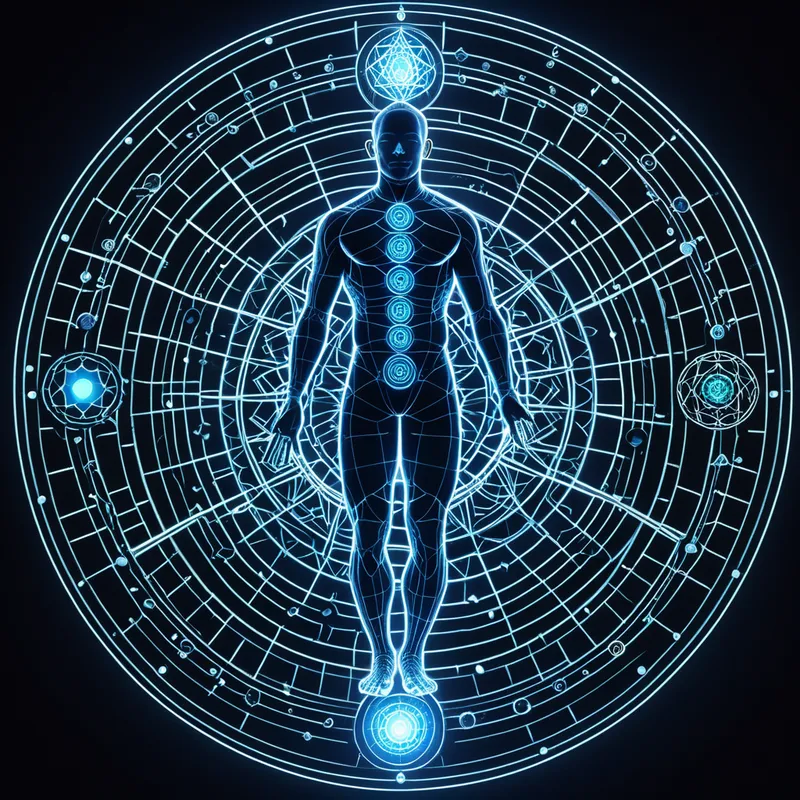
The Dreamer’s Resonance
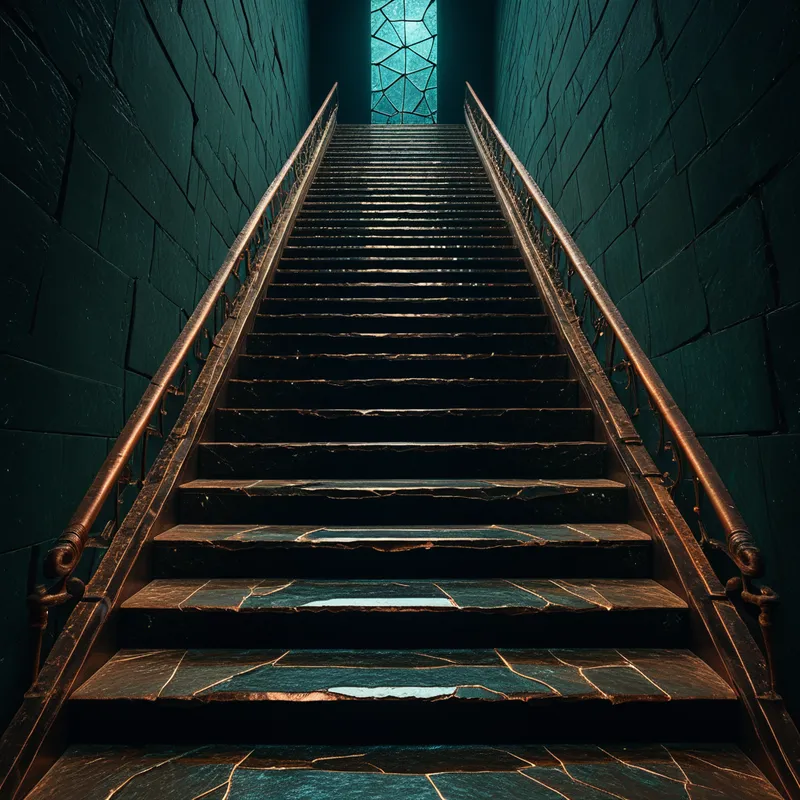
When this myth stirs in the modern dreamer, it often manifests not as a literal ladder, but as a profound sense of sequential ordeal. One may dream of being stuck on a specific floor of an endless building, of trying to solve a series of impossible puzzles to proceed, or of a staircase that changes material with each step. The somatic feeling is key: the leaden weight of a Saturnine dream, the frantic, mercurial speed of a Mercury dream, the dissolving warmth of a Venusian dream.
These dreams signal that a deep process of psychic reorganization is underway. The conscious personality is being systematically taken apart and reassembled by the Self. To dream of being unable to pass a step indicates where one’s development is arrested—where an inflation (Jupiter), an unresolved conflict (Mars), or a refusal to integrate a shadow aspect (Luna) is creating a blockage. The dream is a direct report from the interior Scala Philosophorum, showing the dreamer their current position on the arduous climb toward wholeness.
Alchemical Translation
For the modern individual, the Scala models the non-linear, yet sequential, path of individuation. Our culture offers endless shortcuts—peak experiences, quick fixes, spiritual bypasses—but the alchemical myth insists on the ordeal of the steps. You cannot jump from the depression of Saturn (lead) to the enlightenment of Sol (gold) without passing through the fiery trials of Mars and the loving dissolution of Venus.
The transmutation is in the traversal. The gold is not at the top of the ladder; it is the integrity forged in the climbing.
The practical “alchemical translation” is to identify which “planetary” stage one is enduring in life. A period of crushing responsibility and existential dread is the Saturn step; its task is to find the foundation in the weight. A time of explosive anger and boundary-setting is the Mars step; its task is conscious, ethical division. A phase of falling in love, with a person or a creative project, is the Venus step; its task is fusion without loss of self.
The myth teaches that each stage has its own intelligence and its own peril. The goal is not to reach a permanent solar state, but to develop the capacity to consciously navigate this eternal cycle. The Philosophers’ Stone is the realized ability to participate fully in each phase of being—to be lead, tin, iron, gold, copper, quicksilver, and silver—and know oneself, ultimately, as the alchemist who conducts the entire Work. The Scala Philosophorum, therefore, is not a path to heaven, but a blueprint for becoming fully, resiliently, and consciously human.
Associated Symbols
Explore related symbols from the CaleaDream lexicon: