Saturn/Lead Myth Meaning & Symbolism
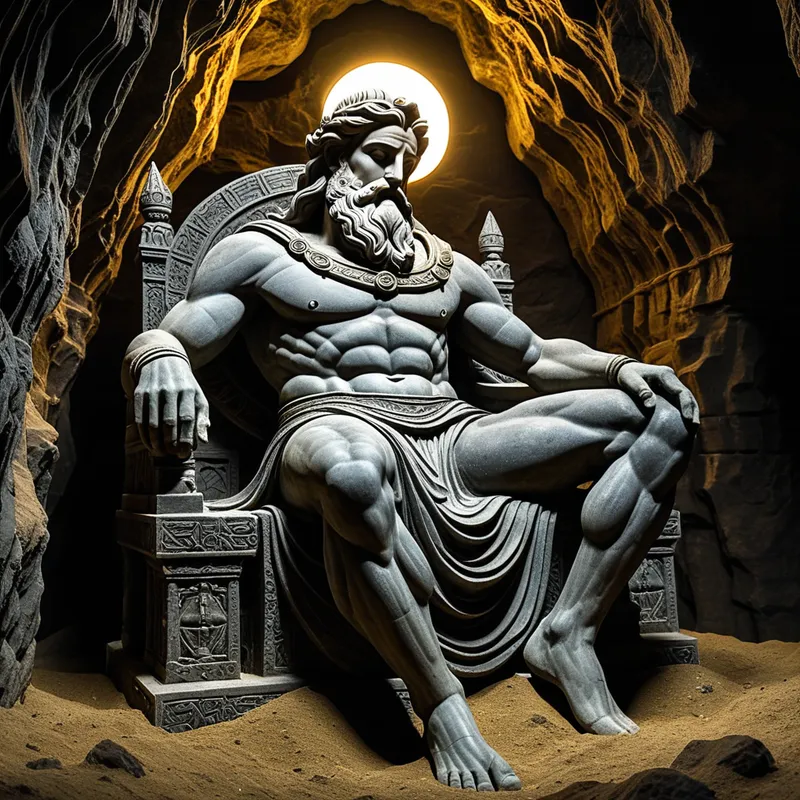
The myth of the ancient god Saturn, bound in lead, representing the necessary weight of time and limitation from which the soul's gold is born.
The Tale of Saturn/Lead
Listen. Before the world was bright, it was dense. Before the spirit soared, it slept, buried deep in the mountain’s cold heart. This is the tale of that sleep, of the weight that dreams of flight.
In the beginning, there was only Prima Materia—a swirling, chaotic sea of potential. From this sea, the old gods arose, and greatest among the ancients was Saturn. He was not a god of light, but of boundaries. His scythe did not cut wheat, but the thread of moments. He was time itself, patient, relentless, and cold. His kingdom was not in the sunlit heavens, but in the deep, silent places: the frozen soil, the bedrock, the long shadow cast by every living thing.
A great melancholy settled upon Saturn. He saw all things born, flourish, and be consumed by the very time he wielded. He was the father who devoured his children, not out of malice, but out of a terrible, lonely law. The other gods, bright and quick, fled his heavy presence. In his solitude, Saturn turned his scythe inward. He pronounced his own sentence: exile. Not to a distant land, but into the very substance of his nature.
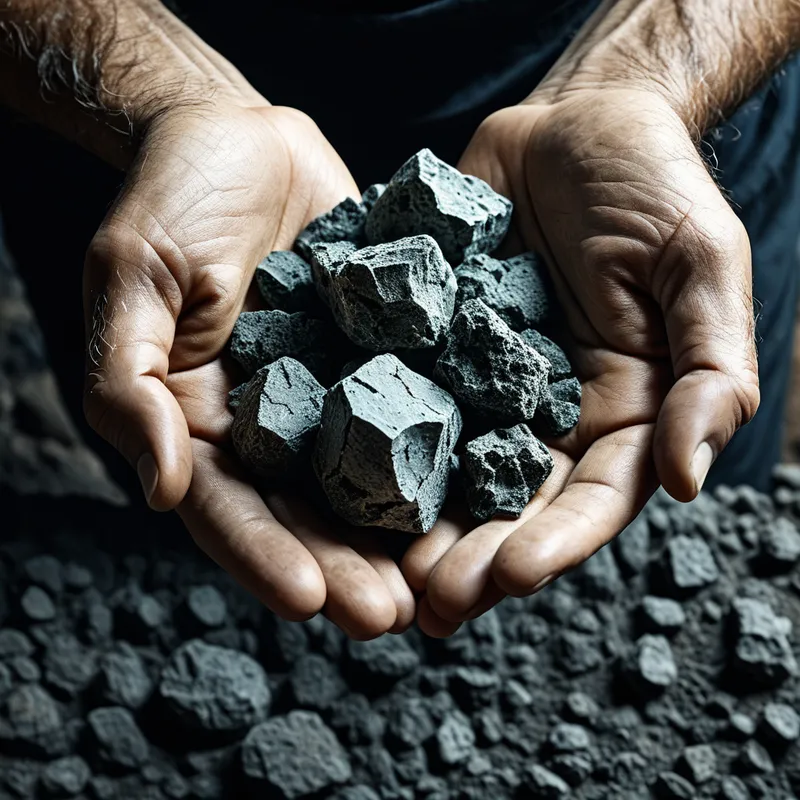
He descended from his bleak throne and walked into the deepest chasm of the earth. There, he called upon the spirits of the mountain. “Bind me,” he commanded, his voice like grinding stone. “Weave my essence into that which is most base, most heavy, most forgotten.” The mountain spirits wept tears of iron and whispered spells of condensation. They drew the cold, slow essence of Saturn into themselves, and from their breath, a new metal was born. It was dull, grey, and impossibly heavy. It did not shine. It did not ring. It absorbed all light and sound into a profound silence. This was lead.
Saturn did not resist. He allowed his limbs to stiffen, his form to compact, his divine consciousness to be submerged in a profound, mineral slumber. The god of time became the prisoner of matter. The scythe fell from his hand and rusted into the ore. His crown of stars tarnished and sank into the grey mass. All that remained was a weight, a coldness, a seeming death.
For eons, he slept within the leaden veins of the world. The sun rose and fell above, unaware. Kingdoms were built and crumbled into dust. Yet, in that absolute darkness, in that crushing density, a secret was kept. A promise. For Saturn, in binding himself, had not destroyed his nature but had concentrated it. He was the seed buried in the winter earth. He was the question not yet asked. He was the long, slow pressure that turns carbon into diamond. He was the necessary night, holding within its black womb the first, faint dream of light.
Cultural Origins & Context
The myth of Saturn/Lead is not a single story from a sacred text, but a living, breathing metaphor that permeated the entire practice of alchemy across Europe and the Islamic world. It was passed down not by bards, but by adepts in smoky laboratories and encoded in cryptic, illustrated manuscripts like the Rosarium Philosophorum. Its tellers were philosophers, physicians, and seekers who saw in the operations of chemistry a mirror for the soul’s journey.
Societally, this myth functioned as a map of the invisible. In an age where the line between matter and spirit was blurred, the alchemist’s work was a sacred duty. The “lead” was not just a metal; it was the unrefined soul, the burden of the mortal condition, the “base matter” of one’s own life experience—full of fear, limitation, and confusion. The myth provided a divine justification for engaging with this darkness. It said: even the lowest, most despised substance contains a god. Your despair, your inertia, your Saturnine melancholy, is not waste. It is the prima materia. It is the starting point of the Great Work.
Symbolic Architecture
Psychologically, Saturn/Lead represents the principle of Nigredo, the essential first stage of any profound transformation. It is the archetype of necessary limitation, contraction, and confrontation with the shadow.
Saturn is the psychic gravity that pulls all flighty fantasies back to earth, to the reality of the body, of time, of consequence.
The god who binds himself symbolizes the ego’s necessary capitulation. We must willingly enter our own leaden state—our depression, our stuckness, our feelings of worthlessness—and not flee from it. This is not masochism, but the deepest realism. Saturn’s scythe is the cut of consciousness that severs us from childish omnipotence, forcing us to acknowledge our boundaries, our mortality, our flaws. The lead is the weight of this realization, the somatic experience of the burden of selfhood.
Yet, within this symbol lies the alchemical secret: the poison is the cure. The very substance that binds (lead) contains the key to liberation (the latent gold). Saturn is not the enemy, but the severe, silent guardian of the threshold. His melancholy is the fertile void, the vacuum domicilium where new consciousness can gestate.
The Dreamer’s Resonance
When this myth stirs in the modern unconscious, it manifests in dreams of profound weight and constraint. The dreamer may find themselves trapped in a small, dark room made of cold metal, or sinking in quicksand or tar. They may be carrying a impossibly heavy, shapeless burden, or trying to run with legs of stone. The somatic feeling upon waking is often one of deep fatigue, pressure on the chest, or a chilling inertia.
These are not nightmares of external persecution, but visitations from the internal Saturn. They signal that the psyche is in the Nigredo phase. An old way of being, an inflated identity, or a neglected truth is undergoing a necessary dissolution. The dreamer is being “led back to lead”—forced to confront the base matter of their existence. It is a psychic winter, a time where energy is withdrawn from the surface world and concentrated in the roots. The dream is the soul’s way of saying, “Stop. You can go no further in the old way. Now, you must wait, and bear the weight of what is.”

Alchemical Translation
The transmutation of Lead into Gold is the core model of individuation. It describes how we turn the raw, often painful material of our lives into the “gold” of self-realization and wisdom.
The process begins with Saturnization: the conscious acceptance of one’s limits, flaws, and mortality. This is the “binding in lead.” One must say, “This heaviness I feel is not an error to be fixed, but my starting point.” It is a descent into sober self-assessment, often triggered by crisis, failure, or the simple weariness of living an inauthentic life.
The alchemist does not fight the lead; they heat it in the vessel of attention, knowing the god sleeps within.
Then comes the Ablutio, the purification by the waters of emotion and reflection, often experienced as tears, grief, or deep introspection. This washes away the dross, the false narratives, leaving only the essential, dense core of the experience.
Finally, under the sustained, patient fire of conscious work—therapy, art, meditation, relationship—the sealed vessel of the endured experience cracks. The latent “gold” is revealed. This gold is not happiness, but meaning. It is not the elimination of leaden feelings, but the discovery of their purpose. The Saturnine limitation becomes the source of depth, patience, and authentic authority. The individual who has undergone this finds that their “lead”—their past wounds, their depressions, their flaws—has become the foundation of their unique value. They have, in a psychological sense, freed the god within the ore, not by escaping time and matter, but by fulfilling its deepest, most patient law. The Sage is born from the ashes of the bound King.
Associated Symbols
Explore related symbols from the CaleaDream lexicon: