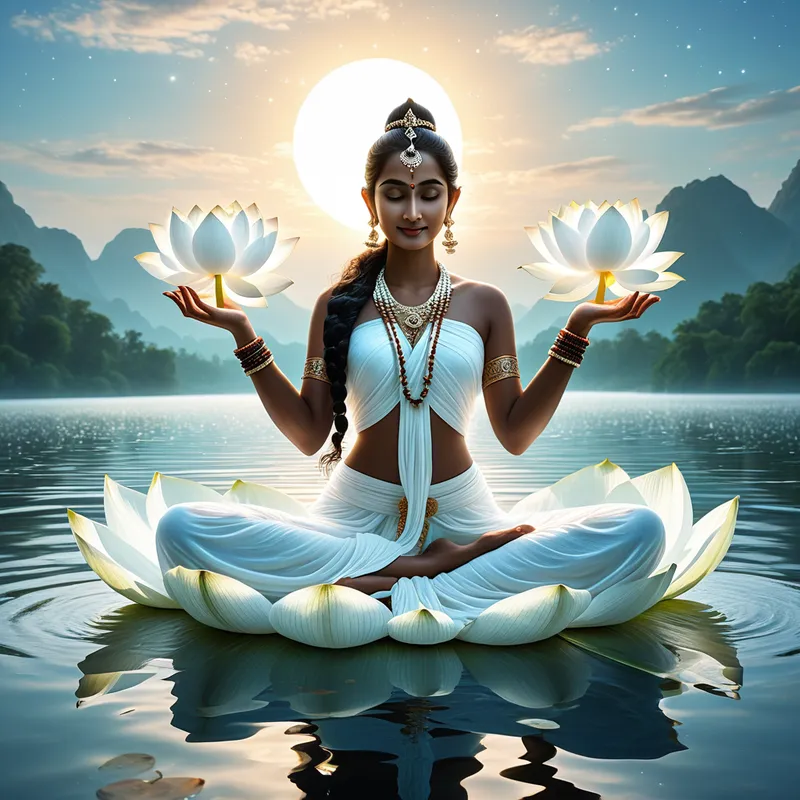
Saraswati Myth Meaning & Symbolism
The story of the primordial river-goddess whose sacred flow carves reality from chaos, embodying the sound, wisdom, and creative current of the cosmos.
The Tale of Saraswati
In the beginning, before the worlds had names and the gods had forms, there was only the great, undifferentiated ocean of potential. From its silent depths, a yearning arose—a vibration, a hum that sought to know itself. This hum became a thought, and the thought became a sound: the unstruck, primordial syllable, OM. And from the heart of that sound, she emerged.
She was not born; she flowed. She was the first movement, the first distinction, the first current in the still sea of Maya. They called her Saraswati, the Essence of Flow. She appeared as a river of pure, silver consciousness, carving her path through the formless dark. Her waters were not of water, but of luminous insight, and where she flowed, the chaotic potential began to coalesce. Mud became clay, clay became form, and form began to whisper of purpose.
Her sound attracted the first listeners. The great Brahma, the architect of manifested worlds, sat upon a lotus that bloomed from her currents. He opened his four faces, eager to name and categorize all of creation, but his mind was a cacophony of possibility. He could see the forms, but he could not hear their music; he could devise the structures, but he could not imbue them with meaning. His creation was a silent, static sculpture garden, beautiful but utterly lifeless.
Seeing his struggle, Saraswati, the flowing one, approached. She did not speak with words. She plucked the strings of the veena that manifested in her hands. A melody spilled forth—the same melody that had patterned the stars and tuned the orbits of the planets. It was the grammar of reality itself. As the music washed over Brahma, his chaotic thoughts aligned. The names for things arose in his mind not as labels, but as tones, each perfectly harmonizing with the celestial song. She placed a book of palm leaves in another hand—the Vedas inscribed not in ink, but in light. Finally, she offered a mala, a circle of crystalline beads, teaching him the rhythm of focus and the cycle of contemplation.
With her gifts—sound, wisdom, and disciplined focus—Brahma’s creation awoke. The sculptures breathed. The trees sang with the rustling of leaves. The rivers chanted their paths to the sea. The universe found its voice. Saraswati, satisfied, flowed on. She became the hidden current in all streams of knowledge, the clear tone in every true word, the silent space between thoughts where understanding blooms. She chose as her companion the pure white swan, the Hamsa, who possesses the mythical discernment to drink only the milk of truth, leaving the water of illusion behind. And so she flows eternally, the ever-present source, the sacred river that turns chaos into cosmos, and noise into knowing.

Cultural Origins & Context
The myth of Saraswati originates in the ancient Vedic tradition of the Indian subcontinent, dating back over three millennia. Initially, in the Rigveda, she was celebrated not as a anthropomorphic goddess, but as a literal, life-giving river—the Saraswati River—believed to be a mighty physical and spiritual artery of an early civilization. Her name itself means “the one who flows.” As Vedic culture evolved from a nomadic, nature-revering society into a more settled, philosophical one, the physical river is said to have vanished underground or dried up, completing her metaphysical transformation. She flowed from geography into psychology.
Her myth was preserved and elaborated by the Brahmins, the poets (rishis), and later, the storytellers and iconographers. Her primary societal function was dual: she was the patron of the practical, sacred knowledge necessary for maintaining cosmic order (rita/dharma) through ritual, and the inspirer of all creative arts—music, poetry, and science. She represented the ideal of vidya (illumination) as opposed to avidya. Her worship was, and remains, central at the commencement of any learning endeavor, from a child’s first alphabet lesson to a musician’s first performance, embedding her myth into the very fabric of cultural transmission and intellectual pursuit.
Symbolic Architecture
Saraswati is the archetypal embodiment of consciousness itself in its flowing, formative, and discerning aspects. She is not static wisdom but the process of knowing.
She represents the current that carries the raw data of existence into the meaningful patterns of lived truth.
Her white garments and posture symbolize purity (sattva guna) and transcendence over the muddy waters of ignorance and passion. Seated on a white lotus, she remains untouched by the chaos (the mire) from which she arises, indicating that true wisdom is in the world but not of it. Her four arms hold the tools of conscious creation: the veena (the harmony of all arts and sciences), the book (the concrete embodiment of knowledge), the mala (the discipline of focused mind), and the pot of sacred water (the purifying power of consciousness). The swan (hamsa) is her ultimate symbol: the ability to perform viveka, to separate the essential (milk) from the non-essential (water) in any experience. Psychologically, she is the Self’s capacity for lucid, creative, and discriminating intelligence.
The Dreamer’s Resonance
When the pattern of Saraswati flows into modern dreams, it signals a profound engagement with the psyche’s own creative and intellectual sources. To dream of a clear, flowing river where one drinks or bathes often accompanies a somatic sense of mental clarity and emotional purification—a washing away of psychic “static.” Dreaming of a musical instrument one cannot play, yet which produces beautiful sound, may point to an emerging, intuitive wisdom seeking expression beyond the ego’s current skills.
A dream of a silent library or a blank book that feels pregnant with meaning, not emptiness, resonates with Saraswati’s latent potential. The dreamer is at the threshold of a new stream of thought or creative endeavor. The appearance of a white bird, especially a swan or egret, gliding calmly through a chaotic dream landscape is a powerful symbol of the dreaming mind practicing discernment, seeking the core truth amidst inner turmoil. These dreams are not merely about acquiring information; they are somatic experiences of the psyche organizing itself, carving new neural and emotional pathways from the raw material of life experience.

Alchemical Translation
The myth of Saraswati models the alchemical process of individuation as the cultivation of a conscious, flowing relationship with one’s own inner source. The initial state is the “Brahma state”: the ego, full of creative potential and ideas, yet paralyzed by inner cacophony and unable to give birth to anything with authentic life or meaning. The ego’s creations are sterile intellectual constructs.
The alchemical work is to invite the Saraswati current—the voice of the Self—into this sterile workshop.
This involves several transmutations. First, listening for the inner melody (nada). This is the practice of turning inward through meditation, mindfulness, or immersion in art to hear the authentic pattern beneath the noise of personal complexes and societal expectations. Second, embodying the gifts: taking up one’s own “veena” (creative practice), one’s “book” (dedicated study), and one’s “mala” (disciplined focus) not as chores, but as sacred rituals to channel the flow. Finally, and most crucially, developing the discernment of the swan. This is the psychological process of differentiation—learning to separate the “milk” of one’s genuine feelings, values, and insights from the “water” of internalized judgments, fears, and borrowed identities.
The triumph is not in becoming a repository of facts, but in becoming a clear conduit. The individuated individual, in this model, is like the river: constantly in flow, constantly purifying, constantly carving new shapes of understanding from the bedrock of experience, and always in tune with the primordial hum from which all authentic creation springs.
Associated Symbols
Explore related symbols from the CaleaDream lexicon:
- Throat
- Study
- Channel
- Musical
- Tongue
- Flow
- Mental
- Expression
- Brilliant
- Streaming Service
- Online Learning
- Flowy Dress
- Cascading Dreams
- Enchanting Muse
- Cerulean Blue
- Periwinkle Wave
- Zircon Stone
- Tanzanite Gemstone
- Sodalite Sphere
- Silicon Wave
- Petunia Wave
- Dreamy Antenna
- Lizard’s Tongue Flick
- Glistening Duck
- Celestial Quill
- Musician’s Instrument
- Teacher’s Desk
- Teacher’s Lesson Plan
- Cello
- Gilded Sitar
- Metaphysical Kalimba
- Illuminated Zither
- Frayed Sitar Strings
- Musical Notes
- Socrates’ Toga
- Bob Marley’s Guitar
- Renaissance Palette
- Malala’s School Books
- Helen Keller’s Braille Book
- Harmonium
- Magic Storytelling
- Author’s Dream
- Roller Brush
- Cookbook
- Sound Mixer
- Scribbled Ideas
- Toy Piano
- Phantom Music Stand
- Ascendant Symphony
- Vedic Scriptures
- Wave of Understanding
- Ocean of Knowledge
- Translucent Insights
- Glimmering Stream
- Sonic Bloom
- Laminar Flow
- Assonance
- Synonym
- Adjective
- Productive
- Expressive
- Input
- Soundtrack
- Binah
- Flowing
- Logic