Salon of Madame de Staël Myth Meaning & Symbolism
A myth of a brilliant woman whose Parisian salon becomes a sanctuary for free thought, challenging a tyrant's empire with the power of conversation and soul.
The Tale of Salon of Madame de Staël
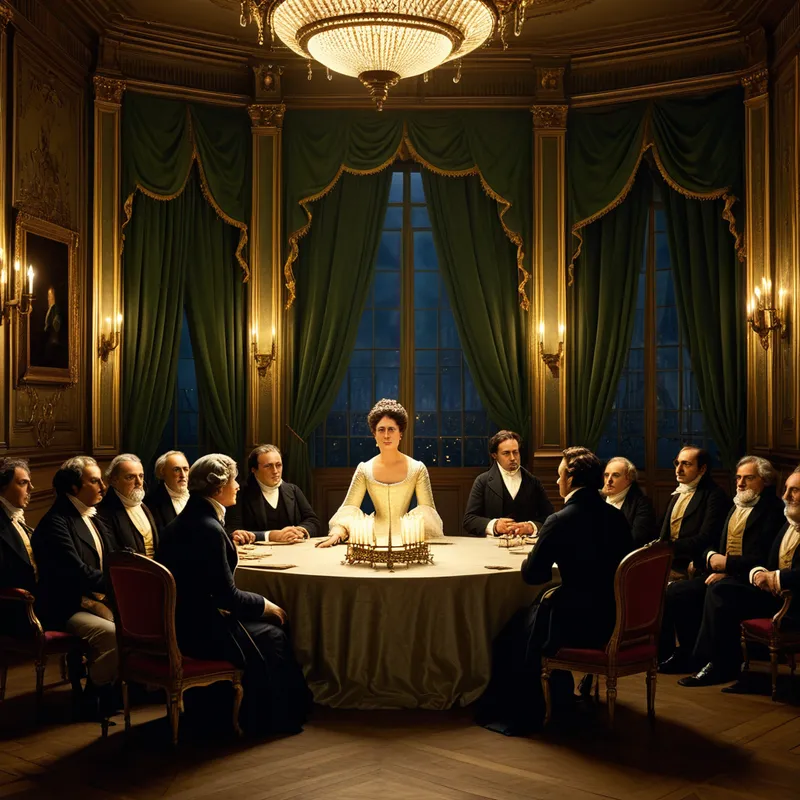
In the heart of a city that fancied itself the new Rome, under the shadow of eagles and the cold gleam of imperial ambition, there existed a different kind of empire. Its capital was not a palace, but a salon. Its sovereign was not a man crowned with gold, but a woman crowned with thought: Germaine, Madame de Staël.
Her realm was a chamber of gilded mirrors and velvet drapes, perpetually alive with the soft roar of a dozen conversations. The air was thick with the scent of beeswax candles, fine perfume, and the intoxicating aroma of ideas too dangerous for the sunlit streets. Here, the currency was wit, the law was logic, and the only passport required was a hungry mind. Poets with fire in their verses, philosophers with worlds in their theories, politicians with shattered ideals—all found sanctuary within these walls. They were the émigrés of the spirit, and she was their undisputed queen, drawing truth from them like a diviner draws water from stone.
But a shadow grew over Paris, long and monolithic. It was the shadow of a single will, a modern Titan who demanded not just obedience, but silence. He could command armies and redraw maps, but the luminous, unruly republic of minds in the Rue du Bac was a conquest that eluded him. He sent warnings that fell like frost. He dispatched spies who listened, but could not comprehend the alchemy they witnessed. The conflict was not of sword against sword, but of monologue against dialogue, of imposed order against organic genius.
The final decree came not with a bang, but with a coldly written order. Exile. She was banished from her city, from the very air that fed her intellect. The salon fell silent, its light extinguished. Yet, as her carriage rolled eastward, away from the center of the world, something miraculous occurred. The salon did not die; it migrated. It reconstituted itself in the chateaus of Coppet, in the drawing rooms of Weimar and Rome. Her exile became a pilgrimage, and her voice, amplified by injustice, became a clarion call across Europe. She wrote not with ink, but with lightning—tomes on literature and passion that dissected the soul of nations and the tyranny of a single soul. The empire of silence had banished a woman, but in doing so, it had unleashed a myth. The conflict found its resolution not in a battle, but in a boundless, unstoppable conversation that echoed far beyond any border, proving that a mind in full flight cannot be caged by any earthly edict.

Cultural Origins & Context
This is not a myth from the misty prehistory of Gaul, but a living legend born from the very crucible of modernity: the aftermath of the French Revolution and the rise of Napoleonic absolutism. The historical Madame de Staël (1766-1817) was a real force—the daughter of finance minister Jacques Necker, a prolific novelist, and the era’s most formidable intellectual hostess. The “myth” of her salon emerged from the collision between her vibrant, inherited Enlightenment ideals and the new, oppressive political reality.
The tale was passed down not by peasant folklore, but through memoirs, letters, and the works of the very luminaries who graced her rooms—Chateaubriand, Goethe, Schiller. Its societal function was multifaceted. For liberals and romantics, it served as a foundational narrative of intellectual resistance, a testament to the power of civil society against the state. For critics, it was a cautionary tale about the political perils of salon influence. Ultimately, it functioned as an origin story for the modern European intellectual: the thinker as a cosmopolitan, independent force, often in necessary opposition to power, whose true nation is the republic of letters.
Symbolic Architecture
At its core, the myth symbolizes the Self in its struggle against the crushing, homogenizing force of the Persona demanded by collective tyranny. The Salon is not merely a room; it is a temenos—a sacred precinct for the psyche. It represents the inner sanctum where complex, contradictory thoughts are allowed to meet, debate, and synthesize without the demand for a single, reductive conclusion.
The true empire is not of land, but of connection; not of enforced silence, but of cultivated speech.
Madame de Staël herself embodies the Senex archetype, but fused with a potent, feminine Anima as leader. She is the psychopomp of ideas, guiding fragments of thought toward wholeness. Napoleon, in the mythic frame, represents the negative aspect of the Father archetype—the will to power that seeks to amputate the complexity of the soul in favor of a sterile, functional order. Exile, then, is transformed from a punishment into a necessary hegira. It is the painful but essential separation from the familiar (the collective consciousness of Paris) that forces the individuating psyche to rely on its own inner resources and to find its truth in a wider, more universal context.

The Dreamer’s Resonance
To dream of the Salon is to dream of a part of one’s own psyche that is yearning for integration. It often appears during periods of intellectual or creative stifling, when external authorities (a job, a relationship, societal expectations) are demanding conformity and silencing inner dialogue.
The somatic experience can be one of both exhilaration and profound anxiety. You may feel the thrilling buzz of animated conversation in the dream, a sense of belonging and mental acuity, juxtaposed with the chilling dread of a looming, faceless authority threatening to break down the door. The dream may culminate in a forced departure—leaving the salon, losing the thread of a crucial argument, the room dissolving. This signifies the painful but necessary recognition that the current environment is hostile to the soul’s growth. The dream is a profound nudge from the unconscious: your inner daimon, your unique intellectual and spiritual fingerprint, is being exiled. It is time to build your salon elsewhere—in a new journal, a new circle of friends, a new internal commitment to your own uncensored truth.

Alchemical Translation
The alchemical process modeled here is that of Citrinitas—the dawning of the intellectual sun after the blackening (Nigredo) of exile and the whitening (Albedo) of lonely reflection.
The crucible of exile does not destroy the self; it distills it. What is burned away is the need for permission; what remains is the imperative to speak.
The initial, glorious salon represents the unconscious gathering of one’s talents and ideas—a blessed, but naive, state where the psyche enjoys its riches without yet confronting the dominant power of the outer world (the personal or collective Napoleon). The confrontation and exile are the essential separatio. The self must be ripped from its comfortable, socially-approved container to truly know itself. The work of exile—the writing, the traveling, the forging of new connections—is the fermentatio and multiplicatio.
The ultimate transmutation is not a return to Paris in triumph, but the realization that the salon was never a place at all. It is a state of being. The individuated psyche becomes a walking, breathing salon—a perpetual, internal, and external forum where opposites converse, where soul speaks to soul, and where the authority of one’s own lived experience and hard-won insight becomes the only ruler one consents to recognize. The myth concludes not with a hero’s return, but with a sage’s dissemination: the point of power is no longer a fixed throne, but a radiating, boundless influence.
Associated Symbols
Explore related symbols from the CaleaDream lexicon: