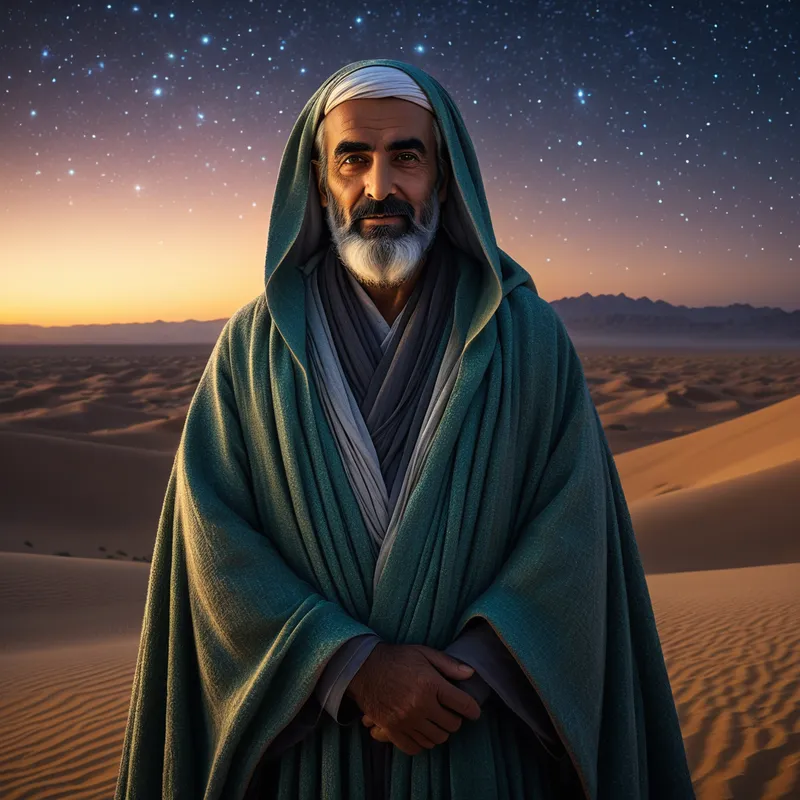
Salman the Pure Companion Myth Meaning & Symbolism
A seeker's epic journey from bondage to liberation, guided by an inner truth that burns away illusion to reveal the divine presence within.
The Tale of Salman the Pure Companion
Listen, and let the tale be told of one who walked the earth yet whose heart resided in the unseen. In the land of Fars, in a village cradled by arid mountains, a boy was born to a noble Zoroastrian family. His name was Salman. From his first breath, a divine discontent stirred within him—a haunting melody of a home he had never seen. The sacred fires of his fathers, though beautiful, could not warm the chill of a deeper longing in his soul.
As a youth, he was sent on an errand to his father’s vast estates. The path led him past an ancient Christian monastery clinging to a cliffside. From within, a sound drifted on the wind—not a song, but a prayer, a chant so pure it seemed to pierce the very fabric of the world. It entered his chest and resonated with the hidden melody of his heart. He stood, transfixed, until the sun dipped below the horizon. When he finally entered the monastery, the monks spoke of a final Prophet, a Khatam an-Nabiyyin, who would come with the primordial religion of Abraham. In that moment, the vague longing crystallized into a single, burning purpose: to find him.
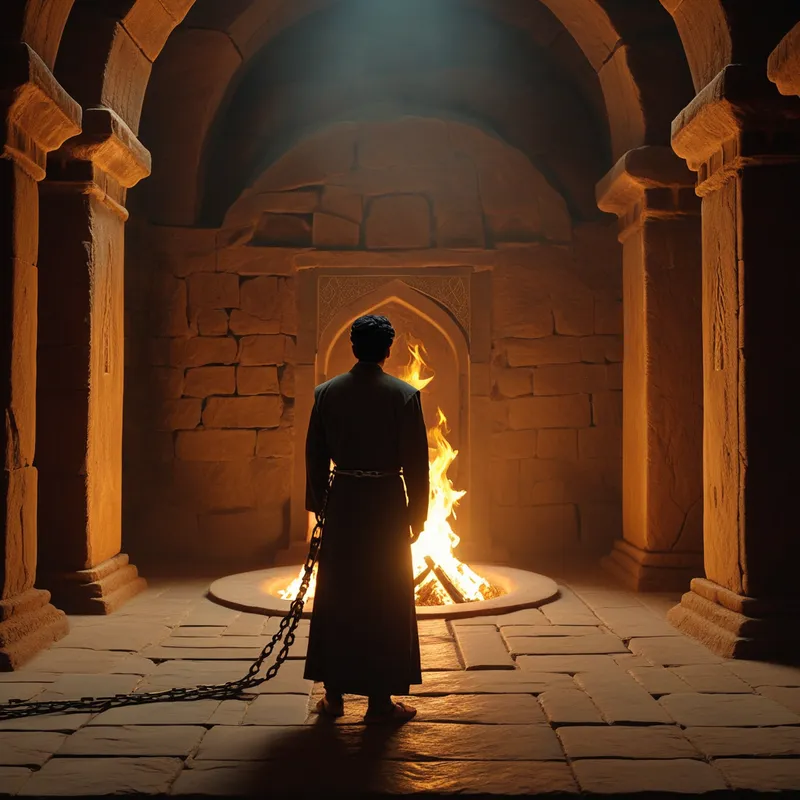
Thus began the great unraveling. He abandoned his family, his wealth, his inherited gods. His quest became a descent—from noble son to wandering seeker, from seeker to betrayed captive, sold into slavery. Chains bound his ankles, yet his spirit soared on the wings of his certainty. He was sold from master to master, each a station on his inward road. One master, a Jewish scholar from the tribe of Bani Qurayza, recognizing the light in his slave, promised him freedom if he helped establish a date-palm orchard. For years, Salman tended the arid soil, planting each sapling with a prayer, watering each root with the sweat of his brow. When the palms grew tall and bore fruit, the master broke his oath. Salman’s heart did not break with it; it grew still more patient, for he knew every “no” brought him closer to the ultimate “yes.”
His final master brought him to Yathrib. There, rumors swirled of a stranger in Makkah speaking of one God. Salman’s soul trembled. When news came that this man had fled to Yathrib itself, Salman took the first fruits of the palm harvest and went to the edge of the city. He saw a man surrounded by light, not of the sun, but of grace. He offered the dates, saying, “This is charity.” The man gave them to his companions. Salman returned, heart sinking. He tried again, saying, “This is a gift.” The man ate from it himself. In that simple, profound act—the acceptance of a gift over charity—Salman knew. This was the one who saw the man, not the slave. He fell to his knees, weeping the tears of a thousand journeys ended, and began to tell his story. The Prophet Muhammad listened, then placed his blessed hand on Salman and said, “You are one of us, of the Ahl al-Bayt.” Salman, the seeker from Fars, was freed, body and soul. He became Salman al-Farsi, the Pure Companion, a living bridge between worlds.
Cultural Origins & Context
The story of Salman is not a formal, codified myth but a living hagiography that pulses at the heart of Sufi tradition. It is drawn from the earliest Islamic histories and Hadith, but in the hands of Sufi poets and masters—from Rumi to Attar—it was alchemized into the supreme allegory of the soul’s journey. It was told in khanqahs and whispered in circles of remembrance, not merely as biography but as a mirror for every aspirant.
Its societal function was multifaceted. For a Persianate world entering the Islamic fold, Salman represented validation and integration, proving spiritual nobility was not a matter of tribe or lineage, but of heart and seeking. For the Sufis, it modeled the complete faqr required on the path: the abandonment of all worldly identity (family, religion, social status) in passionate pursuit of the Divine Beloved. The story democratized sainthood, showing that the highest station could be reached from the lowest earthly position—that of a slave.
Symbolic Architecture
Salman is the archetype of the salik, the wayfarer. His journey is the soul’s odyssey from the bondage of conditioned identity (nafs) to the freedom of essential truth (fitrah). Each stage is a symbolic death.
The true slavery is not the chain on the ankle, but the unquestioned belief in the name you were given at birth. Liberation begins when you sell yourself to the quest.
His Zoroastrian birth represents the soul’s initial confinement within a legitimate but partial truth—the fire of spirit trapped in rigid form. The Christian monks symbolize the intuition of a coming fulfillment, the heart’s recognition of a more intimate covenant. His successive enslavements are the stripping away of attachments: to homeland, to comfort, to the very hope of fairness. The date-palm orchard is a profound symbol of tawakkul; he labors for years on a promise, his work itself becoming his worship, his patience the fertilizer for the trees—and for his own soul. The final test with the dates is the ultimate discernment: charity (zakat) maintains distance, while a gift (hadiyya) creates kinship. The Prophet’s acceptance signifies the Divine recognizing and embracing the purified soul, not for its deeds, but for its essence.

The Dreamer's Resonance
When this myth stirs in the modern unconscious, it often manifests as dreams of profound searching within constraint. One may dream of being a scholar in a library where all the books are in a forgotten language, yet feeling an urgent need to find one specific volume. Or of working a tedious, repetitive job, but with the somatic sensation that each repetitive motion is secretly carving a key.
These dreams signal the psyche’s engagement in the Salman Process: a deep, often frustrating, phase where the conscious ego feels trapped by circumstances (a job, a relationship, an internalized belief system), while the Self is using that very constraint as the necessary crucible. The emotional tone is not of despair, but of poignant, patient urgency. There is a somatic signature of a "pulling" in the chest—the heart’s magnetic attraction to its origin. The dreamer is being taught that the path to freedom runs directly through the center of their apparent bondage.

Alchemical Translation
Psychologically, Salman’s myth maps the individuation process with stunning clarity. The starting point is the persona—the “Zoroastrian nobleman”—a socially coherent but spiritually suffocating identity. The call of the monks is the eruption of the Self, the first undeniable intimation that one’s current life is a translation of a far richer original text.
The alchemy occurs not in escaping the chain, but in discovering the chain is made of a metal that can be transmuted into a mirror.
The long years of slavery are the shadow work. Each “master” represents an unconscious complex—perhaps the “Betrayal” complex, the “Injustice” complex, the “Labor-Without-Reward” complex—that must be consciously served and endured until its psychic energy is redeemed. This is the nigredo, the blackening, where all false lights are extinguished. Planting the orchard is the commitment to life and growth even in the desert of the soul, the slow, faithful building of psychic structure (nakhl).
The final meeting with the Prophet is the coniunctio, the sacred marriage of the purified soul (Salman) with the inner guiding principle, the al-Insan al-Kamil. It is the moment when the seeker realizes the Guide was not an external figure to be found, but the deepest truth of his own seeking itself, made manifest. He is freed because he finally recognizes himself as free. The transmutation is complete: the slave is revealed as the sage, the seeker as the sought.
Associated Symbols
Explore related symbols from the CaleaDream lexicon:
- Journey — The central motif of Salman's life, representing the soul's obligatory migration from the periphery of illusion to the center of divine reality.
- Fire — The sacred flames of his birth, later transformed from an external object of worship into the inner, consuming passion that guides his search.
- Chains — The literal and symbolic bondage of inherited identity, social expectation, and worldly attachment that must be willingly carried on the path to liberation.
- Tree — The date-palm orchard he cultivates, symbolizing patience, fruitful labor, and the slow, organic growth of the soul even in arid conditions.
- Key — The intuitive recognition in the Prophet's simple act of accepting a gift, which unlocks the final door to his spiritual homeland.
- Companion — The ultimate state Salman achieves, not as a follower but as an intimate member of the spiritual family, embodying divine friendship.
- Shadow — The successive masters and periods of enslavement, representing the necessary engagement with and integration of the psyche's oppressed and powerless aspects.
- Light — The inner radiance that guides him through darkness, culminating in the recognition of the prophetic light, which is the light of the awakened Self.
- Gift — The transformative moment where charity becomes communion, symbolizing the shift from transactional spirituality to the offering of the pure heart.
- Heart — The true compass of the journey, the organ of spiritual perception that heard the call long before the mind understood it.