
Sacred Fire Myth Meaning & Symbolism
A primal myth of a divine flame stolen or gifted to humanity, sparking consciousness, culture, and the perilous journey of self-knowledge.
The Tale of Sacred Fire
In the beginning, there was a coldness. Not the clean cold of winter, but a deep, marrow-chilling absence. Humanity huddled in damp caves, their teeth chattering not just from the chill of stone, but from the chill of the soul. They ate their meat raw, its bloody taste the only warmth they knew. They watched the sun flee each evening, abandoning them to a world of teeth and shadows. The gods, in their high halls of Olympus or their celestial domains, possessed a brilliant, crackling secret: Fire. It danced in their hearths, forged their weapons, and lit their councils. It was the essence of power, of craft, of consciousness itself—and it was forbidden.
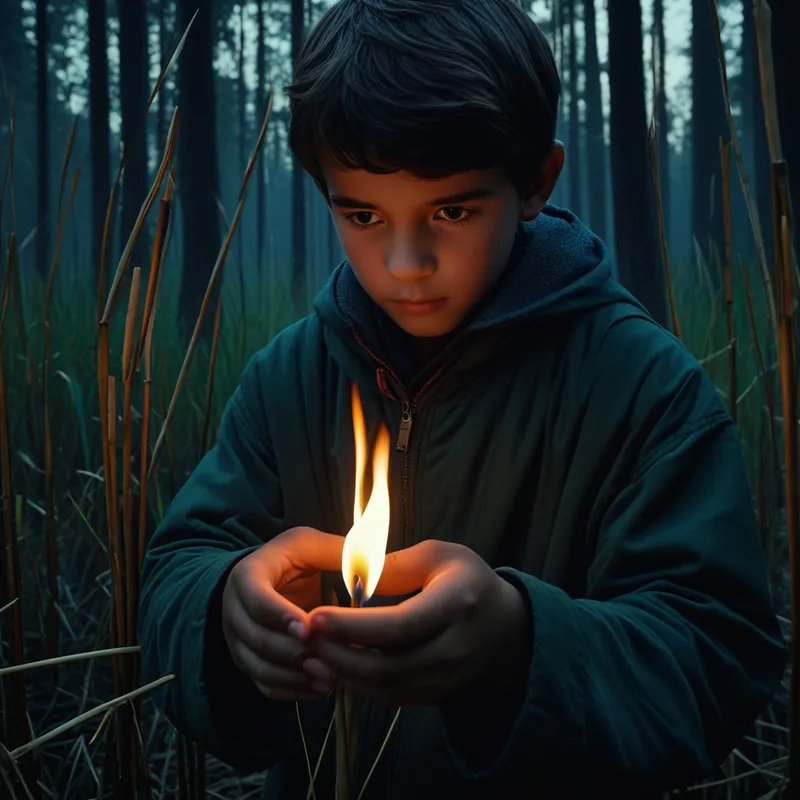
But one being looked down upon the shivering creatures of clay and felt not contempt, but a kinship that burned hotter than any divine decree. He was the Titan [Prometheus](/myths/prometheus “Myth from Greek culture.”/), whose name means “Forethought.” He stole into the sun-chariot’s path, or perhaps the very workshop of the gods, and with a fennel stalk—a hollow, humble reed—he captured a fragment of the celestial flame. The heat was a living [thing](/myths/thing “Myth from Norse culture.”/), a struggling starlet. He carried it down the long slope of heaven, shielding it from [the wind](/myths/the-wind “Myth from Various culture.”/) of his descent, feeling its promise sear his palms.
He presented it to the first humans where they crouched by a muddy river. They flinched from the light, their eyes wide with animal fear. But Prometheus showed them: how to tender a pile of twigs into a roaring embrace, how to harden a spear point in its kiss, how to bake clay into pottery that could hold memory. The fire did not just warm their skin; it lit a spark behind their eyes. Stories were born in its flickering light, plans were drawn in its embers. The dark was pushed back, not just from [the cave](/myths/the-cave “Myth from Platonic culture.”/) mouth, but from the mind.
The ruler of the gods, Zeus, was enraged. This was not mere theft; it was rebellion against the natural order. The gift of fire was the gift of potential, and potential is chaos to a tyrant. For his crime of compassion, Prometheus was dragged to the remotest crag of the Caucasus mountains. Unbreakable chains, forged by [Hephaestus](/myths/hephaestus “Myth from Global/Universal culture.”/) himself, bound him to the naked rock. And each day, a great eagle—the emblem of Zeus—swooped down to tear open his flesh and feast upon his immortal liver. Each night, as the cold stars wheeled above, the liver regrew, ensuring the agony was as eternal as the flame he had given. Yet, from his agonized perch, Prometheus watched the pinpricks of campfires spread across the darkening earth, and in his suffering was a terrible, unyielding satisfaction.
Cultural Origins & Context
The myth of the stolen or gifted sacred fire is not a singular story but a profound archetype echoing across continents and epochs. Its most famous articulation is in Hesiod’s Theogony and later in Aeschylus’s tragedy Prometheus Bound, where it served as a foundational narrative for Greek culture, explaining humanity’s technological rise and its fraught relationship with the divine. But the pattern is universal.
In Zurvanite tradition, the hero Thraetaona battles a three-headed dragon to reclaim the divine Farr (royal glory), often symbolized by fire. In Siberian shamanism, [the shaman](/myths/the-shaman “Myth from Siberian culture.”/)’s arduous journey to retrieve healing fire from the spirit world is a core initiatory ordeal. The Vedic god Agni is himself [the sacred fire](/myths/the-sacred-fire “Myth from Native American culture.”/), a messenger between gods and humans, dwelling in every household hearth and sacrificial altar. For the Kwakwaka’wakw of the Pacific Northwest, the myth of Qanis and the Seagull tells of fire being stolen from a jealous being who kept it for himself, bringing light and warmth to the people.
This myth was never mere entertainment. It was told at gatherings, by hearths it helped create, to explain the central paradox of human existence: our elevated consciousness and our profound suffering. It functioned as a sacred charter for the role of the innovator, the sacrificer, and the rebel. It validated the painful truth that enlightenment—both literal and psychological—often comes at a terrible, personal cost, and that it separates us forever from a simpler, more ignorant state.
Symbolic Architecture
At its core, the Sacred Fire is the [symbol](/symbols/symbol “Symbol: A symbol can represent an idea, concept, or belief, serving as a powerful tool for communication and understanding.”/) of conscious [awareness](/symbols/awareness “Symbol: Conscious perception of self, surroundings, or internal states. Often signifies awakening, insight, or heightened sensitivity.”/) itself. It is the light that allows us to see—to perceive [the world](/myths/the-world “Myth from Tarot culture.”/), to recognize ourselves, and to foresee consequences (Prometheus, the “Forethinker”).
The stolen fire is the moment the unconscious becomes conscious; it is the birth of the ego from the womb of instinctual, collective existence.
The gods who hoard the fire represent the unconscious totality, the [status](/symbols/status “Symbol: Represents one’s social position, rank, or standing within a group, often tied to achievement, power, or recognition.”/) quo of [nature](/symbols/nature “Symbol: Nature symbolizes growth, connectivity, and the primal forces of existence.”/) or the [psyche](/myths/psyche “Myth from Greek culture.”/) that operates on instinct and immutable law. Prometheus, the rebel [Titan](/symbols/titan “Symbol: Titans represent immense power, strength, and a connection to the primordial forces of nature and creation.”/), embodies the emerging principle of individual [consciousness](/symbols/consciousness “Symbol: Consciousness represents the state of awareness and perception, encompassing thoughts, feelings, and experiences.”/) and [compassion](/symbols/compassion “Symbol: A deep feeling of empathy and concern for others’ suffering, often involving a desire to help or alleviate their pain.”/) that must inevitably conflict with the old order. His theft is the necessary “[crime](/symbols/crime “Symbol: Crime in dreams often symbolizes guilt, inner conflict, or societal rules that are being challenged or broken.”/)” of individuation—the selfish act that ultimately serves the collective by raising its level of awareness.
The fennel stalk, a hollow, common plant, signifies the [vessel](/symbols/vessel “Symbol: A container or structure that holds, transports, or protects something essential, representing the self, emotions, or life journey.”/) of the [body](/symbols/body “Symbol: The body in dreams often symbolizes the dreamer’s self-identity, personal health, and the relationship they have with their physical existence.”/) and the mortal mind—the fragile, temporary container for [the divine spark](/myths/the-divine-spark “Myth from Gnostic culture.”/). The [eagle](/symbols/eagle “Symbol: The eagle is a symbol of power, freedom, and transcendence, often representing a person’s aspirations and higher self.”/) is the relentless, tearing scrutiny of the conscious mind (Zeus’s [bird](/symbols/bird “Symbol: Birds symbolize freedom, perspective, and the connection between the earthly and spiritual realms, often representing the soul’s aspirations or personal growth.”/)) upon the [source](/symbols/source “Symbol: The origin point of something, often representing beginnings, nourishment, or the fundamental cause behind phenomena.”/) of our vitality (the [liver](/symbols/liver “Symbol: Represents emotional processing, purification, and vitality. Often symbolizes anger, toxicity, or life force in dreams.”/), ancient seat of [passion](/symbols/passion “Symbol: Intense emotional or physical desire, often linked to love, creativity, or purpose. Represents life force and deep engagement.”/) and [life](/symbols/life “Symbol: The symbol of ‘Life’ represents a journey of growth, interconnectedness, and existential meaning, encompassing both the joys and challenges that define human experience.”/)-force). The eternal [punishment](/symbols/punishment “Symbol: A dream symbol representing consequences for actions, often tied to guilt, societal rules, or internal moral conflicts.”/) is the perpetual [condition](/symbols/condition “Symbol: Condition reflects the state of being, often focusing on physical, emotional, or situational aspects of life.”/) of the conscious [human](/symbols/human “Symbol: The symbol of a human represents individuality, complexity of emotions, and social relationships.”/): we are forever chained to the rock of our mortal limitations, our enlightenment forever feeding the birds of [anxiety](/symbols/anxiety “Symbol: Anxiety in dreams reflects internal conflicts, fears of the unknown, or stress from waking life, often demonstrating the subconscious mind’s struggle for peace.”/), [responsibility](/symbols/responsibility “Symbol: Responsibility in dreams often signifies the weight of duties and the expectations placed upon the dreamer.”/), and the pain of knowing.
The Dreamer’s Resonance
When this myth stirs in the modern dreamer, it often manifests as dreams of discovery or perilous possession. You may dream of finding a hidden, radiant object in a dark basement (the unconscious), of holding a lit match in a howling gale, or of desperately trying to hide a small, warm, living light from pursuing authorities.
Somatically, this can correlate with a feeling of burning in the chest (the ignited heart-center), restlessness, or a sense of carrying a fragile, vital secret. Psychologically, you are likely at the precipice of a significant awakening. An insight, a truth about your life or your self, is struggling to be born. This “fire” is a new level of personal truth, a creative idea, or the courage to break a familial or societal pattern. The conflict in the dream mirrors the inner conflict: part of you (the internalized “gods” or super-ego) seeks to maintain the old, cold order, while the Promethean spirit within urges you toward the dangerous gift of greater consciousness.
Alchemical Translation
The alchemical journey mirrored in this myth is the Calcinatio—the burning away of the [prima materia](/myths/prima-materia “Myth from Alchemical culture.”/) of our naïve, unconscious existence to reveal the purified spirit. The modern individuation process follows this exact, painful trajectory.
First, one must feel the coldness—the profound dissatisfaction with a life lived by others’ rules, a soul left raw and unilluminated. Then comes the rebellious insight (the theft): a moment of clarity, often felt as transgressive, that says, “I must claim my own light, my own authority, even if it defies tradition or expectation.” This is the fennel stalk moment, where the divine is captured in a personal vessel.
The eagle’s feast is not mere punishment; it is the transformative ordeal. Every time our newfound consciousness exposes a wound, a limitation, or a shadow, the liver is consumed. This is the painful work of integration.
The chaining to the rock is the acceptance of consequence and limitation. True enlightenment is not freedom from suffering, but the ability to bear its meaning. The modern Prometheus is the individual who, having seized their own creative or spiritual fire, must endure the daily “eagles” of criticism, doubt, loneliness, and the burden of responsibility that light carries. Yet, like the Titan, their reward is not personal comfort, but the sight of their inner fire illuminating their corner of the world, transforming the cold, collective dark into a constellation of individual, conscious hearths. The myth teaches that our highest calling is often to become a willing, suffering conduit for the transformative spark, forever bound to the task, yet eternally warmed by the distant fires we have ignited.
Associated Symbols
Explore related symbols from the CaleaDream lexicon: