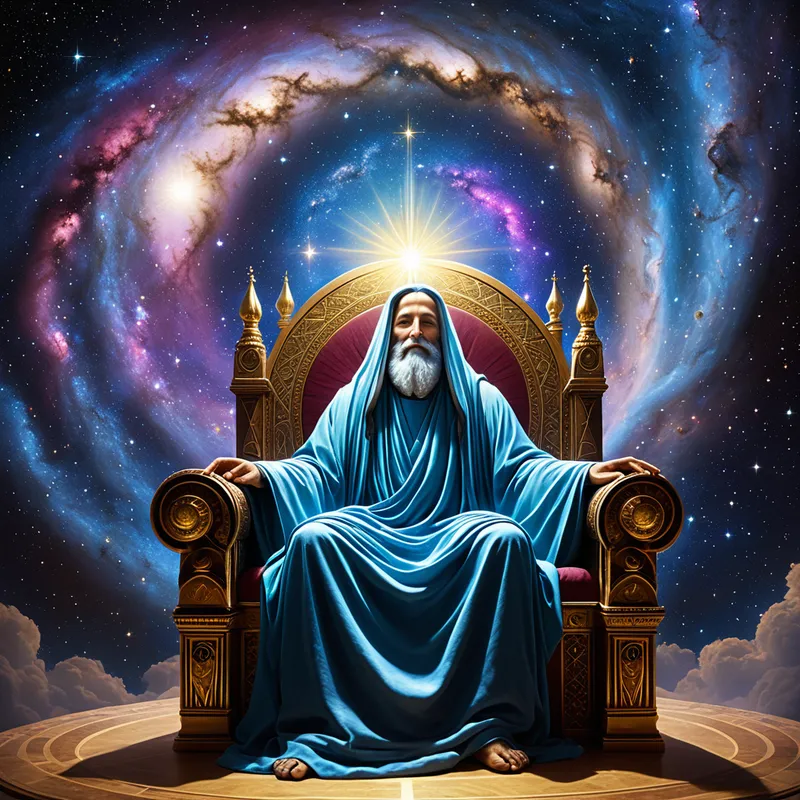
Sabbath Myth Meaning & Symbolism
The divine command to cease from all labor, a sacred rhythm woven into the fabric of creation itself, establishing a temple in time.
The Tale of Sabbath
In the beginning, there was a Word, and the Word was a song of making. For six great movements, the Singer called forth light from the deep, spun the heavens into a tapestry, gathered the waters and bared the land. With each refrain—“ki tov”—the universe resonated with a new, vibrant note. Beasts roamed the fresh earth, birds traced arcs across the newborn sky, and the sea teemed with life, each a verse in the unfolding epic.
On the sixth day, the Singer bent close to the damp clay. Breath was given, not as a wind, but as a shared spirit—ruach—and the first human awoke, a mirror fashioned to reflect the Singer’s own image. The work was complete. The cosmos hummed with activity, a symphony of growth, hunt, bloom, and decay.
Then came the seventh movement. But this was a movement of profound silence.
The Singer ceased. The divine hands, which had shaped mountains and painted the wings of butterflies, grew still. The voice that had commanded chaos into order fell quiet. Not a silence of absence, but a silence of fullness. A new thing was created: Shabbat. It was not another day of doing, but a sanctuary in time, a palace built from hours instead of stone. The Singer entered this palace of rest and blessed it, setting it apart from all other days, hallowing it. The first Sabbath was not an afterthought; it was the crown of creation, the breath taken after the poem is spoken, the frame that makes the masterpiece complete. The universe, for the first time, experienced not a command, but an invitation: to simply be, in the radiant, satisfied presence of the One who had finished the work.

Cultural Origins & Context
The myth of Sabbath is etched into the foundational text of the Torah, in the book of Genesis. Its transmission was not merely narrative but legal and liturgical, codified in the Mosaic Law as the Fourth Commandment: “Remember the Sabbath day, to keep it holy.” Its societal function was revolutionary. In an ancient world defined by unending agricultural and imperial labor, the Sabbath instituted a mandatory, egalitarian pause. The slave and the master, the immigrant and the native-born, even the working animal—all were granted the same reprieve.
This was not just a day off; it was a weekly enacted myth. By ceasing labor, the community collectively re-entered the finished perfection of the original creation and the divine rest. It was a protest against the tyranny of endless production and a tangible remembrance of liberation from slavery in Egypt—a people no longer defined by what they could produce for a Pharaoh, but by their capacity to mirror their God’s holy rest. The prophets would later frame its neglect not as a legal infraction, but as a broken relationship, a failure to trust in divine provision.
Symbolic Architecture
The Sabbath is the archetypal symbol of completion that precedes and enables true being. Its core meaning is not inactivity, but a different kind of work: the work of attention, relationship, and sanctification.
The most sacred thing one can create is an emptiness that the divine may fill.
Psychologically, Sabbath represents the Self imposing a necessary rhythm on the tireless ego. The ego’s mandate is to “do,” to build, to achieve, to control—a reflection of the first six days. The Sabbath is the psyche’s inherent wisdom that without a deliberate cessation, the ego becomes a tyrant, and the soul is colonized by its own productivity. The “blessing” of Sabbath is the recognition that our worth is not contingent on our output. The “hallowing” is the act of setting apart a psychic space where we are not defined by our functions, but can encounter our own being, and the Being behind all being.
It symbolizes the hieros gamos of time and eternity, where the linear, progressive march of days is pierced by a vertical shaft of the timeless. It is the temple not made with hands, a weekly return to the source.
The Dreamer’s Resonance
When the Sabbath archetype stirs in the modern dreamer, it often manifests as dreams of profound stillness amidst chaos, or frustrating paralysis that, upon reflection, feels oddly necessary. You may dream of a machine grinding to a graceful halt, its gears settling into peaceful alignment. You may find yourself in a familiar room where all the clocks have stopped, yet instead of panic, a deep relief floods you. Alternatively, you may dream of desperately trying to complete a task—packing a suitcase, writing an exam—but your hands move through molasses, or the tools dissolve in your grasp.
These are somatic signals from the psyche. The “Sabbath dream” is the unconscious enforcing a rest the conscious mind refuses to take. The feeling of paralysis is the ego’s resistance to the Self’s decree of cessation. The body in the dream is communicating a deep exhaustion not just of muscle, but of spirit. It is the soul’s immune response to the pathogen of perpetual motion, creating a symptomatic shutdown to force a healing crisis. To dream of Sabbath is to be presented with a non-negotiable invitation: your current rhythm is unsustainable. A sacred emptiness must be carved out, or your inner world will create it for you, often through illness, burnout, or a crisis of meaning.

Alchemical Translation
The alchemical process mirrored in the Sabbath myth is the Ablutio followed by the Coniunctio. The six days of labor represent the arduous work of Nigredo and Albedo—engaging with the world, facing our shadow, refining our persona. But the work is incomplete without the seventh stage: the sacred marriage of the conscious ego with the timeless Self.
Individuation is not a ceaseless striving, but a rhythmic dance of engagement and release. The Self is realized not only in what we accomplish, but in what we dare to leave unfinished.
For the modern individual, the alchemical translation is the practice of sacred interruption. It is the conscious, willful introduction of a “stop” into the personal chemistry of one’s life. This pause is the crucible where the lead of frantic doing is transmuted into the gold of authentic being. In the silence of the pause, the disparate elements of our psyche—our achievements and our failures, our thoughts and our feelings—are allowed to settle and recombine without our interference. The ego, accustomed to steering, must learn to be a passenger. In that surrender, the deeper, guiding intelligence of the Self can be heard. We are not just human doings; we are human beings. The Sabbath myth teaches that our highest state, our most divine reflection, is found not in the frenzy of creation, but in the poised, blessed, and hallowed capacity to rest within it, complete.
Associated Symbols
Explore related symbols from the CaleaDream lexicon: