Runes Myth Meaning & Symbolism
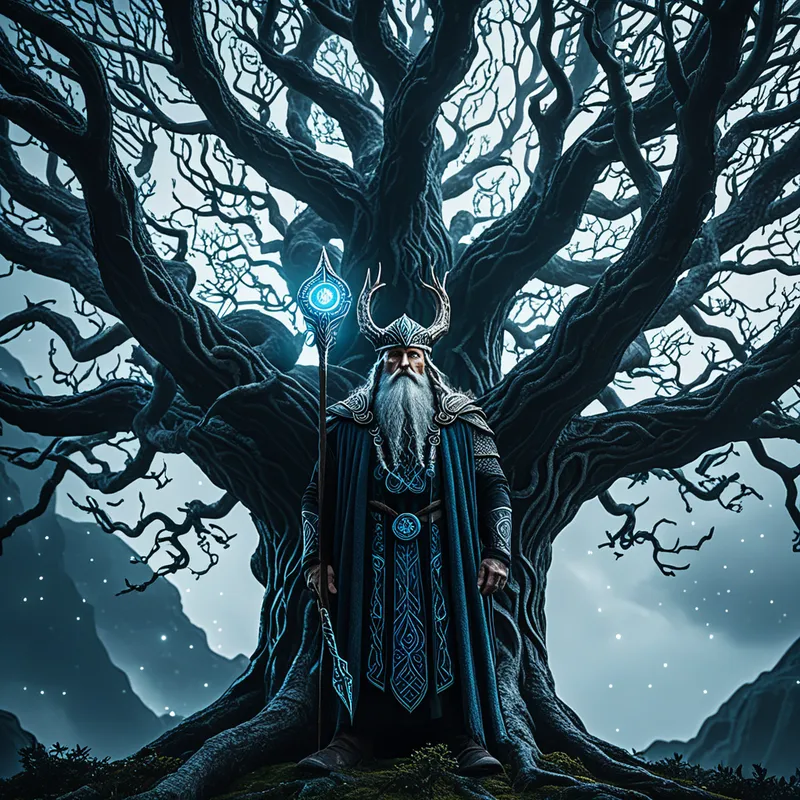
The god Odin hangs himself on the World Tree for nine nights, pierced by his own spear, to gain the secret wisdom of the Runes.
The Tale of Runes
Listen, and hear the price of wisdom.
In the time before memory, when the Yggdrasil was young and its roots drank from wells of terrible knowledge, there was a hunger in the heart of the All-Father. Odin sat upon his high seat, Hliðskjálf, and saw all that was and would be. Yet a shadow lay upon his sight, a secret woven into the very bones of the world. It was the secret of the Runes, the hidden laws of existence, the song that shaped reality. To know them was to hold the threads of fate.
But this knowledge was not given. It was taken, and the cost was everything.
Driven by a longing that burned like a cold star, Odin journeyed to the deepest root of the World Tree, where it gnaws at the well of Urd. The air was thick with the scent of damp earth and ancient moss. The silence was not empty, but listening. There, beneath the vast, groaning arch of the root, he took off his cloak and his crown. He took his own spear, the mighty Gungnir, and with a cry that echoed in no ear but his own, he drove it through his own side.
He hung himself upon the Tree.
For nine nights and nine days, the god of the hanged men hung. No mead passed his lips, no bread filled his belly. The wind of the worlds lashed him. The cold seeped into his bones, a frost that bit deeper than any winter. He stared into the abyss of the well below, his single eye unblinking, peering into the swirling mists of memory and destiny. He was a sacrifice to himself, an offering of his own flesh and breath upon the altar of Yggdrasil.
On the final night, at the brink of dissolution, when his consciousness was but a flicker in the vast dark, he saw. A movement in the roots. A shimmer in the void. Not with his eye, but with his spirit. From the depths of his agony, from the union of his offered life and the Tree’s enduring silence, light emerged. It was not a gentle light, but a searing, knowing radiance. Shapes formed in the air before him—angular, stark, profound. They carved themselves into his mind, into the bark of the Tree, into the fabric of being itself.
He saw the Runes. He knew them. With a final, gasping breath that was both a death rattle and a birth cry, he reached out a trembling hand. He grasped them. And then, cut down by his own will, he fell from the Tree, reborn, whole, and forever changed. The secret was his. The terrible, glorious price had been paid.
Cultural Origins & Context
This profound myth is recorded in the Old Norse poem Hávamál (“The Sayings of the High One”), a part of the Poetic Edda. Here, Odin himself narrates the ordeal in the first person. This was not a story for children at bedtime; it was esoteric knowledge, likely preserved and transmitted by skalds (poets), seers, and those initiated into the mysteries of magic (seiðr) and divination.
In the pre-Christian Norse worldview, knowledge was not abstract. It was a potent, often dangerous force, intimately linked with power, fate, and survival. The myth of the Runes served multiple societal functions. It established the ultimate pedigree for the runic alphabet, sanctifying it as a divine technology. It framed the pursuit of wisdom as a heroic, yet perilous, initiatory journey, validating the role of the seeker and the sacrificer in a culture that valued both the warrior and the wise one. Most importantly, it presented a sacred model for how one accesses hidden reality: not through casual study, but through radical, willing self-surrender to the process.
Symbolic Architecture
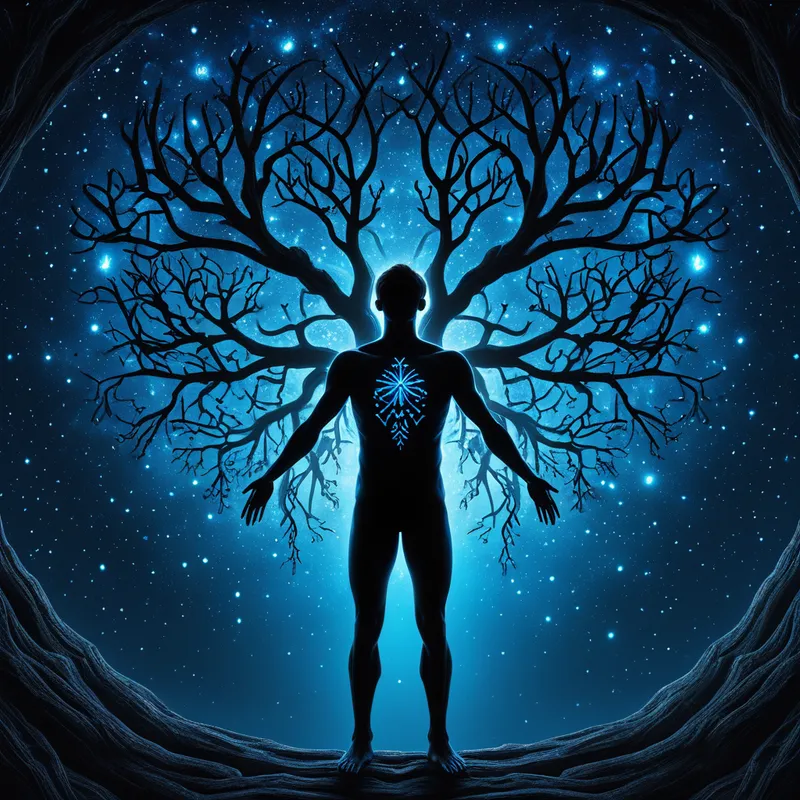
At its core, this myth is not about acquiring information. It is about the alchemy of consciousness through ordeal. Odin, the Alföðr, represents the seeking psyche, the ego-consciousness that realizes its knowledge is incomplete. The Yggdrasil is the axis of existence, the structure of the Self in its totality—connecting the conscious (Asgard), the unconscious (the roots and wells), and everything in between.
The Runes are the archetypal language of the unconscious, the fundamental patterns that govern psychic reality. To know them is to read the grammar of the soul.
The nine nights symbolize a gestation period, a descent into the womb of the unconscious. The spear, Gungnir, is the penetrating instrument of will, the focused intent that must be turned inward in self-confrontation. Hanging is the state of suspension—the ego is rendered helpless, strung up between opposites, unable to act in its ordinary way. This is the critical dissolution of the old knowing self. The ordeal models the psychological truth that transformative wisdom is born not from comfort and accumulation, but from a voluntary encounter with one’s own depths, shadows, and pain. The prize is not power over the world, but a resonant understanding with it.

The Dreamer’s Resonance
When this myth stirs in the modern dreamer, it often manifests as dreams of suspension, hanging, or being pinned. One might dream of being caught in the branches of a great tree, or immobilized while crucial knowledge is just out of reach. There may be dreams of a profound, self-inflicted wound that does not kill but illuminates.
Somatically, this can correlate with feelings of being “in limbo,” stuck in a life transition, or bearing the weight of a difficult insight that is restructuring one’s identity. Psychologically, the dreamer is in the throes of what James Hillman called the “suicidium,” not a literal death wish, but the necessary death of a outworn attitude, a former way of knowing, or a superficial identity. The psyche is enacting the mythic pattern: the conscious mind is being stripped of its pretensions and hung out to dry, so that a deeper, more authentic pattern of knowing—the personal “runes”—can be revealed from within. It is a terrifying but sacred process of deconstruction preceding revelation.
Alchemical Translation
The individuation journey modeled here is one of sacrificial gnosis. For the modern individual, Odin’s ordeal translates into the courageous decision to confront what one does not know about oneself. The “spear” is the focused question we must pose to our own depths: What pattern holds me back? What truth have I avoided? We “hang ourselves” on the issue—we commit to it fully, suspending our old narratives and comforts.
The transmutation occurs in the holding. By enduring the tension of not-knowing, by offering our old certainty as a sacrifice, the latent structure of a new understanding crystallizes.
The “nine nights” are the period of incubation, where we must resist the urge to prematurely resolve the tension with easy answers. This is the nigredo, the dark night of the soul. The eventual “grasping of the runes” is the emergence of a new symbolic attitude—a personal insight that feels foundational, like discovering a hidden law of your own being. It grants no easy power, but a sober capacity to “read” your life’s patterns, to carve your will with greater awareness, and to bear the responsibility that comes with true self-knowledge. You become, in a sense, the scribe of your own fate, having learned the alphabet from the Tree of your own suffering and seeking.
Associated Symbols
Explore related symbols from the CaleaDream lexicon: