Rumi Myth Meaning & Symbolism
A scholar's soul is shattered by a wandering mystic, then rewoven into poetry by the cosmic dance of divine, all-consuming love.
The Tale of Rumi
Listen. There was once a man who knew everything, and therefore knew nothing at all.
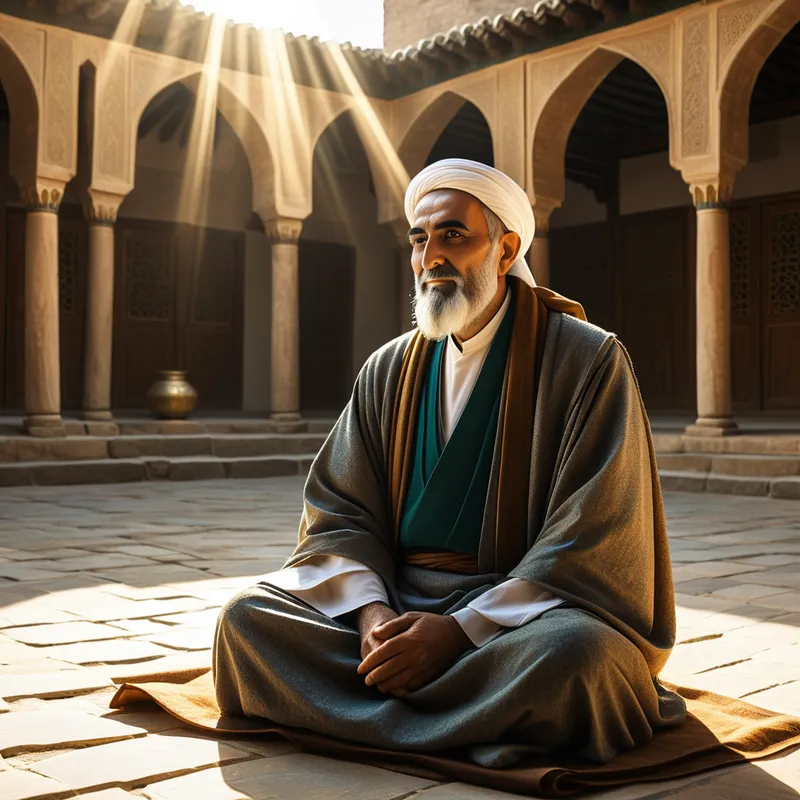
In the city of Konya, under a sky the color of faded turquoise, lived Mawlana Jalal ad-Din, a pillar of knowledge. His mind was a grand library, his words were precise legal rulings, and his shadow fell long and respectable across the courtyards of the madrasa. He was a mountain of certainty, revered, immovable. He knew the weight of every law, the interpretation of every verse, the path of every star in the scholar’s firmament.
Then, the desert wind blew in a beggar.
He was called Shams of Tabriz, his cloak ragged, his eyes holding the uncontained fire of a thousand suns. He did not knock on the city gate; he appeared at the threshold of Mawlana’s very soul. Their meeting was not polite. It was a collision.
“Who is greater,” Shams demanded, his voice like gravel and honey, “Muhammad, or Bistami, who said ‘Glory be to me!’?” The question was a blade, designed not to debate but to dismantle. It sliced through the careful architecture of Mawlana’s learning, seeking the raw, pulsing truth beneath. The scholar’s world, so orderly, cracked. The conversation that followed was a whirlwind that lasted days, a spiritual wrestling match where all of Mawlana’s books were thrown into a metaphysical fire.
From that fire, Mawlana emerged, but he was no longer Mawlana. He was Rumi—the one from Rum. The mountain had been leveled to fertile dust. The revered teacher became the mad lover, abandoning his lectures to search for the face of the Divine in the face of this ragged sun, Shams. Their communion was so intense it burned the social fabric. Whispers turned to resentment. And one night, Shams vanished, likely murdered by those who could not bear the blinding light of this union.
This was the second, more terrible shattering. Rumi’s grief was oceanic. He wandered the streets, composing raw, aching verses to his lost beloved. He searched in Damascus, howling his loss into the wind. He found not Shams, but the essence Shams had pointed to. In his despair, he heard the rhythmic hammering of the goldbeaters in the marketplace. Click-clack, click-clack. The sound entered him, became a heartbeat. He began to turn, his arms outstretched, one palm facing heaven to receive, the other facing earth to bestow.
He began to whirl.
As he turned, the poetry poured forth—not from his mind, but from the center of the turning. The Masnavi was born, a river of stories within stories. The Divan-e Shams erupted, each ode a burning coal signed with the name of his lost sun. In the turning, the lover, the beloved, and the love itself became one. The scholar was gone. The mourner was gone. All that remained was the dance—the Sama—and the endless song of return.
Cultural Origins & Context
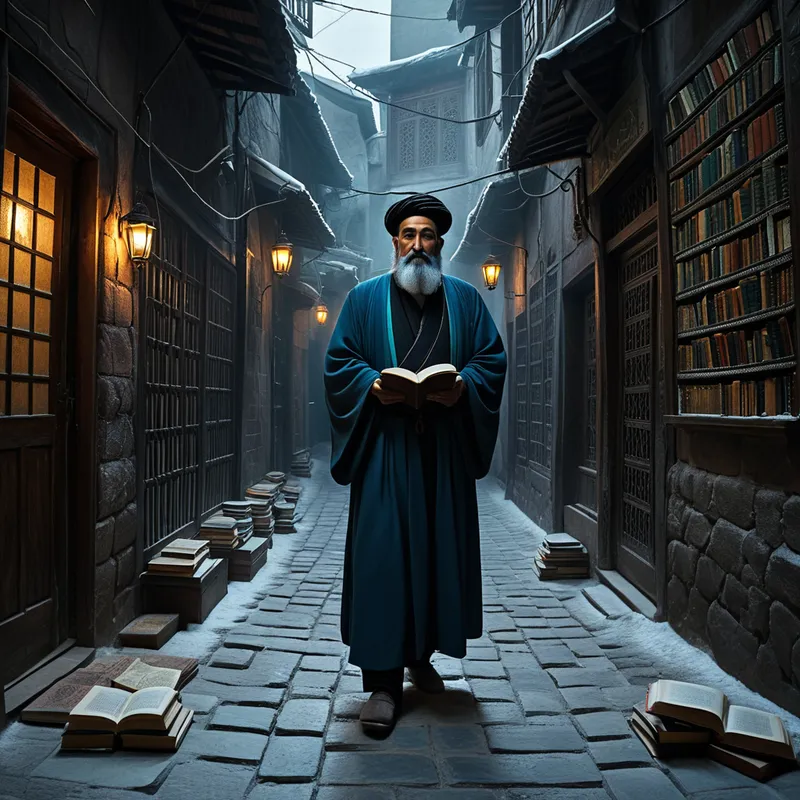
This is not a myth of antiquity, but a living story born in the 13th century CE from the fertile ground of Persianate Sufism. Rumi was a historical figure, a theologian and jurist in Seljuk Anatolia. The transformative encounter with Shams of Tabriz is recorded by his son, Sultan Walad, and disciples in hagiographies like the Manāqib al-‘Ārifīn. The story functions as a foundational mythos for the Mevlevi Order.
It was passed down not as cold history, but as a sacred narrative in dhikr circles and through the oral recitation of his poetry. Its societal function was dual: it provided a model for the radical Sufi path of fanā (annihilation in the Divine), and it legitimized the ecstatic, poetic, and musical expressions of devotion that often sat uneasily with more legalistic religious authorities. The tale served as a map, showing that the journey to God begins not with more knowledge, but with the shattering of the known self.
Symbolic Architecture
The myth is a perfect allegory for the soul’s awakening. Rumi, the Scholar, represents the ego-complex in its highest, most refined form: the conscious personality built on achievement, reputation, and intellectual control. It is a necessary stage, but a fortress nonetheless.
Shams of Tabriz is the archetypal catalyst, the personified Self. He is the disruptive, numinous force from the unconscious that arrives to dismantle the ego’s fortress. His question is the symbolic “sword of discrimination,” cutting through illusion.
The Beloved is not found in libraries, but in the burning of them.
His disappearance is critical. It represents the withdrawal of the projected divine. The seeker must realize the sun (Shams) was not outside, but was the light of their own inner core. The grief that follows is the nigredo of the alchemical process—the necessary blackening, dissolution, and despair.
The Whirling is the symbol of psychic integration. The turning axis is the surrendered ego, now aligned with the center (the Self). One hand up, one hand down: the human becomes a conduit between heaven and earth, spirit and matter. The poetry that flows is the new language of the integrated psyche, speaking in symbols, metaphors, and ecstatic truth beyond logic.
The Dreamer’s Resonance
When this myth stirs in the modern dreamer, it signals a profound crisis of identity. One might dream of a revered teacher or mentor (the Rumi-figure) being publicly humiliated or their office burning down. Or, one might encounter a terrifying yet fascinating homeless person, a wild animal, or a forceful stranger (the Shams-figure) who disrupts a carefully planned event.
Somatically, this can feel like a literal vertigo—a spinning sensation upon waking, or dreams of falling from a great height. Psychologically, it is the process of de-integration. The conscious attitude, which has served well, is being forcibly broken open by contents of the unconscious too powerful to ignore. The dreamer is not going mad; they are being prepared for a larger life. The grief felt upon Shams’s disappearance manifests as dreams of searching endlessly for a lost person or object in endless, labyrinthine cities—a somatic expression of the soul’s longing for its own essence.
Alchemical Translation
The myth of Rumi is a master blueprint for individuation. It models the stages not as a gentle progression, but as a violent, loving catastrophe followed by a creative rebirth.
- The Calcination (The Shattering): The ego’s structures (Rumi’s scholarship) are burned away by the encounter with the Self (Shams). This is a painful, involuntary death of the old personality.
- The Dissolution (The Grief): With the catalyst gone, the psyche enters a fluid, chaotic state. Old attachments and identities dissolve in the “water of tears.” This is a period of depression, confusion, and wandering—the spiritual wasteland.
- The Coagulation (The Whirling): From the chaos, a new organizing principle emerges. It is not a return to the old solidity, but a dynamic, rotating equilibrium. The ego, now serving the Self, becomes the axis for a larger motion.
- The Multiplication (The Poetry): The integrated state produces a continuous, overflowing creativity. This is the “philosopher’s stone”—the ability to transmute base experience (grief, love, doubt) into golden wisdom that nourishes the self and the world.
The goal is not to become spiritual, but to become so utterly human that the divine has no choice but to dance within you.
For the modern individual, this means that a life crisis—the loss of a career, a devastating heartbreak, a collapse of meaning—is not merely a misfortune. Viewed through this myth, it is the potential beginning of the sacred dance. The task is not to rebuild the old fortress, but to learn to stand in the open desert where the wind blows, and then, to find the music in the silence and begin to turn.
Associated Symbols
Explore related symbols from the CaleaDream lexicon: