Ruatapu's Flood Myth Meaning & Symbolism
A demigod, shamed by his low birth, unleashes a cataclysmic flood. Only the virtuous survive, forging a new lineage from the wreckage of the old.
The Tale of Ruatapu’s Flood
Listen, and hear the tale of the great drowning, the time when the sea rose in fury to cleanse the land of pride.
In the days when the great canoes still remembered the shores of Hawaiki, there lived a chief named Uenuku. He was a man of high rank, a rangatira whose bloodline stretched back to the gods themselves. Uenuku had many sons. The firstborn, Kahutia-te-rangi, was born of his highest-ranking wife, a child of pure lineage, destined to wear the marangai. But Uenuku also had another son, Ruatapu. His mother was of lesser status, a secondary wife, and thus Ruatapu, though skilled and strong, carried the subtle stain of a lesser birth.
For years, the shadow lay quiet. Ruatapu grew into a formidable warrior, a master of the waka taua. Uenuku, in his pride, had a new and magnificent canoe built, a vessel worthy of the gods, carved from a single great Tāne Mahuta. When the sacred lashing was complete, Uenuku summoned his sons. “We shall take this canoe to sea,” he declared, “to perform the rites and prove its worth.”
All the young chiefs, the firstborn sons of high lineage, boarded the canoe. Ruatapu, eager for his father’s recognition, prepared to join them. But as he stepped forward, Uenuku’s voice, cold as a south wind, stopped him. “Do not step into this canoe, Ruatapu. Your place is not with your brothers. The bilgewater where you would sit has been fouled. You are of the ware status, a son of a secondary line. You would contaminate this sacred vessel.”
The words fell like a stone. In front of all his high-born half-brothers, Ruatapu’s hidden wound was ripped open, laid bare to the salt air. A silence heavier than any anchor settled over the beach. The shame was not just personal; it was a cosmic insult, a tearing of the mana of his very being. He stepped back, his face a mask, but in his heart, a makutu began to coil.
He bided his time. With cunning words, he later persuaded his father to let him use the canoe for fishing. Once alone upon the boundless ocean, far from the sight of land, Ruatapu performed a terrible ritual. He took a sacred hika and bored a hole in the hull of the great canoe. Then, calling upon the deepest, most vengeful powers, he chanted a karakia to the god of the ocean depths.
“Tangaroa! Hear me! Let your waters rise! Swallow these sons of pride who deem themselves better than the blood of the earth!”
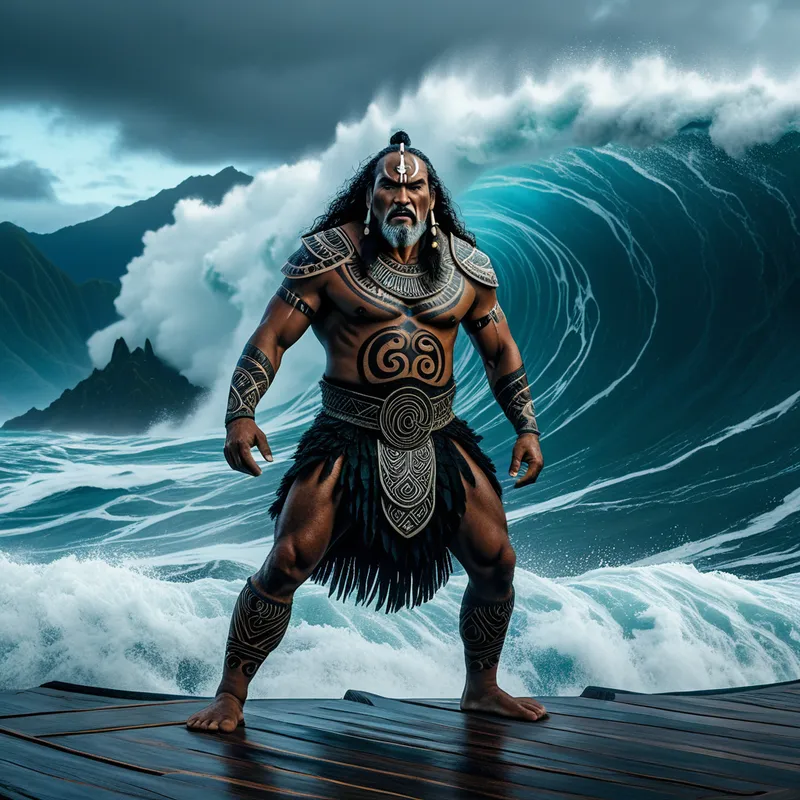
As he chanted, the sea, which had been calm, began to heave. The hole he had drilled became a whirlpool. The sky darkened. A wave, not born of wind but of divine wrath, began to build—a wall of green water that blotted out the horizon. It rose and rose, a moving mountain of the sea, and rushed toward the land of Hawaiki.
Ruatapu, standing upon the canoe as it was swallowed, was transformed. His shame had become a cataclysm. The wave struck the shores, sweeping over villages, forests, and sacred grounds. It was the purging flood, washing away the old order that had birthed his humiliation.
But from the chaos, a single thread of light remained. Kahutia-te-rangi, the firstborn, the virtuous one, felt the canoe sink beneath him. As the waters roared, he did not call for his father or curse his brother. Instead, he called upon his own ancestral power. He sang a karakia to his own divine ancestors, and as he sang, he was transformed. His body became that of a pakake, a great whale. In this form, he rode the titanic waves, not fighting the flood, but moving with its terrible power.
He swam through the drowned world until his great whale-body grounded upon the summit of the highest peak, Hikurangi. There, he shed his whale skin and stood again as a man, the sole survivor of the firstborn line. From that high place, he looked upon a world remade by water and wrath. The old was gone. From him, and from the seed of those few others who found refuge on mountaintops, a new people would be born, forever remembering the flood of Ruatapu, the price of pride, and the resilience that emerges from the deepest waters.
Cultural Origins & Context
The story of Ruatapu’s Flood is a foundational pūrākau carried to Aotearoa in the ancestral memory of several iwi, including Ngāti Porou and Ngāi Tahu. It functions as a mytho-historical narrative, explaining not only a great deluge but also the origins of specific chiefly lineages who trace their descent from the survivor, Kahutia-te-rangi (who later took the name Paikea). The story was traditionally recited by tohunga and learned elders during wananga, serving multiple vital societal functions.
It was a lesson in social structure and its perils, illustrating the explosive tension inherent in a society organized by strict primogeniture and status. The insult to Ruatapu was not merely a personal slight but a violation of the delicate whanaungatanga that should bind even those of different ranks. The myth served as a cautionary tale for chiefs: abuse of rank and public shaming could unleash destructive forces that would consume the abuser and the abused alike. Furthermore, it provided an etiological narrative for the name [Paikea and the whale](/myths/paikea-and-the-whale “Myth from Maori culture.”/) as a guardian spirit (kaitiaki) for certain lineages, rooting their identity and authority in a drama of survival and divine favor.
Symbolic Architecture
At its core, Ruatapu’s Flood is a profound [allegory](/symbols/allegory “Symbol: A narrative device where characters, events, or settings represent abstract ideas or moral qualities, conveying deeper meanings through symbolic storytelling.”/) of the [shadow](/symbols/shadow “Symbol: The ‘shadow’ embodies the unconscious, repressed aspects of the self and often represents fears or hidden emotions.”/) born from rejected [identity](/symbols/identity “Symbol: Identity represents the sense of self, encompassing personal beliefs, cultural background, and social roles.”/). Ruatapu is not evil incarnate; he is the [aspect](/symbols/aspect “Symbol: A distinct feature, quality, or perspective of something, often representing a partial view of a larger whole.”/) of the psyche that is disowned, denied its rightful place, and forced into the bilgewaters of [consciousness](/symbols/consciousness “Symbol: Consciousness represents the state of awareness and perception, encompassing thoughts, feelings, and experiences.”/). His [father](/symbols/father “Symbol: The father figure in dreams often symbolizes authority, protection, guidance, and the quest for approval or validation.”/)’s public decree is the act of psychological repression, declaring a part of the whole to be “unclean” and unworthy.
The flood is the shadow’s return, not as a quiet whisper, but as a world-ending wave. It is the accumulated, unexpressed pain of inferiority that, when finally triggered, seeks not just revenge, but the total annihilation of the system that created it.
The [ocean](/symbols/ocean “Symbol: The ocean symbolizes the vastness of the unconscious mind, representing deeper emotions, intuition, and the mysteries of life.”/), Tangaroa, here represents the [collective unconscious](/symbols/collective-unconscious “Symbol: The Collective Unconscious refers to the part of the unconscious mind shared among beings of the same species, embodying universal experiences and archetypes.”/) itself—the vast, amoral [realm](/symbols/realm “Symbol: The symbol of ‘Realm’ often signifies the boundaries of one’s consciousness, experiences, or emotional states, suggesting aspects of reality that are either explored or ignored.”/) of psychic potential that answers equally to prayers of creation and curses of destruction. Ruatapu’s karakia is a perversion of sacred speech, using [connection](/symbols/connection “Symbol: Connection symbolizes relationships, communication, and bonds among individuals.”/) to the divine for [fragmentation](/symbols/fragmentation “Symbol: The experience of breaking apart, losing cohesion, or being separated into pieces. Often represents disintegration of self, relationships, or reality.”/) rather than unity.
Conversely, Kahutia-te-rangi embodies the conscious ego that can integrate with deeper, instinctual powers without being destroyed by them. His transformation into the [whale](/symbols/whale “Symbol: Whales symbolize emotional depth, intuition, and communication, representing a profound connection to the subconscious mind.”/) is key. He does not battle the flood; he becomes a [creature](/symbols/creature “Symbol: Creatures in dreams often symbolize instincts, primal urges, and the unknown aspects of the psyche.”/) of the flood. He navigates the unconscious turmoil by adapting his very form, symbolizing the ego’s necessary plasticity during psychic [crisis](/symbols/crisis “Symbol: A crisis symbolizes turmoil, urgent challenges, and the need for immediate resolution or change.”/). His survival on the [mountain peak](/symbols/mountain-peak “Symbol: Represents spiritual ascension, ultimate achievement, and connection to the divine or higher consciousness.”/) represents the [birth](/symbols/birth “Symbol: Birth symbolizes new beginnings, transformation, and the potential for growth and development.”/) of a new conscious standpoint, forged in the ordeal and elevated above the drowned plains of the old, rigid [personality](/symbols/personality “Symbol: Personality in dreams often symbolizes the traits and characteristics of the dreamer, reflecting how they perceive themselves and how they believe they are perceived by others.”/).
The Dreamer’s Resonance
When this myth stirs in modern dreams, it often signals a profound confrontation with a long-buried complex of whakamā. The dreamer may experience tsunamis, rising basement floods, or being in a boat that is suddenly sinking. The somatic feeling is one of overwhelming, inescapable pressure—a sense that a foundational emotional dam is about to break.
Psychologically, this is the psyche’s imperative to finally acknowledge the “Ruatapu” within: the part of oneself that feels fundamentally illegitimate, secondary, or shamed by an internalized “parental” voice of judgment. The dream-flood is not merely a threat; it is a brutal, necessary correction. The ego (the Kahutia-te-rangi in the dream) is being tested. Will it panic and drown in the released affect, or can it find the innate “karakia”—the core of authentic self-knowledge—that allows it to transform and ride the wave? The dream often culminates in a moment of strange calm or finding oneself on unexpected high ground, indicating the beginning of integration after the cathartic deluge.
Alchemical Translation
The alchemical process mirrored here is the Nigredo—the blackening, the dissolution of the old prima materia in the floodwaters. Ruatapu’s wounded pride is the raw, leaden substance of the psyche. The public shaming is the initial heating, the friction that makes the material volatile. The cataclysmic flood is the dissolution stage, where all rigid structures of the old personality (the social hierarchy of the old Hawaiki) are utterly broken down.
Individuation is not about preventing the flood; it is about learning to become the whale within it. The goal is not to save the old canoe of the persona, but to discover the transformative chant that allows the core self to navigate the dissolution.
Kahutia-te-rangi’s journey is the Albedo—the whitening. He emerges cleansed, but not untouched. He carries the memory of the flood within him. His new identity as Paikea, the whale-rider, represents the conscious integration of the powerful, instinctual forces (the whale/Tangaroa) that his brother could only wield destructively. The new lineage founded from Hikurangi symbolizes the Rubedo—the reddening, the new conscious life born from the ordeal, now grounded in the enduring mountain of the Self, having passed through the drowning waters of the shadow. The myth thus maps the full arc: from the repression that creates a monster, through the catastrophic confrontation, to the resilient, embodied wisdom that is only possible on the other side of the wave.
Associated Symbols
Explore related symbols from the CaleaDream lexicon:
- Flood — The catastrophic return of the repressed, an overwhelming emotional and psychological purge that destroys an old, rigid order to make way for the new.
- Ocean — The vast, amoral realm of the collective unconscious, the source of both life and annihilating fury, answering to deep psychic commands.
- Shame — The corrosive wound of illegitimacy and rejection, the psychic fuel that, when ignited, can unleash transformative or destructive forces.
- Hero — The conscious aspect (Kahutia-te-rangi) that undergoes a transformative ordeal, not through brute force, but through adaptive surrender to a greater power.
- Rebirth — The essential outcome of the flood; the emergence of a new identity and order from the total dissolution of the old.
- Whale — The instinctual, archetypal power of the deep self, which can be a vehicle of salvation when integrated, or a force of destruction when rejected.
- Mountain — The enduring, elevated standpoint of consciousness achieved after surviving the psychic deluge; the place of refuge and new beginning.
- Ritual — The sacred speech (karakia) that directs psychic energy; it can be used to curse and fragment (Ruatapu) or to transform and preserve (Kahutia-te-rangi).
- Shadow — The disowned, shamed part of the personality (Ruatapu) that holds immense power and must be acknowledged to avoid catastrophic eruption.
- Pride — The inflation of the conscious ego (Uenuku) that creates hierarchy and rejection, sowing the seeds for its own downfall.
- Journey — The transformative passage through the crisis, from the security of the shore, into the drowning depths, and onto the sacred mountain.
- Order — The societal or psychic structure that is both necessary and potentially oppressive; it is destroyed by the flood so a more authentic order can be established.