Road to Damascus Myth Meaning & Symbolism
A zealous persecutor is struck blind by a divine vision, leading to a total inversion of identity and purpose, becoming the very thing he once sought to destroy.
The Tale of Road to Damascus
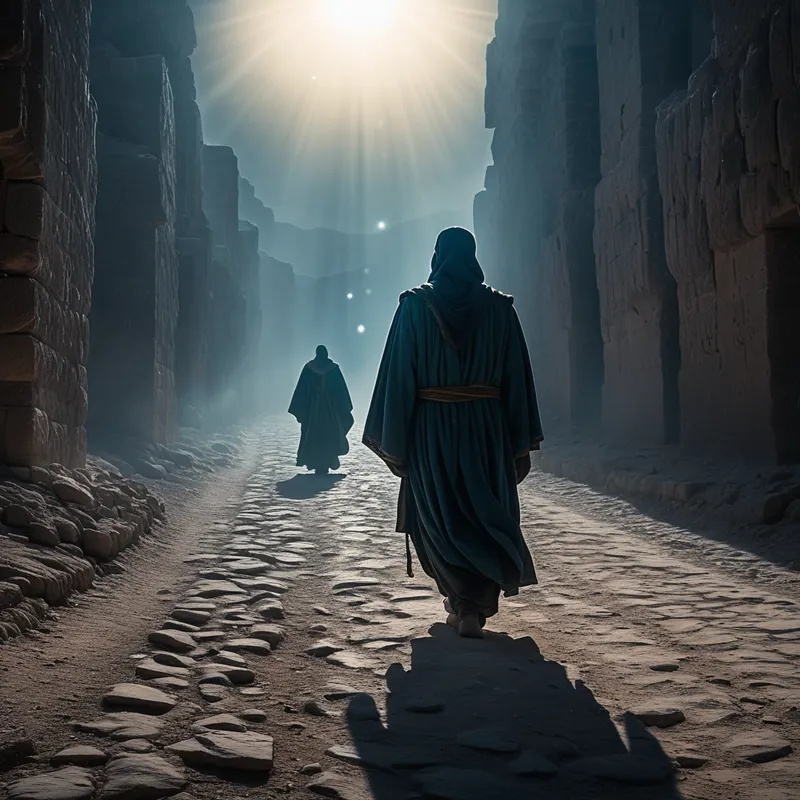
The sun was a hammer on the stones of the road. It beat down upon a man whose heart was a furnace of righteous certainty. His name was Saul of Tarsus, and he moved with the grim purpose of a storm. In his possession were letters, seals of authority granting him power to hunt. His quarry: followers of The Way, those who whispered the name of the crucified prophet from Galilee. To Saul, they were a blasphemous infection, a tear in the sacred fabric of the world, and he would be the needle that sewed it shut. The air shimmered with heat; the dust of the road clung to his robes and the sandals of his companions. Damascus lay ahead, a city of shadows where he would root out the heresy.
Then, without cloud or warning, the world dissolved.
A light, not of the sun, not of any fire known to man, exploded from the heavens. It was a soundless concussion of pure radiance, a force that threw Saul from his feet onto the hard, unyielding earth. He tasted dust and terror. The light was not around him; it was within him, searing through his eyes, burning away sight, flooding his skull. He was blind in a universe of white fire.
And from the center of that consuming brilliance, a Voice. It was not heard with the ear but known in the marrow of the bone. It spoke his name, not as a question, but as an indictment and a summons all at once.
“Saul, Saul, why do you persecute me?”
Trembling, pressed into the dust, the man who knew all the answers could only form a question. “Who are you, Lord?”
The Voice that was Light answered: “I am Jesus, whom you are persecuting.”
In that moment, the furnace of his certainty went cold. The hunter discovered he had been aiming his spear at the heart of God. The letters of condemnation in his pack became ashes in his mind. The road, the city, his entire life—all of it vanished, replaced by this devastating, intimate confrontation. The Light did not argue doctrine; it revealed identity. The “I” that Saul persecuted was not a distant idea, but a living presence he had been wounding with every arrest, every threat, every breath of hatred.
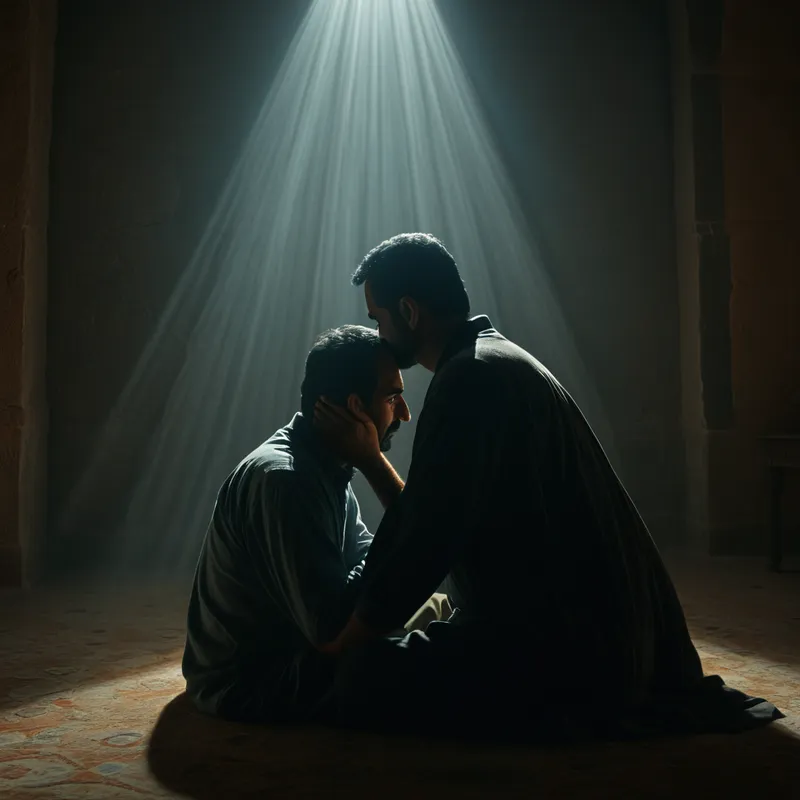
The light faded, leaving not darkness, but a profound, empty blackness. His companions, struck dumb, helped him to his feet. The man who had set out to see with fierce clarity now had to be led by the hand, a broken vessel into which a new world had been poured. For three days in Damascus, he sat in blindness, neither eating nor drinking. The old Saul was dying in that dark room. The man who would be Paul was being born.
Cultural Origins & Context
This account originates from the Christian New Testament, specifically in the Acts of the Apostles (Chapter 9) and echoed in Paul’s own letters (Galatians 1). It is a foundational conversion narrative, a cornerstone of Christian hagiography. Unlike the gradual teachings of Jesus to his disciples, Paul’s calling was abrupt, authoritative, and unasked-for, establishing his apostolic credentials not from human instruction but from direct divine revelation.
The story functioned as a powerful piece of legitimizing propaganda for the early church. It transformed the community’s most feared and zealous enemy into its most prolific and intellectually formidable advocate. The tale was told to illustrate the overwhelming power of divine grace—that no one is beyond its reach—and to validate the radical inclusion of Gentiles into the faith, a mission Paul would champion. It served as a mythic template for sudden, total conversion, a psychological archetype that would resonate through centuries of Christian testimony.
Symbolic Architecture
The Road to Damascus is not merely a geographic location; it is the axis of a psychic earthquake. It represents the critical juncture where a constructed identity, built on conviction and action, is shattered by a reality it cannot comprehend.
The most dangerous prison is the one whose walls are made of your own certainties. Liberation begins when the light that blinds you also lets you see.
Saul represents the totalized ego, the persona of the righteous persecutor. His journey is one of purpose, but it is a purpose flowing from a fragmented, unconscious shadow—he projects his own inner conflict onto an external enemy. The blinding light is the eruption of the Self, the central archetype of wholeness in Jungian terms, into the narrow confines of the ego’s worldview. It does not gently persuade; it obliterates the old mode of perception.
The blindness that follows is profoundly symbolic. It is not a punishment, but a necessary void. The physical sight that served his old mission must be dissolved so that a new, inner sight can be cultivated. He must be led, become dependent, and sit in the darkness of not-knowing. The three days of fasting and blindness mirror the period between crucifixion and resurrection—a necessary descent into the underworld of the psyche where the old self dies so a new one can emerge.
The Dreamer’s Resonance
When this mythic pattern stirs in the modern dreamer, it often manifests not as a biblical vision, but as a profound disorientation within the dream narrative. One may dream of driving a car that suddenly loses all navigation, the road signs melting into nonsense. Or of being in a familiar room when the walls become transparent, revealing an infinite, terrifying landscape beyond.
Somatically, this can feel like a sudden drop, a electric jolt, or a sensation of being pinned or frozen. Psychologically, it signals a moment where a deeply held self-concept—“I am a successful person,” “I am a victim,” “I am always right”—is being confronted by an aspect of the psyche it has violently excluded. The dream-ego, like Saul, is being shown that the very energy it has been fighting against (a creative impulse, a need for vulnerability, a buried trauma) is, in fact, a central part of its own wholeness. The process is one of traumatic insight, where the ground of one’s identity falls away, forcing a painful but ultimately integrative reckoning.

Alchemical Translation
The alchemical process mirrored here is the nigredo—the blackening, the putrefaction, the dark night of the soul. Saul’s confident, solar consciousness (the pursuit of light through law) is plunged into the utter blackness of blindness and helplessness. This is the essential first step in psychic transmutation: the dissolution of the old, rigid form.
The gold is not found by polishing the lead, but by reducing the lead to its prima materia—a chaotic, black mass—from which the new form can arise.
The journey models individuation as a crisis of inversion. The conscious attitude, pushed to its extreme, becomes its own opposite. The persecutor becomes the apostle. This is not a simple change of opinion, but a death-and-rebirth sequence. The ego does not negotiate with the Self; it is overthrown by it. For the modern individual, this translates to those shattering moments when life—through loss, failure, or unexpected revelation—forcefully ends a chapter. A career defining identity collapses. A foundational relationship ends. A long-held belief proves catastrophically false.
The “Road” is then any path of committed, purposeful life. The “Damascus” is the destination of that old purpose. The miracle and the trauma occur in the space between, when the larger psyche intervenes to say, “You are not who you think you are, and your destination is not what you believe.” The subsequent period of blindness—the depression, the confusion, the lostness—is the fertile void. It is the incubation period where, stripped of the old sight, the new vision—one of deeper connection, purpose, and humility—can begin, painfully, to form. One does not simply choose a new path; one is chosen by a truth so vast it requires the annihilation of the old traveler to make room for the new.
Associated Symbols
Explore related symbols from the CaleaDream lexicon: