Rasa Lila Myth Meaning & Symbolism
The celestial dance where Krishna multiplies himself to dance with each Gopi, symbolizing the soul's ecstatic, individual union with the divine.
The Tale of Rasa Lila
Listen. The night is not empty. It is full of a sound that pulls at the very marrow of the soul—a flute. It is the call of [Krishna](/myths/krishna “Myth from Hindu culture.”/), the dark-hued god who walks [the earth](/myths/the-earth “Myth from Hindu culture.”/) as a cowherd boy in the forests of Vrindavan. The air is thick with the scent of [jasmine](/myths/jasmine “Myth from Persian culture.”/) and damp earth, and [the moon](/myths/the-moon “Myth from Tarot culture.”/) hangs low, a perfect silver disc bathing [the world](/myths/the-world “Myth from Tarot culture.”/) in a milky, intoxicating light.
In every home in the village, a heart quickens. The Gopis, the milkmaids, hear it. Wives, mothers, daughters—their domestic duties fall from their hands like dust. The flute-song is a hook in the heart, a summons they cannot, will not, refuse. One by one, they slip from their sleeping households, abandoning their looms, their kitchens, their beds. They run, their silken skirts whispering through the dewy grass, driven by a longing so profound it feels like the only truth they have ever known.
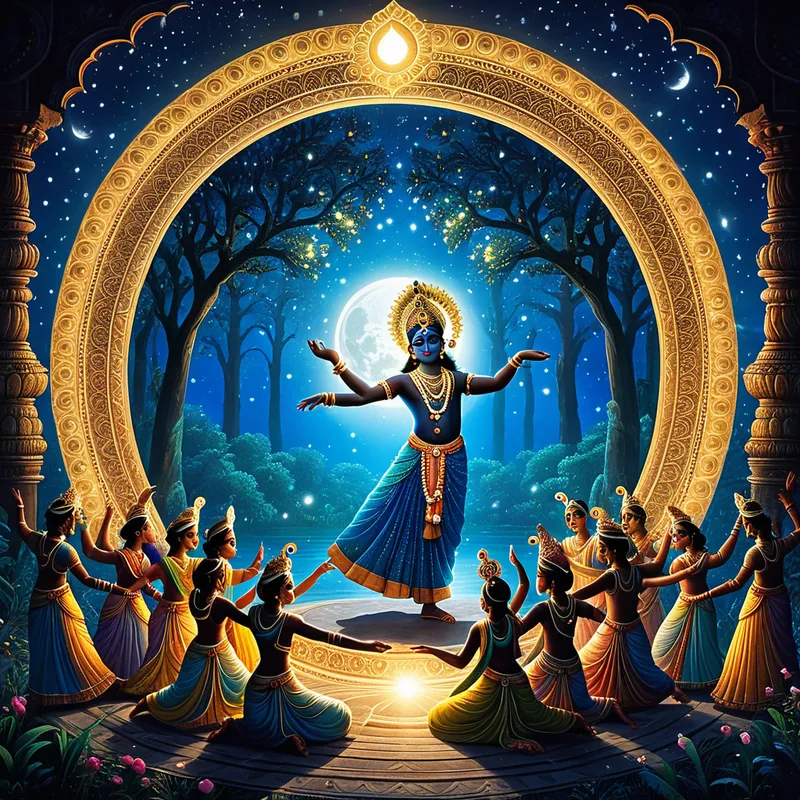
They converge in a moon-drenched clearing. And there he is. Krishna, his smile holding the mischief of the universe, his eyes pools of infinite night. He begins to dance, and the world holds its breath. The Gopis join, forming a great circle, their love a tangible force. But a shadow crosses their joy—a whisper of jealousy. Each Gopi burns with the desire to be the sole partner of the beloved. They yearn for an exclusive embrace in this shared ecstasy.
Seeing this, Krishna performs his divine miracle. He does not choose one. He becomes all. In a flash of incomprehensible grace, he multiplies himself. Not a copy, but a full, complete, and utterly present Krishna for each and every Gopi. Each woman finds herself dancing with her own Krishna, who gazes at her as if she is the only soul in all of creation. He holds her hand, matches her step for step, his attention undivided. The circle now holds not one dance, but countless unique, simultaneous unions. The flute is silent; the music is the rhythm of their circling feet and beating hearts. In this divine paradox, the ultimate intimacy is experienced not in isolation, but within the communal circle of shared devotion. The night deepens, the dance continues—a perfect, eternal moment where the many and the one are reconciled in a whirl of bliss.
Cultural Origins & Context
The story of the Rasa Lila finds its most celebrated poetic expression in the Bhagavata Purana, composed roughly between the 8th and 10th centuries CE. It is the pinnacle of the Bhakti movement, which democratized the divine, making God accessible through emotion rather than solely through ritual or knowledge.
The myth was not merely read; it was performed. The Manipuri dance tradition is built around enacting the Rasa Lila, and across India, countless devotional songs, poems, and plays have kept its essence alive. Its societal function was revolutionary. In a stratified society, it presented a spirituality where the soul’s status—whether king or milkmaid—was irrelevant. The only qualification was the intensity of one’s longing, prema. It gave a powerful, emotional language to the seeker, validating the experience of divine love as overwhelming, all-consuming, and worth abandoning the conventional world to pursue.
Symbolic Architecture
On the surface, a [story](/symbols/story “Symbol: The symbol of ‘Story’ represents the narrative woven through our lives, embodying experiences, lessons, and emotions that shape our identities.”/) of a god dancing with [village](/symbols/village “Symbol: Symbolizes community, connection, and a reflection of one’s roots or origins.”/) women. At its [depth](/symbols/depth “Symbol: Represents profound layers of consciousness, hidden truths, or the unknown aspects of existence, often symbolizing introspection and existential exploration.”/), a map of the [cosmos](/symbols/cosmos “Symbol: The entire universe as an ordered, harmonious system, often representing the totality of existence, spiritual connection, and the unknown.”/) and the [psyche](/myths/psyche “Myth from Greek culture.”/). The Rasa Lila is not a romance but a metaphysics of [relationship](/symbols/relationship “Symbol: A representation of connections we have with others in our lives, often reflecting our emotional state.”/).
Krishna represents the absolute, the formless divine [consciousness](/symbols/consciousness “Symbol: Consciousness represents the state of awareness and perception, encompassing thoughts, feelings, and experiences.”/), the Brahman that has taken a personal, lovable form. The Gopis are the individual [human](/symbols/human “Symbol: The symbol of a human represents individuality, complexity of emotions, and social relationships.”/) souls, jivatmas. The [forest](/symbols/forest “Symbol: The forest symbolizes a complex domain of the unconscious mind, representing both mystery and potential for personal growth.”/) of Vrindavan is the manifested world, [nature](/symbols/nature “Symbol: Nature symbolizes growth, connectivity, and the primal forces of existence.”/) itself, which is not an [obstacle](/symbols/obstacle “Symbol: Obstacles in dreams often represent challenges or hindrances in waking life that intercept personal progress and growth. They can symbolize fears, doubts, or external pressures.”/) to God but the very [playground](/symbols/playground “Symbol: A playground in dreams embodies the essence of childhood, creativity, and freedom, often representing one’s inner child and the search for joy.”/) where the divine [drama](/symbols/drama “Symbol: Drama signifies narratives, emotional expression, and the exploration of human experiences.”/) unfolds. The [flute](/symbols/flute “Symbol: The flute epitomizes elegance and grace, often symbolizing harmony, beauty, and spirituality.”/) is the call of the absolute, an irresistible pull from the [depths](/symbols/depths “Symbol: Represents the subconscious, hidden emotions, or foundational aspects of the self, often linked to primal fears or profound truths.”/) of being that disrupts ordinary, egoic [life](/symbols/life “Symbol: The symbol of ‘Life’ represents a journey of growth, interconnectedness, and existential meaning, encompassing both the joys and challenges that define human experience.”/).
The central, breathtaking symbol is Krishna’s multiplication. This is the resolution of the soul’s greatest anguish: the fear that God’s love is finite, that one must compete for grace, that union requires the negation of others or the loss of self.
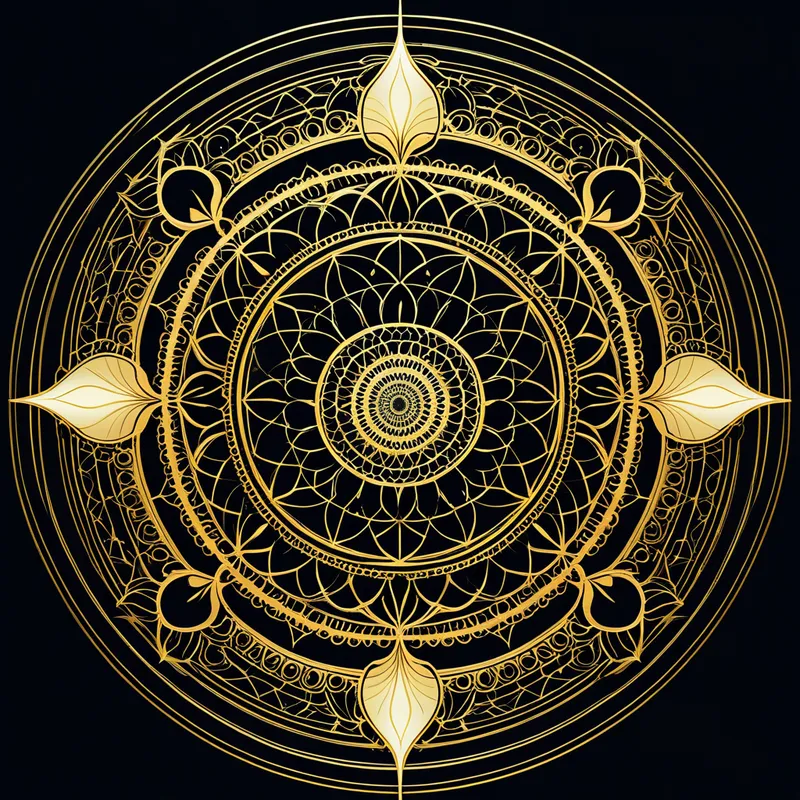
The [multiplication](/symbols/multiplication “Symbol: Represents exponential growth, spiritual expansion, and the amplification of energy or consciousness beyond linear progression.”/) reveals a fundamental [truth](/symbols/truth “Symbol: Truth represents authenticity, honesty, and the quest for knowledge beyond mere appearances.”/): the divine is not a scarce resource. The absolute can be in a full, complete, and unique relationship with each fragment of itself without ever being divided or diminished. Each Gopi experiences a Krishna tailored to her own consciousness, her own [capacity](/symbols/capacity “Symbol: A measure of one’s potential, limits, or ability to contain, process, or achieve something, often reflecting self-assessment or external demands.”/) for love. The circle dance, the rasa [mandala](/symbols/mandala “Symbol: A sacred geometric circle representing wholeness, the cosmos, and the journey toward spiritual integration.”/), then becomes a [symbol](/symbols/symbol “Symbol: A symbol can represent an idea, concept, or belief, serving as a powerful tool for communication and understanding.”/) of the cosmos—a harmonious whole composed of infinite, unique, and equally valid relationships with the center.
The Dreamer’s Resonance
When this myth stirs in the modern unconscious, it rarely appears as a literal Indian dance. It manifests as a pattern of feeling and imagery. To dream of the Rasa Lila is to dream of a profound somatic and psychological process: the crisis and resolution of exclusive longing.
You may dream of hearing a beautiful, haunting melody that compels you to leave your house, your job, your identity behind. You may find yourself in a strange, nocturnal landscape searching for a source of light or love. The conflict arises when you arrive at a gathering and see the beloved—a person, a goal, a state of being—surrounded by others who also seek their attention. The dream-ego is seized by jealousy, inadequacy, and the painful sense of being just one among many.
The psychic resolution, if the dream moves towards healing, is not the elimination of the others, but a sudden, miraculous shift in perspective. The beloved figure may turn and see only you, even while engaging with others. Or you may realize you are simultaneously dancing with multiple partners, all of whom are facets of the same essence. This is the psyche working to integrate the reality of shared, non-possessive connection. It is moving from [the ego](/myths/the-ego “Myth from Jungian culture.”/)’s demand for special, exclusive validation towards the soul’s capacity to participate in a collective ecstasy without losing its individual signature.
Alchemical Translation
For the modern individual on the path of individuation, the Rasa Lila models a critical alchemical translation: the transmutation of possessive, ego-centric love into participatory, cosmic love.
[The first stage](/myths/the-first-stage “Myth from Alchemical culture.”/) is the Call of the Flute—the eruption of [the Self](/myths/the-self “Myth from Jungian culture.”/) (the total, unconscious psyche) into conscious life. This is the midlife crisis, the creative urge, the spiritual awakening that disrupts our comfortable, conventional identity (the Gopi’s domestic life). We are compelled to follow it, often at great cost.
The second stage is the Circle of Longing—entering the therapeutic or introspective space where we meet others on the path and, crucially, where we confront our own shadow of jealousy and scarcity. We see the “other Gopis” as rivals for the analyst’s attention, for success, for enlightenment. We believe wholeness is a trophy only one can win.
The alchemical miracle, the rubedo or reddening, is the realization of multiplicity. It is the understanding that the Self (Krishna) is not a monolithic entity to be captured, but a dynamic, relational field.
The psychic transmutation occurs when we realize that the wholeness we seek does not require us to become the sole partner of the divine, but to fully embody our own unique dance with it. We must allow the Self to “multiply”—to show us its myriad facets through our relationships, our creative acts, our different social roles. The goal is not to possess the center, but to find our authentic place in the circling [mandala](/myths/mandala “Myth from Buddhist culture.”/) of life, dancing our own steps while harmonizing with the greater rhythm. The ecstasy (rasa) is not in merger and obliteration, but in the bliss of being uniquely seen and met within the grand, beautiful, and endless dance.
Associated Symbols
Explore related symbols from the CaleaDream lexicon: