Ranginui Myth Meaning & Symbolism
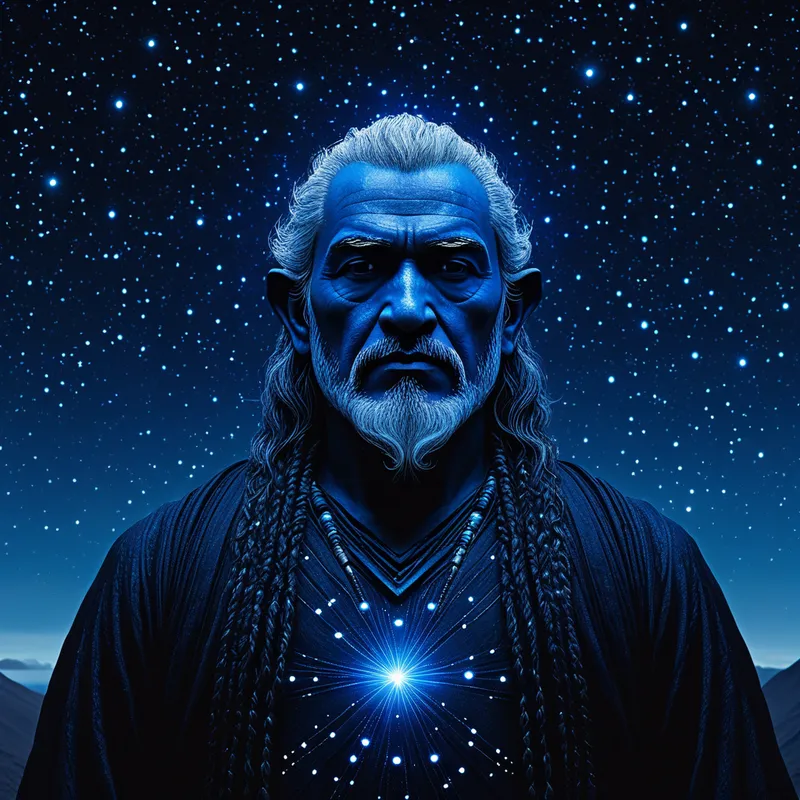
The primal embrace of Sky Father Ranginui and Earth Mother Papatūānuku is severed by their children, creating the world and the space for life.
The Tale of Ranginui
In the beginning, there was only the embrace. A silent, eternal, suffocating closeness. Ranginui, the sky, lay pressed upon Papatūānuku, the earth. Their love was absolute, a union so complete it left no room for anything else. Between them, in the warm, damp, perpetual twilight, their children were born. They were not born into light, but into the cramped, dark hollow of their parents’ bodies. They lived in a world without horizon, without sky, without ground—only the pressing weight of a father’s back and the unyielding support of a mother’s breast.
The children grew in this primal womb. There was Tāne-mahuta, who would become the forests. Tangaroa of the restless seas. Rongo-mā-tāne of the sweet potato. [Tūmatauenga](/myths/tmatauenga “Myth from Maori culture.”/), the fierce warrior. Tāwhirimātea, the tempest. And others, each a force of nature yet unborn, trapped in the dark.
And in that dark, a thought took root. A thought of space. Of light. Of difference. The children began to whisper, to conspire. “We cannot live like this,” they said. “We are curled and stunted. We must part them. We must let the light in.” But to part one’s parents—to break the sacred, world-forming embrace—was a crime of unimaginable scale. It was an act of cosmic rebellion.
One by one, the sons tried. Tangaroa pushed with the force of tides, but could not separate the wet skin of sky from earth. Tūmatauenga rose, the future war god, and hacked with fury. His blows were fierce, but they only scarred the flesh of his parents, creating the first valleys and mountains—wounds of love and conflict. He could not lift the sky.
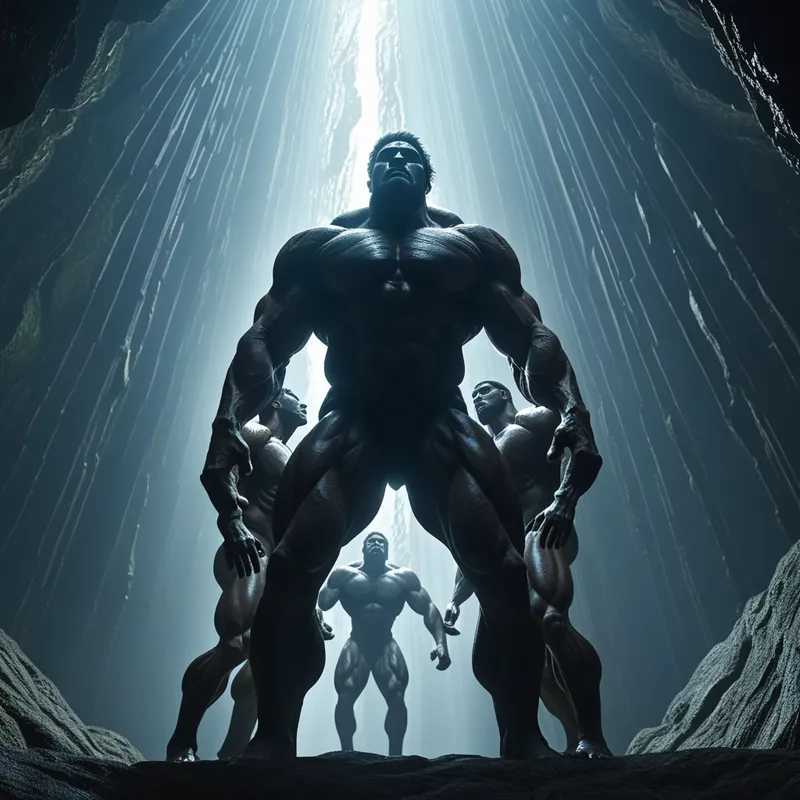
Then it was Tāne-mahuta’s turn. He did not push upwards. Instead, he planted his feet firmly upon his mother, Papatūānuku, and placed his strong shoulders against his father, Ranginui. He began to strain. Not with violence, but with a slow, inexorable, organic pressure. He pushed as a tree pushes towards the sun, with deep, silent determination. The muscles of the world creaked. The air, thick with the breath of the parents, grew taut.
A sound, then—a groan of cosmic sorrow, a tearing of celestial flesh. A sliver of light, piercing and painful, sliced through the eternal dark. Ranginui cried out, his tears becoming the first rain. Papatūānuku shuddered, her sighs becoming the mists that rise from the land. Tāne-mahuta pushed harder, his body trembling with the effort of creation itself. And then, with a final, heart-rending heave, he forced them apart.
Ranginui was thrust upwards, becoming the distant, blue vault, adorned with stars—his eyes, forever looking down in grief. Papatūānuku lay below, now a distinct, solid ground, her body clothed in forests and valleys. Between them was Te Ao Mārama—the World of Light. And into this world, the children finally emerged, blinking, into their own domain. But one child refused the light. Tāwhirimātea, the wind, furious at the separation of his parents, fled to the bosom of his father and vowed eternal vengeance, sending his storms to ravage the earth below. The world was born, beautiful and terrible, from an act of necessary betrayal.
Cultural Origins & Context
This cosmogony, known as the Te Wehenga o Ranginui rāua ko Papatūānuku, is the foundational narrative of Māori cosmology. It was not a mere story for entertainment, but the sacred template of reality itself, recited by tohunga (priests and scholars) during rituals of immense importance. Its transmission was oral, precise, and tapu (sacred), forming the core of whakapapa—the genealogical recitation that connects all people, gods, and elements of the natural world back to this primal couple.
The myth functioned as a societal and psychological anchor. It explained the origin of the natural world: why the sky is distant, why rain falls (the Sky Father’s tears), why mist rises (the Earth Mother’s sighs), and why storms rage (Tāwhirimātea’s grief). More profoundly, it established the fundamental Māori concept of relationship and duty. The violent yet creative act of the children created the necessary space for life (ora), but it also created eternal longing and a debt. Humanity, as descendants of Tāne-mahuta, lives in the space of that separation, tasked with maintaining balance and connection—the whanaungatanga (kinship)—between the now-divided realms of sky and earth, spirit and matter.
Symbolic Architecture
At its [heart](/symbols/heart “Symbol: The heart symbolizes love, emotion, and the core of one’s existence, representing deep connections with others and self.”/), this is not a [story](/symbols/story “Symbol: The symbol of ‘Story’ represents the narrative woven through our lives, embodying experiences, lessons, and emotions that shape our identities.”/) of creation ex nihilo, but of creation through [differentiation](/symbols/differentiation “Symbol: The process of distinguishing or separating parts of the self, emotions, or identity from a whole, often marking a developmental or psychological milestone.”/). The primal state is one of undifferentiated unity—a psychological state akin to the unconscious [symbiosis](/symbols/symbiosis “Symbol: A dream of mutual dependence and interconnected growth, often representing harmonious relationships or integrated aspects of the self.”/) of [infant](/symbols/infant “Symbol: The infant symbolizes new beginnings, innocence, and the potential for growth and development.”/) and [mother](/symbols/mother “Symbol: The symbol of ‘Mother’ represents nurturing, protection, and the foundational aspect of one’s emotional being, often associated with comfort and unconditional love.”/), or the unexamined [life](/symbols/life “Symbol: The symbol of ‘Life’ represents a journey of growth, interconnectedness, and existential meaning, encompassing both the joys and challenges that define human experience.”/) where no distinctions of self, other, thought, or feeling exist.
The birth of consciousness is always an act of violence against the bliss of unconscious unity.
Ranginui and Papatūānuku represent the archetypal parental [dyad](/symbols/dyad “Symbol: A fundamental pair or duality representing unity, opposition, and the foundational structure of existence in spiritual and mythological traditions.”/), the original container of all potential. Their embrace is the [womb](/symbols/womb “Symbol: A symbol of origin, potential, and profound transformation, representing the beginning of life’s journey and the unconscious source of creation.”/) of psyche, but a womb one must eventually leave to become an individual. The children symbolize the emergent contents of that psyche—the drives, talents, and faculties (war, cultivation, weather, thought) that cannot develop in a state of enmeshment.
Tāne-mahuta’s method is deeply symbolic. He does not attack; he separates. He uses a [tree](/symbols/tree “Symbol: In dreams, the tree often symbolizes growth, stability, and the interconnectedness of life.”/)’s growth—an organic, upward, life-seeking force. This represents the natural, instinctual drive toward individuation, the psyche’s inherent [movement](/symbols/movement “Symbol: Movement symbolizes change, progress, and the dynamics of personal growth, reflecting an individual’s desire or need to transform their circumstances.”/) toward light and [consciousness](/symbols/consciousness “Symbol: Consciousness represents the state of awareness and perception, encompassing thoughts, feelings, and experiences.”/), even when that [movement](/symbols/movement “Symbol: Movement symbolizes change, progress, and the dynamics of personal growth, reflecting an individual’s desire or need to transform their circumstances.”/) causes profound [grief](/symbols/grief “Symbol: A profound emotional response to loss, often manifesting as deep sorrow, yearning, and a sense of emptiness.”/). The resulting world, Te Ao Mārama, is the [realm](/symbols/realm “Symbol: The symbol of ‘Realm’ often signifies the boundaries of one’s consciousness, experiences, or emotional states, suggesting aspects of reality that are either explored or ignored.”/) of differentiated consciousness, where things have names, forms, and [space](/symbols/space “Symbol: Dreaming of ‘Space’ often symbolizes the vastness of potential, personal freedom, or feelings of isolation and exploration in one’s life.”/) between them to relate.
The Dreamer’s Resonance
When this myth stirs in the modern dreamer, it often manifests as somatic and spatial anxiety. One may dream of being crushed between two immense, loving, but suffocating presences. Of living in a dark, warm, but confining space with no exit. The dream ego may feel a desperate need to “push upwards,” to create a crack of light, often accompanied by immense guilt and fear of catastrophic consequences.
This is the psyche working through a necessary separation. It could relate to leaving a family system, differentiating from a partner in a codependent relationship, or even distinguishing one’s own thoughts and values from internalized parental or societal voices. The stormy vengeance of Tāwhirimātea appears as the emotional backlash—the rage, grief, and inner turmoil that follows any meaningful act of self-definition. The dream is not prescribing the action, but rehearsing the profound psychological process of moving from unconscious unity to conscious, and therefore vulnerable, individuality.
Alchemical Translation
The alchemical journey of individuation mirrors the myth’s structure precisely. The initial state, the prima materia, is the unconscious, undifferentiated self (the embrace). The work (opus) begins with separatio—the most difficult and painful of alchemical operations. This is the conscious differentiation of components: distinguishing the spiritual (sky) from the material (earth), the masculine from the feminine principles within, and the ego from the parental complexes.
To become whole, one must first consent to be torn apart.
Tāne-mahuta is the archetype of the Self orchestrating this operation. His strength is rooted in the earthly reality of the body and instinct (Papatūānuku), while his thrust is toward spirit, awareness, and vision (Ranginui). The light that floods in is the light of consciousness, which initially feels harsh and exposing. The tears and sighs are the unavoidable lacrimae rerum—the sorrow of things—that accompanies any genuine growth.
The ultimate goal is not to abandon the parents in their divided state, but to relate to them consciously from the newly created space. In psychological terms, this means holding the tension between opposites (spirit/matter, love/autonomy, dependence/independence) without collapsing back into unconsciousness. One honors the connection—the whakapapa—while standing firmly in one’s own world of light. The reborn individual can then look up to the sky of spirit and down to the earth of body, no longer crushed by them, but sustained in the creative, painful, beautiful space between.
Associated Symbols
Explore related symbols from the CaleaDream lexicon:
- Sky — The domain of Ranginui, representing the father principle, spirit, consciousness, distant longing, and the archetypal masculine.
- Earth — The body of Papatūānuku, representing the mother principle, the unconscious, matter, nurturing support, and the archetypal feminine.
- Separation — The core, traumatic, and creative act performed by the children, symbolizing the necessary psychological differentiation that births individual consciousness.
- Light — Te Ao Mārama, the World of Light that floods in after the separation, representing consciousness, awareness, clarity, and the space for life to manifest.
- Rain — The tears of Ranginui, symbolizing the grief that accompanies loss of unity and the fertilizing connection that persists across the separation.
- Tree — Embodied by Tāne-mahuta, representing organic growth, the axis mundi connecting earth and sky, and the steady, upward thrust of the individuation drive.
- Storm — The wrath of Tāwhirimātea, symbolizing the emotional chaos, internal conflict, and psychic backlash that follows any radical act of self-definition.
- Space — The crucial void created between sky and earth, representing the psychological container where relationship, choice, and conscious life become possible.
- Grief — The pervasive emotion of the separated parents, a sacred sorrow that acknowledges the cost of creation and the enduring bond that defines the new world.
- Rebellion — The essential, transgressive act of the children against the primal order, representing the courage required to challenge enmeshment and claim one’s own domain.
- Embrace — The original, suffocating unity of the parents, symbolizing the unconscious state of undifferentiated bliss from which all individual life must eventually struggle free.