Rahu Myth Meaning & Symbolism
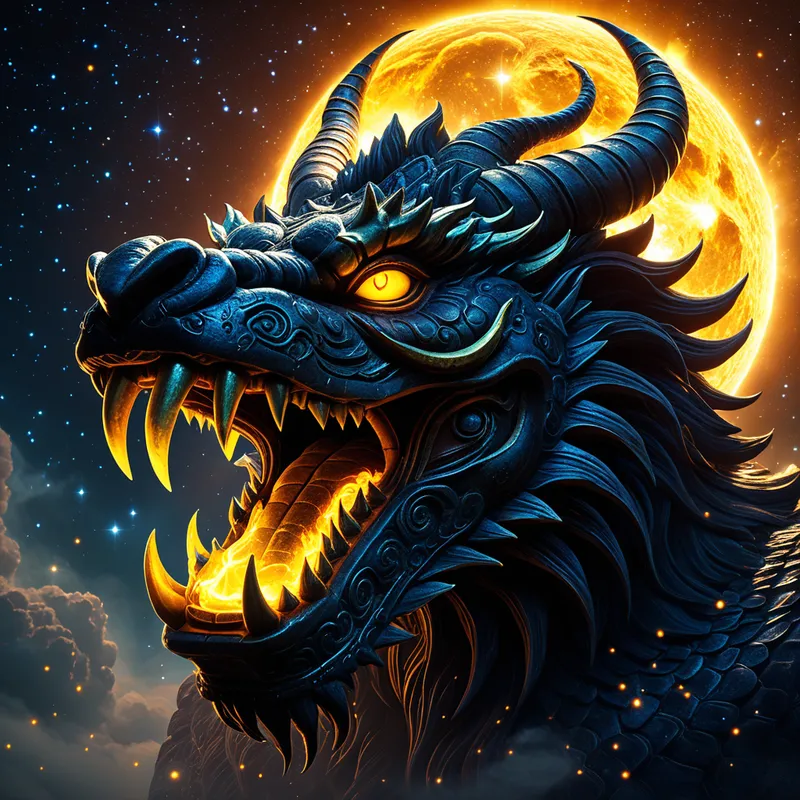
A demon, disguised as a god, drinks the nectar of immortality. Beheaded, his head lives on, eternally chasing the sun and moon to devour them.
The Tale of Rahu
In the time before time, when the cosmos was young and the gods were still discovering their own might, a great disturbance rippled through the celestial realms. The Asuras and the Devas, locked in an eternal war, found themselves weary and diminished. Their immortality was but a long lease, and [the shadow](/myths/the-shadow “Myth from Jungian culture.”/) of decay began to touch them all.
They turned to the primordial ocean, the [Kshirasagara](/myths/kshirasagara “Myth from Hindu culture.”/). With [the world](/myths/the-world “Myth from Tarot culture.”/)-serpent Vasuki as a rope and the mountain Mandara as a churn, they began to stir the depths. The gods held the serpent’s tail, the demons its head, and they pulled. The ocean frothed and churned, yielding both wonders and terrors—a deadly poison, a wish-fulfilling cow, [the moon](/myths/the-moon “Myth from Tarot culture.”/) itself. And then, from the foaming heart of the milky sea, arose Dhanvantari, holding the clay pot, the Kumbha, brimming with Amrita.
A fierce hunger ignited in every being present. The nectar meant eternal sovereignty, an end to fear. But [Vishnu](/myths/vishnu “Myth from Hindu culture.”/), knowing the demons could not be allowed such power, took the form of the enchanting Mohini. She would distribute the nectar, she said, but only to the gods. The demons, mesmerized by her grace, agreed.
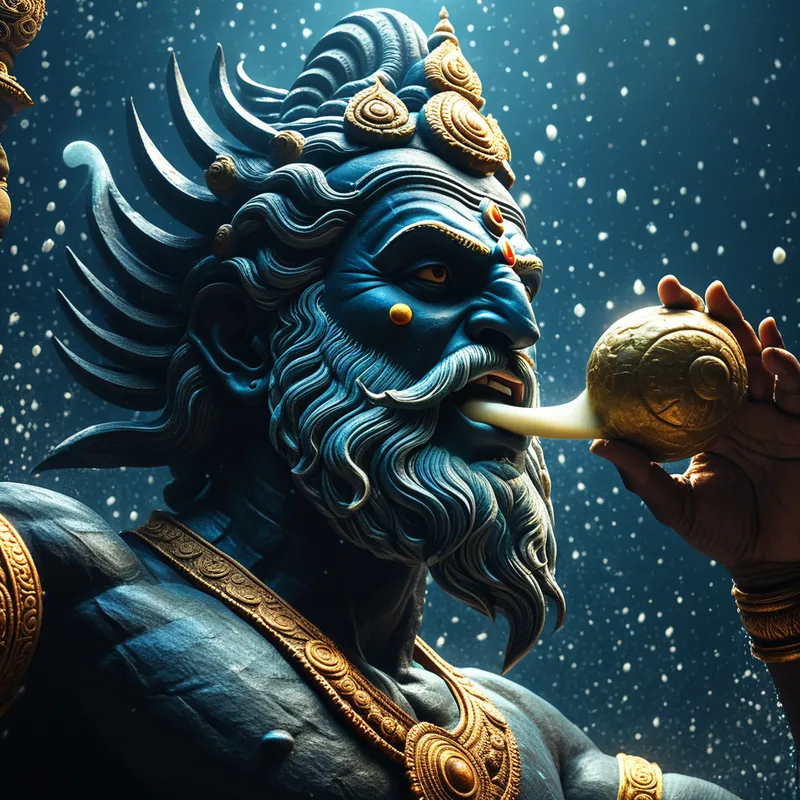
They sat in two rows. Mohini moved down the line of gods, letting each drink deeply. But among the demons sat one named Svarbhanu, whose ambition was as vast as [the void](/myths/the-void “Myth from Buddhist culture.”/). He saw the trick. Quietly, he slipped from his place among the Asuras and took a seat between the sun god, [Surya](/myths/surya “Myth from Hindu culture.”/), and the moon god, Chandra. Disguising his demonic nature, he took on the radiant form of a Deva.
As Mohini approached, he held out his cup. The divine nectar touched his lips. It flowed down his throat. At that very moment, Surya and Chandra, recognizing the interloper, cried out in alarm: “This is no god! This is an Asura!”
The cry shattered the enchantment. Mohini’s form shimmered, and in her place stood Vishnu, his face a mask of cosmic resolve. Before the nectar could pass Svarbhanu’s throat and grant immortality to his entire body, Vishnu’s divine discus, the [Sudarshana Chakra](/myths/sudarshana-chakra “Myth from Hindu culture.”/), flashed through the air. It was a slice of pure cosmic law.
The demon’s head was severed from his body. But the nectar had already reached his throat. The head, now immortal, roared with a fury that shook the stars. The body, named Ketu, writhed and fell away. The head, now known as Rahu, ascended into the heavens, blazing with immortal rage. He fixed his gaze upon Surya and Chandra, the betrayers who had named him. For all eternity, he would chase them across [the sky](/myths/the-sky “Myth from Persian culture.”/). And when he catches them, he opens his vast, shadowy maw and swallows them whole—bringing darkness to the world in an eclipse. But having no body to digest them, they always fall back out, and the light returns. The chase begins anew, forever.
Cultural Origins & Context
The myth of Rahu is woven into the earliest cosmological layers of Vedic and later Puranic literature. It served a dual function: as an etiological tale explaining the dramatic, awe-inspiring, and once-frightening phenomena of solar and lunar eclipses, and as a profound narrative about the consequences of cosmic order (Dharma) and disorder.
Passed down through generations by priests (Brahmins) and storytellers (Sutas), the story was recited during rituals, particularly those meant to counteract the inauspicious influences believed to emanate during an eclipse. In Jyotisha (Vedic astrology), Rahu and Ketu became the shadow planets, the north and south lunar nodes, representing karmic points of intense destiny and upheaval. The myth thus moved from the fire-lit storytelling circle into the complex mathematics of celestial charts, embedding itself not just in culture, but in the perceived architecture of fate itself.
Symbolic Architecture
Rahu is the [archetype](/symbols/archetype “Symbol: A universal, primordial pattern or prototype in the collective unconscious that shapes human experience, behavior, and creative expression.”/) of the unintegrated [shadow](/symbols/shadow “Symbol: The ‘shadow’ embodies the unconscious, repressed aspects of the self and often represents fears or hidden emotions.”/), the part of [the self](/myths/the-self “Myth from Jungian culture.”/) that achieves immortality but remains severed from wholeness. His [story](/symbols/story “Symbol: The symbol of ‘Story’ represents the narrative woven through our lives, embodying experiences, lessons, and emotions that shape our identities.”/) is not one of evil, but of potent, misguided desire that is caught in the act of transformation.
Rahu is the moment of desire crystallized into eternal fact—a head with a throat that has tasted godhood, forever divorced from the body that could give that experience meaning.
The Amrita represents the ultimate psychic prize: total [consciousness](/symbols/consciousness “Symbol: Consciousness represents the state of awareness and perception, encompassing thoughts, feelings, and experiences.”/), enlightenment, or self-realization. Rahu’s method—deception and disguise—symbolizes [the ego](/myths/the-ego “Myth from Jungian culture.”/)’s attempt to seize wholeness through trickery, bypassing the necessary labor of [integration](/symbols/integration “Symbol: The process of unifying disparate parts of the self or experience into a cohesive whole, often representing psychological wholeness or resolution of internal conflict.”/). The swift, surgical strike of Vishnu’s discus is the intervention of a higher principle of order, ensuring that such a partial, egoic [seizure](/symbols/seizure “Symbol: A sudden, uncontrolled physical or emotional disruption, often symbolizing loss of control, overwhelming forces, or a system malfunction.”/) cannot be fully consummated.
Surya and Chandra, the sun and [moon](/symbols/moon “Symbol: The Moon symbolizes intuition, emotional depth, and the cyclical nature of life, often reflecting the inner self and subconscious desires.”/), represent the complementary principles of conscious [clarity](/symbols/clarity “Symbol: A state of mental transparency and sharp focus, often representing resolution of confusion or attainment of insight.”/) (the sun, the perceiving self) and reflective feeling (the [moon](/symbols/moon “Symbol: The Moon symbolizes intuition, emotional depth, and the cyclical nature of life, often reflecting the inner self and subconscious desires.”/), the [soul](/symbols/soul “Symbol: The soul represents the essence of a person, encompassing their spirit, identity, and connection to the universe.”/)). Rahu’s eternal vengeance upon them symbolizes how the unintegrated shadow constantly threatens to [eclipse](/symbols/eclipse “Symbol: An eclipse symbolizes change, transitions, and sometimes unexpected challenges, marking a significant transformation process.”/) our conscious [awareness](/symbols/awareness “Symbol: Conscious perception of self, surroundings, or internal states. Often signifies awakening, insight, or heightened sensitivity.”/) and our emotional [depth](/symbols/depth “Symbol: Represents profound layers of consciousness, hidden truths, or the unknown aspects of existence, often symbolizing introspection and existential exploration.”/), plunging us into temporary periods of [confusion](/symbols/confusion “Symbol: A state of mental uncertainty or disorientation, often reflecting internal conflict, lack of clarity, or overwhelming choices in waking life.”/), fear, or unconsciousness—the personal [eclipse](/symbols/eclipse “Symbol: An eclipse symbolizes change, transitions, and sometimes unexpected challenges, marking a significant transformation process.”/).
The Dreamer’s Resonance
When the pattern of Rahu emerges in modern dreams, it often manifests as a potent, disembodied force. One might dream of a voracious, floating head; of being exposed as an impostor just as one attains a longed-for goal; or of a celestial body being swallowed by darkness.
Somatically, this can feel like a constriction in the throat—the site of Rahu’s partial immortality. Psychologically, it signals a process where a powerful desire or a denied aspect of the self (the shadow) has been activated. This aspect has “tasted” recognition or power but has been abruptly “cut off” from expression, often through an act of self-betrayal, societal judgment (the “cry” of Surya and Chandra), or an internalized moral law (Vishnu’s discus). The dreamer is in the grip of a potent, karmic complex—a “head” full of ambition or hunger that feels disconnected from the practical, grounded “body” of their life, leading to cycles of compulsive pursuit and inevitable frustration.

Alchemical Translation
The individuation process modeled by Rahu is not about defeating the demon, but about understanding the nature of its eternal, partial existence. Rahu cannot be destroyed; he is immortal. The alchemical work is to comprehend his orbit within our own [psyche](/myths/psyche “Myth from Greek culture.”/).
The goal is not to stop the eclipse, but to learn to stand in its shadow and understand what the temporary darkness reveals.
First, we must recognize our own “Rahu-like” desires—the ambitions we pursue through disguise, the parts of ourselves we sneak into the line of the gods, hoping for a taste of wholeness without doing the full work. The “beheading” is often a necessary, if painful, moment of disillusionment, where a partial identity or strategy is severed by reality.
The alchemical translation lies in giving purpose to [the immortal](/myths/the-immortal “Myth from Taoist culture.”/) head. In some astrological interpretations, Rahu, though a shadow, grants worldly success and unconventional genius when consciously engaged. This translates to the psychological task of redirecting that immense, eternal hunger. Instead of letting it chase and eclipse our sun (conscious purpose) and moon (emotional life), we must ask: What is this hunger truly for? Can the immortal, disembodied head—now a fixture of our inner sky—become a witness rather than a devourer? Can its eternal chase be reframed as the necessary orbital rhythm of a psyche that contains both light and the shadow that defines it?
The ultimate integration is realizing that Rahu and Ketu, the head and the body, are one being, torn apart. The journey toward wholeness involves feeling the phantom pain of that severance and, in that feeling, beginning the slow, impossible, and essential work of remembering their original unity. We do not become gods by drinking the nectar; we move toward wholeness by understanding the eternal, ravenous shadow that our sip of ambition creates.
Associated Symbols
Explore related symbols from the CaleaDream lexicon: