Ragnarök Twilight Myth Meaning & Symbolism
The cataclysmic twilight of the gods, a prophecy of total destruction from which a new world and a new humanity are born.
The Tale of Ragnarök Twilight
Listen. The wind from the north carries a scent of iron and frost. The great Yggdrasil shudders, root to crown. This is the Ragnarök, the destiny of the powers, and its song is one of unmaking.
It begins not with a shout, but with a long, cold silence—the Fimbulwinter. Three winters with no summer between. Snow drives horizontally, burying homes and hope. Brothers turn to blades over crusts of bread. The bonds of kinship and oath freeze and snap. In this endless grey, the wolves who chase the sun and moon, Sköll and Hati, finally close their jaws. Light is swallowed. The stars vanish from the heavens.
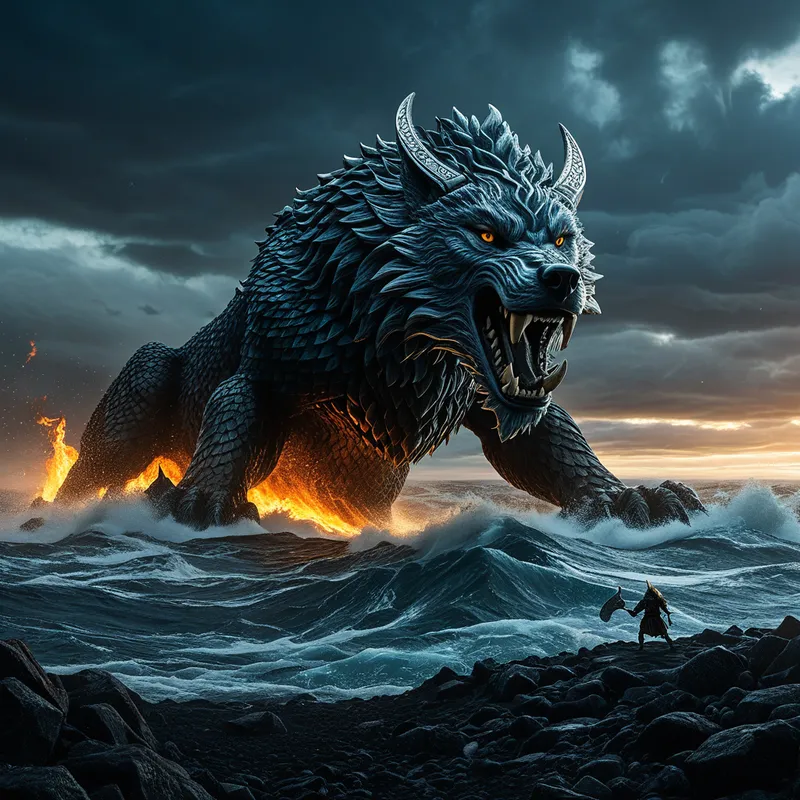
Then, the shaking. The earth quakes so violently that every fetter, every chain forged by god-craft, shatters. From deep woods, the bound wolf Fenrir breaks free, his slavering jaws stretching from earth to sky. From the ocean’s bed, the Midgard Serpent writhes to the surface, vomiting venom that poisons sea and air. The ship Naglfar, its hull built from the untrimmed nails of the dead, is loosed, bearing Surtr and all the hosts of Muspelheimr. From the south comes fire; from the north, ice. And the horn of Heimdallr sounds its final, mournful blast, calling all to the field of Vígríðr.
Here, in the gathering dark, the Aesir and Vanir don their battle-gear one last time. Odin, in his golden helm, rides to meet Fenrir. Thor strides forth to grapple the World Serpent. Týr, one-handed, faces the hound Garmr. Loki, freed, leads the chaotic host. And they fall. Odin is consumed. Thor slays the serpent but staggers nine steps and drowns in its venom. Týr and Garmr slay each other. Heimdallr and Loki trade final, fatal blows.
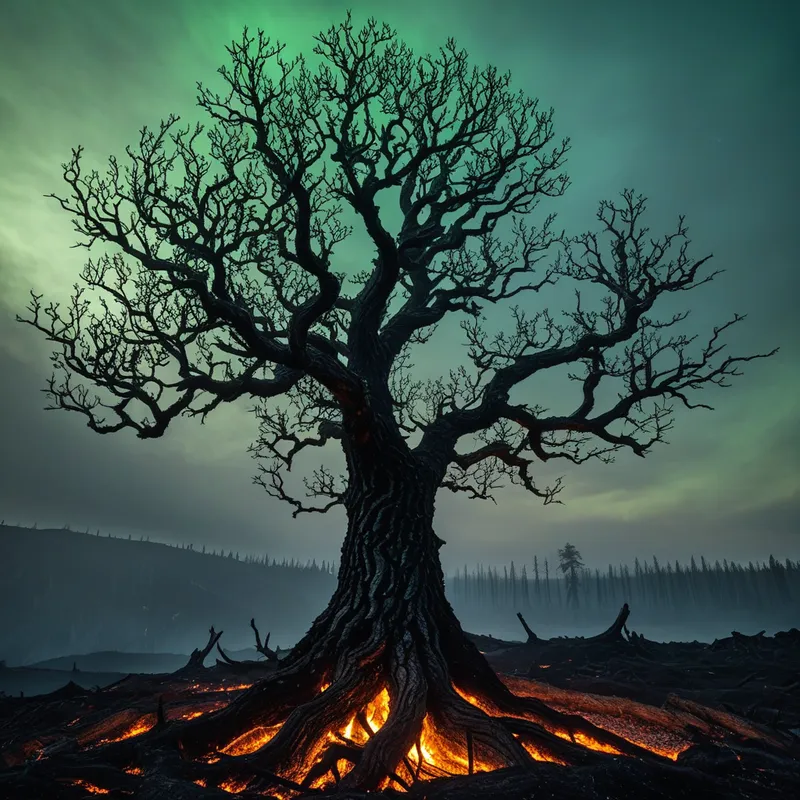
Surtr swings his flaming sword, and the fire engulfs all. Yggdrasil groans, its trunk a torch. The earth sinks into the boiling sea. There is nothing. No sound but the hiss of steam. No light but the dying embers of creation.
And then… a gentle sigh. The waters recede. A new earth rises from the waves, green and fair. From a wood, two humans, Líf and Lífþrasir, emerge, having hidden in Hoddmímis holt. The sun, born anew, is chased by a daughter no less fair. And in the grass of Idavollr, where the Aesir once held court, the sons of the gods return. Vidar and Móði find in the grass the ancient gaming pieces of gold, left by their fathers. The cycle is not ended. It has been cleansed, and begins again.
Cultural Origins & Context
The myth of Ragnarök is preserved primarily in two 13th-century Icelandic texts: the Poetic Edda, a collection of older verse, and the Prose Edda, a handbook for skalds (poets) written by Snorri Sturluson. These sources are Christian-era transcriptions of a far older, oral tradition. The myth was not a simple story of the end times, but a deeply embedded cosmic framework. It was recited by skalds and known by the people, serving as a narrative that explained the nature of their world—a world perceived as fundamentally fragile, held in a temporary balance between primal forces of order and chaos, ice and fire.
Its societal function was multifaceted. It validated a heroic ethos: if even the gods face their doom with courage, so too must humans. It provided a cosmology where destruction was not meaningless but part of a destined, regenerative cycle. This was crucial for a culture familiar with harsh winters, familial feuds, and the ever-present threat of chaos. Ragnarök was the ultimate expression of wyrd—the inescapable weave of destiny that even the gods could not avoid, only meet with honor.
Symbolic Architecture
Ragnarök is not merely an apocalyptic fantasy; it is a profound symbolic map of psychic inevitability. It represents the necessary dissolution of a ruling psychological order—the established “gods” or dominant complexes within the psyche—that has become rigid, corrupt, or out of balance.
The twilight of the gods is the dawn of the self. What must die is not the soul, but the outdated persona that claims to be the soul.
The Fimbulwinter symbolizes a prolonged psychic winter, a state of depression, sterility, and frozen feeling where the old ways no longer sustain life. The breaking of bonds signifies the collapse of internal agreements and identifications. The monstrous children of Loki—Fenrir, the Midgard Serpent, Hel—represent the repressed shadow contents, the chaotic and instinctual forces that the conscious ego (the Aesir) has tried to bind and control. Ragnarök is the moment these bindings fail, and the shadow erupts in full, catastrophic force.
The death of the gods is the de-throning of outdated archetypal dominants. Odin, the ruling consciousness obsessed with knowledge and control, is devoured by the ravenous instinct (Fenrir). Thor, the brute force of the ego, triumphs over the encircling problem (the Serpent) but is poisoned by it in the process. The fire of Surtr is the purifying, if terrifying, flame of a truth that burns away all that is inauthentic.
The Dreamer’s Resonance
When this myth stirs in the modern dreamer, it announces a profound, non-negotiable process of psychic death and rebirth. One does not dream of Ragnarök during minor adjustments, but during life-quakes: the end of a foundational identity (career, relationship, belief system), a confrontation with a long-avoided truth, or a descent into a crushing depression that feels like an endless winter.
Dream imagery may include: world-ending natural disasters (floods, fires, earthquakes), the collapse of familiar buildings or landscapes, encounters with terrifying, unstoppable beasts, or a pervasive atmosphere of finality and doom. Somatic experiences often accompany this—a feeling of being “shaken to the core,” deep fatigue, or a cold dread. This is the psyche’s Heimdallr sounding the alarm. The old psychic governance is under siege. The dreamer is not going mad; they are being prepared for an alchemical dissolution. The process feels catastrophic because it is; the very structures that have defined the self are being dismantled.
Alchemical Translation
The alchemical process mirrored in Ragnarök is the nigredo—the blackening, the putrefaction, the utter dissolution of the prima materia. In individuation, this is the stage where the conscious attitude is humbled, broken down, and stripped of its illusions. It is a descent into the chaotic waters from which the new earth will emerge.
The gold of the new world is not found by avoiding the fire, but in surviving the crucible. The survivors, Líf and Lífþrasir, are not heroes; they are the bare, essential spark of consciousness that endures.
For the modern individual, the “alchemical translation” of Ragnarök is the practice of conscious surrender. It is not fighting the inner Fimbulwinter, but learning to endure its cold, to let the old identities freeze and fall away. It is facing the inner Fenrir—the rage, the grief, the wildness one has chained—not to slay it, but to be devoured by it, allowing the controlling ego (Odin) to die so that a more integrated consciousness (Vidar, who silently tears the wolf’s jaw apart) can later emerge.
The triumph is not in preventing the twilight, but in participating in it consciously, and in trusting the promise of the green earth that rises after. The gaming pieces of gold found on the new Idavollr symbolize that the essential patterns, the archetypal rules of the game of life, remain. They are simply picked up by a renewed consciousness, ready to play again with more wisdom, having looked into the abyss and seen that destruction is but one phase in the psyche’s eternal cycle of renewal. The goal is not to build a fortress against the end, but to become like the world tree: capable of being scorched, and yet holding within its core the latent memory of life, ready to sprout once more.
Associated Symbols
Explore related symbols from the CaleaDream lexicon: