Radha-Krishna Myth Meaning & Symbolism
The eternal, often unfulfilled love between the divine cowherd Krishna and his beloved Radha, representing the soul's passionate longing for the absolute.
The Tale of Radha-Krishna
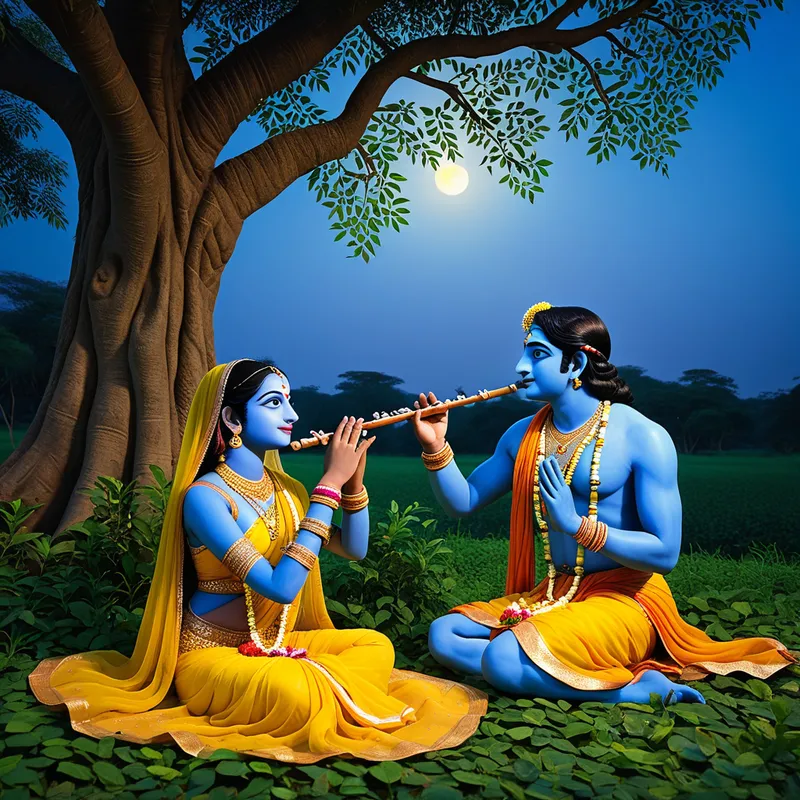
Listen. The air in Vrindavan is thick with the scent of [jasmine](/myths/jasmine “Myth from Persian culture.”/) and damp earth, humming with the breath of a thousand sleeping cows. Here, beneath the ancient, sprawling kadamba trees, a different kind of day begins as dusk falls. It is the hour of the murali.
He is [Krishna](/myths/krishna “Myth from Hindu culture.”/), whose skin holds the depth of monsoon clouds and whose smile holds the promise of all creation and its dissolution. He is the cowherd boy, playful and elusive, his footprints leaving not impressions in the dust but blossoms. And then, there is [Radha](/myths/radha “Myth from Hindu culture.”/). She is not merely a gopi, a cowherd maiden; she is its essence. Her being is an altar upon which the ordinary is consecrated into the sacred by the mere thought of him.
The conflict is not of swords and shields, but of proximity and separation, of union and eternal seeking. The rising action is the call of the flute. Its notes do not travel through air but through the very fabric of the heart. They pull Radha from her home, from her duties, from [the world](/myths/the-world “Myth from Tarot culture.”/) of names and forms. She forgets the path, her hair comes undone, her feet bleed on thorns she does not feel. The forest becomes a [labyrinth](/myths/labyrinth “Myth from Various culture.”/) of divine madness, each turning bringing her closer to the source of that sound, yet also deepening her longing.
They meet in bowers of flowering creepers, by silver rivers under a moon that seems to glow only for them. In these unions, time stops. The universe contracts to the space between their glances. He crowns her with forest flowers; she anoints him with love that has no name. They dance the [Rasa Lila](/myths/rasa-lila “Myth from Hindu culture.”/), a whirling constellation of joy where the lover and the beloved, the one and the many, become indistinguishable.
But the resolution is not a “happily ever after” in a palace. It is the dawn. Krishna, the divine player, must leave. He departs for Mathura, to his destiny as a prince and warrior. Radha does not follow. She remains in Vrindavan, in the landscape of memory and longing. Her love does not diminish; it transforms. It becomes a fire that burns without fuel, a river that flows without a source. She becomes the one who waits, the one who loves in absence, making separation itself a form of the most profound union. The myth does not end; it echoes in every twilight and every note of a distant flute, forever unfinished, forever complete.
Cultural Origins & Context
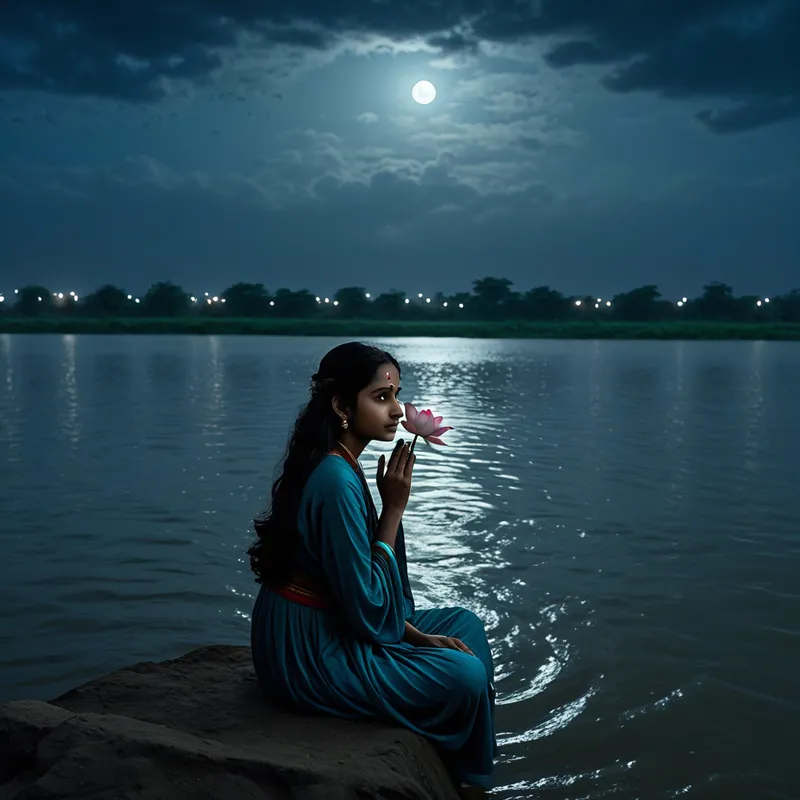
The Radha-Krishna narrative, as we know it today, is a magnificent tapestry woven over centuries. While Krishna’s exploits are central to the ancient Mahabharata and the Bhagavata Purana, the figure of Radha as his supreme consort blossomed later, particularly within the Bhakti movement from the 6th century CE onwards.
This was a revolutionary spiritual shift. The Bhakti poets—like Andal in the south, and later Mirabai, Chaitanya Mahaprabhu, and the poets of the Pushti Marg—sang not in classical Sanskrit, but in the vernacular languages of the people. They democratized divinity, asserting that the ecstatic, personal love of the gopis for Krishna was the highest path to god. Radha, as the pinnacle of this love, became the model for the devotee. Her story was passed down not in dry theological tracts, but through soul-stirring poetry, song, dance, and visual art, making the divine romance accessible to every heart. Societally, it provided a potent counter-narrative to rigid caste and ritual structures, placing raw, human emotion at the center of the spiritual quest.
Symbolic Architecture
At its core, the myth is not a historical romance but a map of the [soul](/symbols/soul “Symbol: The soul represents the essence of a person, encompassing their spirit, identity, and connection to the universe.”/)‘s [journey](/symbols/journey “Symbol: A journey in dreams typically signifies adventure, growth, or a significant life transition.”/). Krishna represents the absolute, the divine [source](/symbols/source “Symbol: The origin point of something, often representing beginnings, nourishment, or the fundamental cause behind phenomena.”/), the Brahman that is both immanent in the world (as the playful cowherd) and transcendent (as the [king](/symbols/king “Symbol: A symbol of ultimate authority, leadership, and societal order, often representing the dreamer’s inner power or external control figures.”/) of Dwaraka). Radha symbolizes the individual [human](/symbols/human “Symbol: The symbol of a human represents individuality, complexity of emotions, and social relationships.”/) [soul](/symbols/soul “Symbol: The soul represents the essence of a person, encompassing their spirit, identity, and connection to the universe.”/), the jivatma.
Their love is the archetypal pull between the finite and the infinite, the wave yearning for the ocean while still being of it.
Krishna’s [flute](/symbols/flute “Symbol: The flute epitomizes elegance and grace, often symbolizing harmony, beauty, and spirituality.”/) is the divine call that awakens the soul from the slumber of mundane existence. Radha’s frantic search through the dark [forest](/symbols/forest “Symbol: The forest symbolizes a complex domain of the unconscious mind, representing both mystery and potential for personal growth.”/) is the soul’s often-confused, painful, yet ecstatic journey through the trials of [life](/symbols/life “Symbol: The symbol of ‘Life’ represents a journey of growth, interconnectedness, and existential meaning, encompassing both the joys and challenges that define human experience.”/) and the unconscious toward enlightenment. The Rasa Lila symbolizes the [cosmic dance](/symbols/cosmic-dance “Symbol: The Cosmic Dance represents the interconnectedness of all existence and the rhythm of life itself, embodying harmony, chaos, and the balance between the two.”/) of creation, where the one (Krishna) manifests as the many (the gopis) to experience the joy of [relationship](/symbols/relationship “Symbol: A representation of connections we have with others in our lives, often reflecting our emotional state.”/), yet remains the central, unifying [consciousness](/symbols/consciousness “Symbol: Consciousness represents the state of awareness and perception, encompassing thoughts, feelings, and experiences.”/). Crucially, their ultimate [separation](/symbols/separation “Symbol: A spiritual or mythic division between realms, states of being, or consciousness, often marking a transition or loss of connection.”/) is the most profound [symbol](/symbols/symbol “Symbol: A symbol can represent an idea, concept, or belief, serving as a powerful tool for communication and understanding.”/). It represents the [truth](/symbols/truth “Symbol: Truth represents authenticity, honesty, and the quest for knowledge beyond mere appearances.”/) that the divine can be fully tasted only in longing, not in permanent possession. The soul’s fulfillment lies not in annihilating [the self](/myths/the-self “Myth from Jungian culture.”/) in the divine, but in maintaining the passionate [tension](/symbols/tension “Symbol: A state of mental or emotional strain, often manifesting physically as tightness, pressure, or unease, signaling unresolved conflict or anticipation.”/) of the [relationship](/symbols/relationship “Symbol: A representation of connections we have with others in our lives, often reflecting our emotional state.”/)—the viraha—which itself becomes the highest form of union.
The Dreamer’s Resonance
When this myth stirs in the modern unconscious, it rarely appears as literal deities. Instead, one may dream of a hauntingly beautiful melody heard from an unknown source, compelling the dreamer to abandon a planned path. One might dream of searching endlessly for a beloved face in a crowded, shifting city, feeling a connection so profound it aches, yet always waking before the reunion. Or perhaps a dream of a perfect, fleeting moment of connection—a glance, a touch—that illuminates the entire dreamscape with golden light, followed by a lingering, melancholic sweetness upon waking.
These dreams signal a somatic and psychological process of awakening to longing. They indicate that [the ego](/myths/the-ego “Myth from Jungian culture.”/) is being called by something deeper—the Self, the anima/animus, or a numinous creative force. The somatic feeling is often a pull in the chest, a sweet anguish. Psychologically, it is the process of Eros breaking through the armor of [Logos](/myths/logos “Myth from Christian culture.”/). The dreamer is being invited to honor a deep, perhaps inconvenient, passion—for a person, a creative pursuit, or a spiritual truth—that disrupts ordinary life but promises a more authentic existence. It is the soul’s discontent with the superficial, craving a sacred encounter.
Alchemical Translation
For the individual on the path of individuation, the Radha-Krishna myth models the alchemy of psychic transmutation. The base metal of ordinary human desire and attachment must be heated in the fire of conscious longing (viraha) to be transformed into the gold of spiritualized love (prema).
The process begins with hearing the “flute”—the call from the Self, which often feels like a disruptive inspiration or a deep dissatisfaction with the persona’s achievements.
The “forest of Vrindavan” is the inner landscape of the unconscious into which one must willingly wander, losing the safe, known paths of the ego. Here, one encounters and integrates shadow aspects (the “thorns” on the path) in service of the quest. Meeting “Krishna” is the numinous experience of connecting with the inner divine counterpart, the anima (for a man) or animus (for a woman), or the Self directly. This brings moments of sublime unity and creativity (the Rasa Lila).
The critical alchemical stage, however, is the “departure for Mathura.” This is the necessary separation, where the ego cannot permanently hold the transcendent experience. The gold is not in clinging to the peak experience, but in the work of Radha—the conscious devotion that continues in the absence. The modern individual must learn to carry the memory of that connection into daily life, allowing the longing to refine the personality, to make work an offering, and relationships a practice of devotion. The union is not a permanent state of bliss, but the ongoing, passionate dialogue between the human and the divine within. The soul (Radha) and the spirit (Krishna) are forever wed in the sacred tension of their love, and that tension is the very engine of a life made whole.
Associated Symbols
Explore related symbols from the CaleaDream lexicon: