Radha and Krishna Myth Meaning & Symbolism
The eternal, often unfulfilled love between the divine cowherd Krishna and his beloved Radha, symbolizing the soul's passionate longing for the absolute.
The Tale of Radha and Krishna
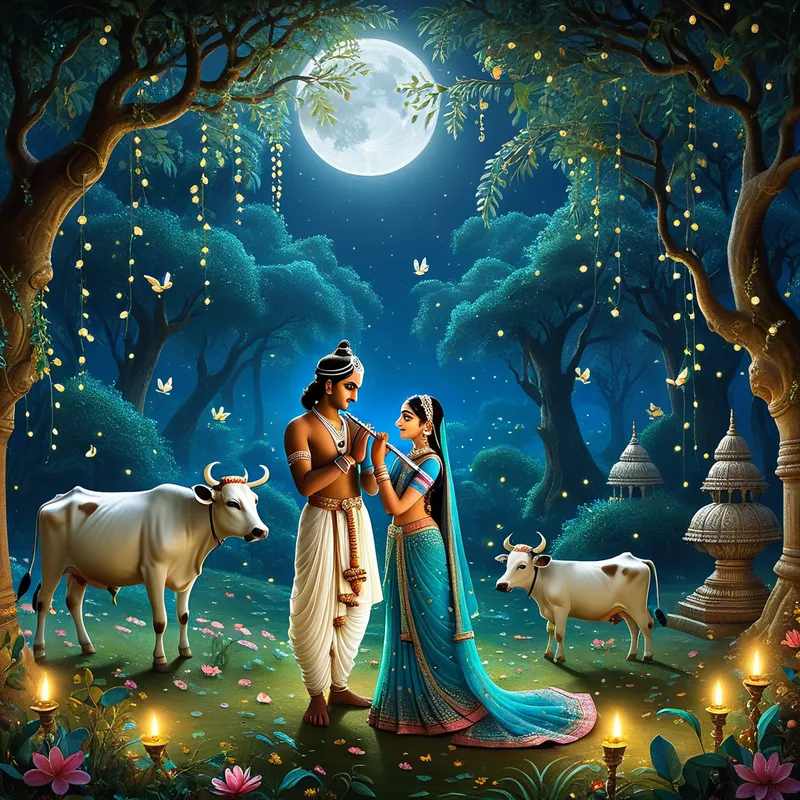
Listen. The air of Vrindavan is thick with the scent of jasmine and dust. It is a realm caught between the earthly and the divine, where every leaf trembles with a secret melody. Here, under the watchful gaze of a thousand stars and the jealous moon, the story unfolds not as history, but as a heartbeat.
He is Krishna, a youth whose dark skin drinks the moonlight, whose eyes hold the promise of creation and its end. In his hands, a simple bamboo flute becomes the axis of the world. When he plays, the rivers slow their flow, the peacocks forget to dance, and the very boundaries between self and other begin to dissolve. The sound is an invitation to a game where the only rule is surrender.
She is Radha. Among all the gopis enchanted by his song, her love is not an infatuation but a fundamental truth, as essential as breath. She is his equal, his shakti (divine energy), the conscious soul to his divine spirit. Their love blooms in the secret groves, a dance of stolen glances and playful arguments, of shared laughter that echoes in the hollows of ancient trees. It is a love that exists outside of social sanction, beyond the bonds of matrimony—a wild, untamed force of nature itself.
But the flute’s song is also a call to duty. The cosmic play (lila) demands separation. Krishna must leave Vrindavan. He must travel to Mathura to confront tyranny and fulfill his destiny as a king and warrior. There is no dramatic farewell, only a lingering absence that settles over the land like a permanent twilight.
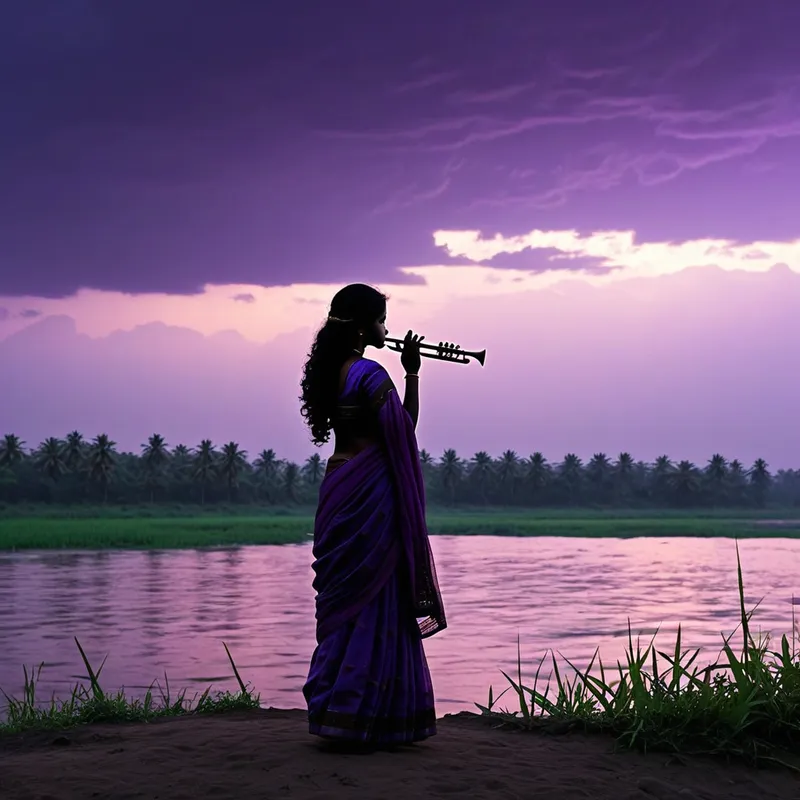
And so, Radha waits. She becomes the embodiment of viraha—the agonizing, ecstatic pain of separation. She wanders the same groves, now silent, seeing his form in the shadows, hearing his flute in the rustle of leaves. Her longing is not despair, but a fierce, burning devotion that becomes her mode of union. In her eternal waiting, in her unwavering love for an absent beloved, she finds a paradox: the deepest connection is forged in the crucible of distance. The myth does not end with a reunion in this world. Their ultimate union is not of bodies, but of essences, a merging into the absolute, Brahman, where lover, beloved, and the love itself become one.
Cultural Origins & Context
The story of Radha and Krishna crystallized primarily in the early medieval period, around the 8th to 12th centuries CE, within the devotional (bhakti) movements that swept across India. While Krishna’s epic deeds are detailed in ancient texts like the Mahabharata and the Bhagavata Purana, Radha’s prominence as his supreme consort blossomed in later poetry and theology.
This myth was carried not by priests in temples first, but by poets, mystics, and singers like Mirabai and Chaitanya Mahaprabhu. It was sung in village squares, performed in dance dramas like raslila, and immortalized in the lyrical, erotic poetry of the Gita Govinda. Its societal function was revolutionary: it proposed that the path to the divine was not through ritual or birthright, but through the raw, personal, and often tumultuous emotion of love. It democratized spirituality, making the intense, human experience of romantic love a legitimate and powerful metaphor for the soul’s journey.
Symbolic Architecture
At its core, this is not a romance, but a profound map of consciousness. Krishna represents the ultimate reality, the divine ground of being—all-attractive, playful, and paradoxically both immanent (in Vrindavan) and transcendent (in his cosmic duties). Radha represents the individual human soul (jivatma), the principle of pure consciousness and devotion that recognizes and yearns for that divine source.
The entire cosmic play is the divine longing for itself, experienced through the soul’s ache for the divine.
Their love in Vrindavan symbolizes the soul’s fleeting, ecstatic moments of mystical union or profound spiritual insight. The flute is the call of the absolute, a vibration that stirs the soul from its slumber. The inevitable separation is the necessary condition of earthly existence; the soul incarnate is, by definition, separate from its source. Radha’s viraha is thus the central spiritual state: the creative, transformative agony of knowing the divine and being apart from it. This longing is not a failure, but the very engine of spiritual seeking.
The other gopis symbolize the scattered senses and aspects of the mind, all drawn to the divine melody but ultimately returning to their worldly duties. Only Radha, representing the focused, devoted consciousness, remains steadfast in her longing, transforming it into a permanent state of worship. Their final, non-worldly union signifies moksha—the soul’s realization of its non-dual nature with the absolute, where the seeker, the seeking, and the sought dissolve.
The Dreamer’s Resonance
When this myth stirs in the modern dreamscape, it rarely appears as literal deities. Instead, one may dream of a profound, magnetic connection with a stranger on a train who disembarks at an unknown station, leaving the dreamer with an indelible, aching imprint. Or one may hear a beautiful piece of music that feels like a memory of a home they’ve never known, waking with a sense of inexplicable loss.
These dreams point to a somatic and psychological process of recognition and yearning. They signal that the dreamer’s psyche is touching upon a deep, archetypal layer where the Self (the total, integrated psyche, akin to Krishna) is making its presence felt to the conscious ego (akin to Radha). The ache is the ego’s growing awareness of a greater wholeness it is separated from—not by geography, but by identification with the personal, the limited, and the temporal. It is the pain of individuation calling, the Self inviting the ego to a larger, more terrifying, and more authentic relationship.

Alchemical Translation
The alchemical process modeled here is the transmutation of personal desire (kama) into divine love (prema), and of ego-consciousness into Self-awareness. The myth provides a roadmap for psychic transmutation:
First, The Enchantment (The Call): The flute’s song. In life, this is the moment of awakening—a glimpse of beauty, truth, or meaning that disrupts ordinary consciousness. It is the call to a deeper life.
Second, The Sacred Romance (The Coniunctio): The playful, intimate union in the grove. Psychologically, this is the temporary, blissful alignment of the ego with the values and guidance of the Self. It feels like being “in love with life,” in a state of flow and meaning.
Third, The Necessary Separation (The Mortificatio): Krishna’s departure. This is the crucible. The blissful state recedes, leaving a painful sense of absence, meaninglessness, or depression. In alchemy, matter must be broken down (solve) before it can be reconstituted (coagula). So too must the ego’s identification with its temporary states be broken down. The pain of viraha is the fire that burns away attachment to the form of the divine (the blissful experience) to reveal devotion to the essence.
The ultimate alchemy is not achieving permanent bliss, but learning to hold the sacred wound of longing as the source of your deepest devotion.
Finally, The Eternal Union (The Rubedo): This is not a return to the initial romance, but a quantum shift. The ego, having been purified and expanded through the fire of longing, no longer seeks the Self as an external object. It realizes its intrinsic, non-dual participation in it. The lover becomes the love. The seeker realizes they are the path and the destination. For the modern individual, this translates to a state of being where one’s life, with all its joys and sorrows, is lived as an offering—not to an external god, but to the profound, mysterious totality of which one is an inseparable part. The separation is seen as the very thing that made the union conscious, and thus, complete.
Associated Symbols
Explore related symbols from the CaleaDream lexicon: