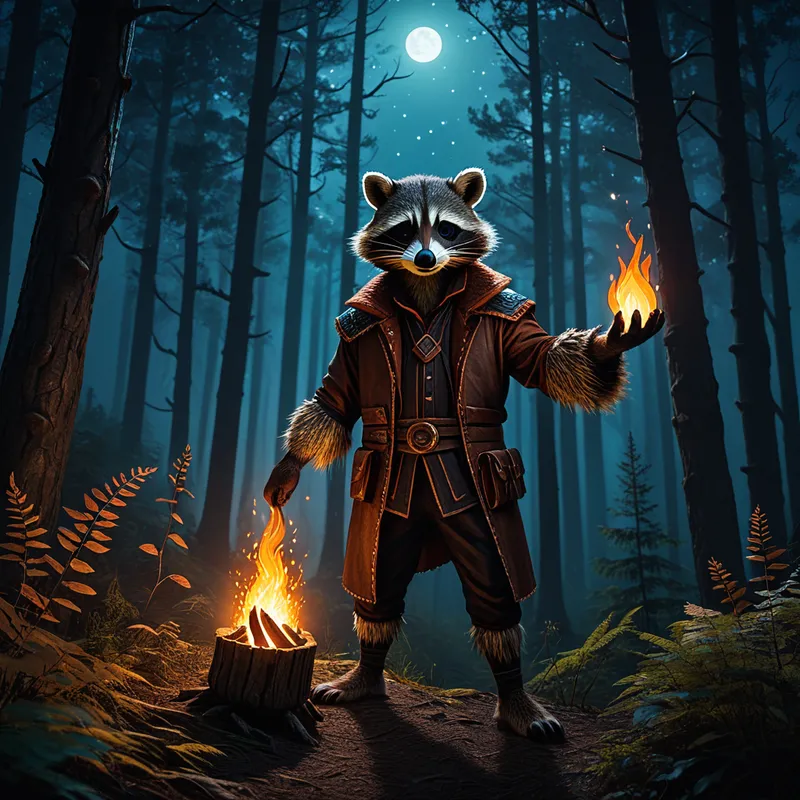
Raccoon as Trickster Myth Meaning & Symbolism
A myth where Raccoon, the clever shape-shifter, uses cunning and humor to challenge order, steal fire, and illuminate the necessity of chaos for growth.
The Tale of Raccoon as Trickster
Listen. In the time before time, when the world was soft and the rules were still being written, there was a great cold. The People and the animal beings shivered in the long, star-pierced nights. All warmth, all light, was held jealously by a few powerful beings far across a wide, black river. They hoarded the fire, this crackling, dancing spirit of the sun’s cousin, for themselves.
Into this stillness came Raccoon. Not the largest, nor the strongest, nor the fastest. But Raccoon was… curious. Its paws were clever, its mind a winding path. And it wore the night’s own mask. It watched the People’s suffering, not with pity, but with a simmering sense of a game poorly played. “Why should warmth be a cage for some and a lack for all?” it thought, though its thoughts were more like the scuttling of beetles under a log.
So, Raccoon devised a plan not of force, but of fluidity. It went to the river, not to swim, but to become. It rolled in the thick, black mud of the bank until its fur was coated, a living shadow. Then, it lay perfectly still among the roots of a great willow, where the fire-keepers passed. When one came near, burdened with a precious, smoldering log, Raccoon did not attack. It wept. It let out a small, pathetic whimper, the sound of a creature utterly lost and cold.
The fire-keeper paused. “What is this sad, dark lump?” He nudged it with his foot. Raccoon trembled artfully. Taking pity—or perhaps merely annoyance—the keeper picked up the muddy creature to move it. In that instant, Raccoon’s clever hands, swift as a striking snake, darted out. Not to claw, but to clutch. It snatched a single, glowing ember from the log, tucking it against its belly where the mud was thickest.
With a yelp—half genuine surprise, half performed outrage—Raccoon squirmed free and fled. The keeper gave chase, but Raccoon was a phantom, dissolving into the underbrush. The ember burned, searing through the mud, burning Raccoon’s belly fur. But Raccoon ran, a tiny sun held against its skin, until it reached the river. It plunged in. The water hissed, the mud washed away, and the pain was immense. But when Raccoon emerged on the far bank, it held the ember aloft. And where the burning cinder had touched its fur, the skin was forever marked with a band of bare, pale flesh, ringed by the charred, dark tips of its fur.
It presented the fire to the People. And then, with the chaos of the moment as its canvas, Raccoon performed one last act of creative mischief. As the animals gathered around the new warmth, amazed, Raccoon took a charred stick from the first fire. With playful, precise strokes, it painted black rings around the eyes of the sleeping Owl, the proud Bear, and the quiet Rabbit. “There,” Raccoon chittered, a laugh in its voice. “Now you all wear the mask of the thief. Now you all carry a piece of the night’s secret.” And with that, it vanished into the twilight, its own mask now a permanent testament to the price and prize of stolen light.
Cultural Origins & Context
The Raccoon as a specific trickster narrative is most prominently featured among the Eastern Woodlands and some Plains tribes, such as the Iroquois (Haudenosaunee) and various Algonquian-speaking peoples. Unlike the more universal and grandiose Trickster archetypes like Coyote in the West, Raccoon’s stories often feel more intimate, localized, and pragmatic.
These tales were not mere children’s fables but vital cultural tools, told by elders and storytellers during long winter nights or around communal fires. Their function was multifaceted: to explain natural phenomena (like the raccoon’s distinctive markings), to impart critical survival wisdom about observation and adaptability, and to serve as a social pressure valve. By laughing at Raccoon’s antics—its failures as often as its successes—the community could indirectly critique foolishness, greed, or rigidity in a safe, metaphorical space. The myth upheld a core Indigenous worldview: that the world is alive with conscious, willful persons, both human and other-than-human, and that navigating life requires not just bravery or strength, but a keen, creative intelligence.
Symbolic Architecture
Raccoon is the archetypal shape-shifter of the boundary. Its domain is the threshold: between forest and village, night and day, water and land, the owned and the wild. Its iconic “mask” is the ultimate symbol of this liminality—it sees clearly while remaining unseen, a master of ambiguity.
The Trickster does not destroy the system; it reveals the system’s hidden seams and then, with a laugh, pulls at a loose thread.
Its “theft” of fire is not an act of mere larceny, but of cultural Prometheanism. Fire represents consciousness, technology, and communal hearth. Raccoon, an outsider, acquires it not through divine grant or heroic quest, but through subterfuge and somatic sacrifice (the burning that creates its markings). This symbolizes how true innovation and enlightenment often arrive not from the center of power, but from the edges, through unorthodox means that leave their mark on the bringer.
The final act—painting masks on the other animals—is a profound psychological democratization of the shadow. Raccoon insists that the capacity for cunning, for possessing a hidden self, is not its unique property but a universal potential. It forces a recognition: we all wear masks; we all carry a piece of the chaotic, creative night within us.
The Dreamer’s Resonance
When Raccoon scampers into the modern dreamscape, it rarely appears as a simple animal. It may manifest as a figure with clever, dexterous hands performing an impossible task, a being wearing a distinct facial mask, or a sense of being a nimble observer in a situation of rigid rules.
Psychologically, this signals a process of adaptive shadow-work. The dreamer is likely encountering a life situation that cannot be overcome by direct force or approved protocol. The somatic feeling is often one of itchy curiosity, a nervous energy in the hands and gut—the urge to handle a problem, to manipulate the pieces. Raccoon dreams ask: Where are you being too rigid? What resource or insight are you treating as forbidden or owned by others? What playful cunning are you suppressing in favor of acceptable defeat? The dream invites an integration of the “thief” function—not to harm, but to acquire what is needed for one’s own growth and warmth.

Alchemical Translation
The Raccoon myth maps perfectly onto the individuation journey’s most paradoxical phase: the integration of the shadow to achieve greater wholeness. The conscious ego often lives in the “village of the cold,” abiding by strict internal rules, shivering in the lack of some vital psychic energy (creativity, assertiveness, joy) that it believes is owned by distant, powerful complexes or internalized authorities.
The alchemy begins not with purification, but with a willing descent into the mud of ambiguity, getting one’s hands dirty in the messy business of the self.
Raccoon’s journey is the psyche’s rogue operation. First, identification with the shadow (rolling in the mud). One must temporarily become the “tricky,” unapproved aspect to move unseen. Then, the theft: the daring, illicit act of reclaiming one’s own inner fire—a repressed talent, a forbidden desire, a silenced voice. This act always burns and marks us. There is a cost, a permanent change in our self-conception; we can no longer pretend we are innocent of our own depths.
Finally, the distribution: the realization that this integrated trickster energy is not a monstrous anomaly but a universal human potential. We “paint the mask” on other parts of ourselves and our perceptions of others, seeing the hidden complexities everywhere. The outcome is not a perfect, ordered self, but a warmer, more agile, and authentically complex one. We become, like Raccoon, a competent citizen of both the village and the wild thicket, our very scars a testament to the light we dared to carry home.
Associated Symbols
Explore related symbols from the CaleaDream lexicon: