Raccoon Myth Meaning & Symbolism
A tale of the clever Raccoon, who through cunning and adaptation, teaches the balance between curiosity and wisdom, and the art of navigating life's shadows.
The Tale of Raccoon
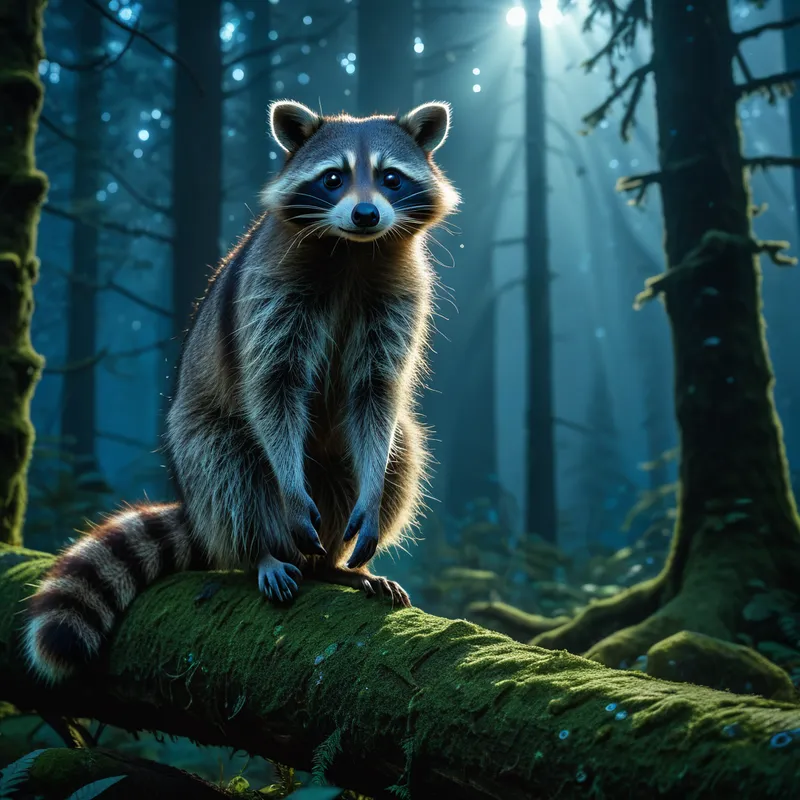
Listen, and let the firelight carry you back to the time when [the world](/myths/the-world “Myth from Tarot culture.”/) was still soft, when animals spoke as we do, and the night was a cloak of deep mysteries. In those days, there was Raccoon, a creature of curious paws and a mind that danced like shadows on [water](/myths/water “Myth from Chinese culture.”/). He was not the largest, nor the strongest, but his eyes held the glint of stolen moonlight.
The People had fire, a gift guarded jealously, its warmth and light kept in the heart of the village. But in the deep woods, the other creatures shivered in the dark. Raccoon watched the flickering glow from the treeline, his clever heart yearning not just for warmth, but for the secret of the flame itself. He saw how it transformed night into day, fear into comfort, raw meat into nourishing feast. “I will have this power,” he whispered to the darkness, and the darkness, his first ally, agreed.
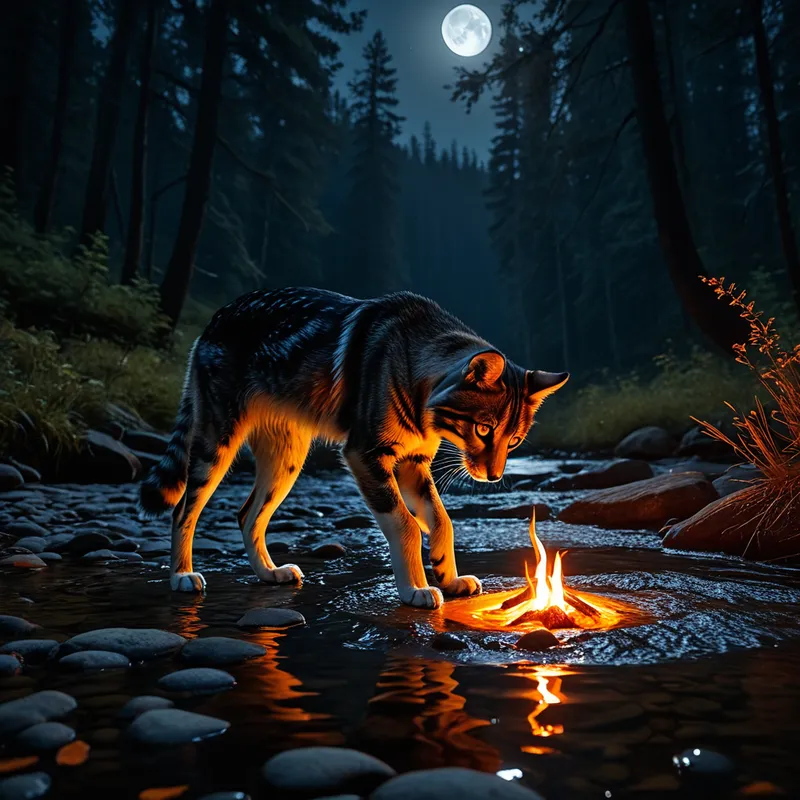
He waited for the moment when the fire-tenders grew drowsy. On silent, padded feet, he became a shadow among shadows, a ripple in the periphery of vision. He did not charge; he insinuated. With a deftness that seemed like magic, he snatched a single, burning brand in his nimble paws. The heat was a shocking, painful bite, but he did not drop it. He fled into the forest, the stolen sun clutched against his chest.
The People raised a cry and gave chase. Raccoon ran, the fire searing his fur, the smell of his own burning flesh sharp in his nose. He came to the bank of a wide, cold river. The pursuers were close. In that moment of desperation, a deeper instinct awoke. He plunged his burning paws into the water. The fire hissed and died, but the pain was soothed. When he pulled them out, the fur was washed clean, but the skin beneath was stained dark by the soot and the memory of the flame. And where he had clutched the brand to his chest, the fur formed five dark bands, like the fingers of a hand that had held power.
He escaped, not with the fire itself, but with its mark upon him forever. From that day, all raccoons bore [the mask](/myths/the-mask “Myth from Various culture.”/) of soot around their eyes, the rings on their tail, and the habit of washing their food in the stream—a perpetual, ritual remembrance of the time they touched the transformative element and were forever changed.
Cultural Origins & Context
The story of Raccoon is woven into the oral traditions of numerous Native American nations, including but not limited to the Cherokee, Iroquois (Haudenosaunee), and various Algonquian-speaking peoples. It belongs to the rich corpus of animal tales that served as the foundational educational and ethical texts of these cultures. These stories were not mere entertainment; they were told by elders around winter fires and during communal gatherings to impart crucial knowledge about the world, social norms, survival, and the nature of character.
Raccoon, as a trickster, occupies a vital role. Unlike the purely destructive trickster, Raccoon’s mischief often leads to necessary change or reveals an important truth. His tale functioned as a complex lesson. It explained the distinctive physical markings of the animal, yes, but more profoundly, it explored themes of consequence, adaptation, and the dual-edged sword of curiosity. It taught listeners about the price of ambition, the importance of quick thinking, and how our deepest trials leave their signature upon us, transforming our very identity.
Symbolic Architecture
Raccoon is the archetypal [shape-shifter](/myths/shape-shifter “Myth from Native American culture.”/) of the [psyche](/myths/psyche “Myth from Greek culture.”/), the master of [the threshold](/myths/the-threshold “Myth from Folklore culture.”/). His domain is the [dusk](/symbols/dusk “Symbol: A transitional period between day and night, symbolizing liminality, reflection, and the merging of opposites in artistic and musical contexts.”/), the riverbank, the edge of the [village](/symbols/village “Symbol: Symbolizes community, connection, and a reflection of one’s roots or origins.”/)—all liminal spaces where one [reality](/symbols/reality “Symbol: Reality signifies the state of existence and perception, often reflecting one’s understanding of truth and life experiences.”/) bleeds into another. The core symbols of his myth are a profound map of a particular kind of intelligence.
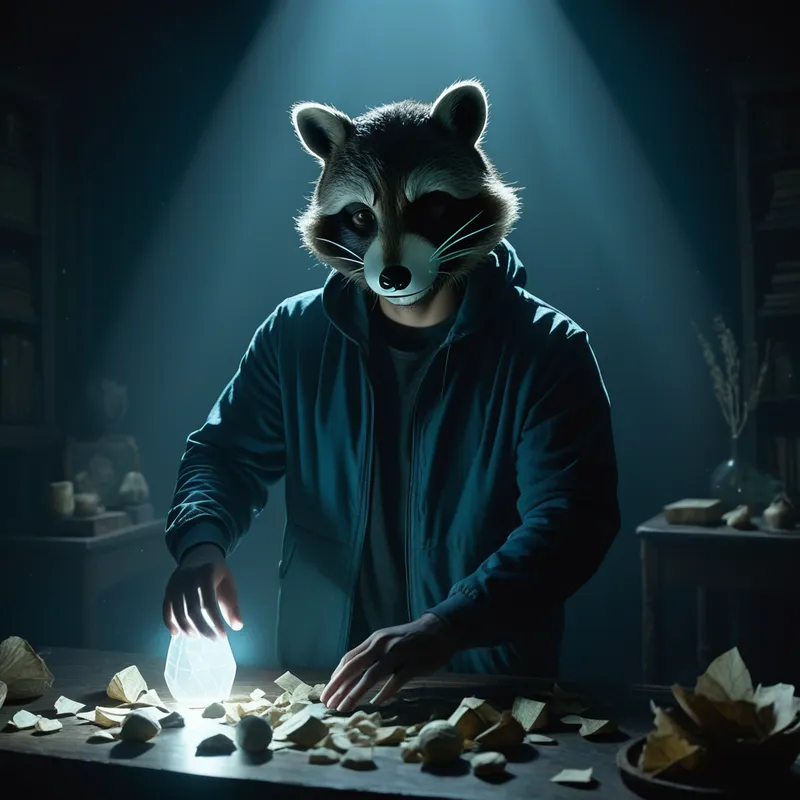
The Mask is his primary [symbol](/symbols/symbol “Symbol: A symbol can represent an idea, concept, or belief, serving as a powerful tool for communication and understanding.”/). It is not a disguise for deception alone, but a symbol of the [persona](/symbols/persona “Symbol: The social mask or outward identity one presents to the world, often concealing the true self.”/) and the [capacity](/symbols/capacity “Symbol: A measure of one’s potential, limits, or ability to contain, process, or achieve something, often reflecting self-assessment or external demands.”/) for [adaptation](/symbols/adaptation “Symbol: The process of adjusting to new conditions, often involving psychological or physical change to survive or thrive.”/). It speaks to the necessity of having a “face” for different situations, but also hints at the authentic self that watches from behind it. The dark bands are the stain of experience, the [knowledge](/symbols/knowledge “Symbol: Knowledge symbolizes learning, understanding, and wisdom, embodying the acquisition of information and enlightenment.”/) gained from brushing against dangerous, transformative forces.
His Paws are his tools of investigation. They represent dexterity, tactile intelligence, and the urge to “handle” the world, to take things apart to understand them. The [ritual](/symbols/ritual “Symbol: Rituals signify structured, meaningful actions carried out regularly, reflecting cultural beliefs and emotional needs.”/) washing is key. It is not merely hygiene; it is a symbolic act of processing, of trying to purify or make sense of what one has acquired, often through unorthodox means.
The trickster does not steal to own, but to understand; his crime is a form of forbidden inquiry, and his punishment is the wisdom tattooed upon his skin.
The Stolen Fire represents culture, technology, [consciousness](/symbols/consciousness “Symbol: Consciousness represents the state of awareness and perception, encompassing thoughts, feelings, and experiences.”/) itself—the powerful, transformative knowledge that is often guarded. Raccoon’s act is a Promethean theft, but on a smaller, more pragmatic scale. He seeks not to gift it to all, but first to understand it for himself. The resulting transformation is not world-altering, but self-altering. He becomes a walking testament to the encounter with a powerful [truth](/symbols/truth “Symbol: Truth represents authenticity, honesty, and the quest for knowledge beyond mere appearances.”/).
The Dreamer’s Resonance
When Raccoon pads into the modern dreamscape, he announces a time of cunning adaptation and curious exploration within the psyche. To dream of Raccoon often coincides with life phases where one feels the need to operate with more guile, to navigate complex social or professional environments where direct force is ineffective. The dreamer may be feeling like an outsider looking in, coveting some “fire”—a skill, a status, a sense of belonging—held by others.
Somatically, this might manifest as restless hands, a feeling of tactile curiosity, or even skin sensitivities—the body remembering the “burn” of a new, perhaps uncomfortable, role or knowledge. Psychologically, Raccoon dreams can surface during times of identity flux. The dreamer is trying on different “masks,” experimenting with personas at work, in relationships, or in creative pursuits. There may be a sense of being marked or changed by a recent experience, a feeling that one has been fundamentally altered, much like Raccoon’s permanently stained fur.
The act of washing in the dream is particularly telling. It points to a subconscious processing, an attempt to “clean” or make sense of something one has acquired—an idea, a relationship, a responsibility—that feels somehow “stolen” or illicitly gained, or simply messy and in need of sorting.
Alchemical Translation
The journey of Raccoon is a masterclass in the alchemy of the shadow. His myth models the process of psychic transmutation through engaged curiosity. The modern individual’s “village fire” is the established order: their inherited beliefs, societal expectations, or comfortable but limiting self-concepts. Raccoon’s impulse is the rebellious, inquisitive spark of the individualing psyche that says, “There is more. I will see for myself.”
The theft is the necessary, often uncomfortable, act of differentiating oneself. It is leaving the warmth of the collective to pursue a personal truth, even if it means getting burned. This is the [nigredo](/myths/nigredo “Myth from Alchemical culture.”/)—the blackening, the searing pain of new awareness that feels like a betrayal of the old self.
Individuation is not a clean, heroic conquest, but a clever, sometimes messy, retrieval of one’s own fire from the communal hearth, leaving the soot of experience as a permanent badge.
The plunge into [the river](/myths/the-river “Myth from Buddhist culture.”/) is the crucial stage of ablutio—the washing. This is the conscious reflection, the therapy, the artistic expression, or the deep introspection where we cool the burn of our new reality and try to purify the raw experience into integrated wisdom. We cannot return the fire, nor can we return to who we were.
The final transformation, the granting of the mask and rings, is the [rubedo](/myths/rubedo “Myth from Alchemical culture.”/)—the reddening, or here, the patterning. The experience is no longer a wound; it is a mark of character. The individual emerges not with the stolen object itself, but fundamentally changed by the encounter. They have developed a “Raccoon-ness”: a resilient, adaptable intelligence, a comfort in the liminal spaces, and a face that honestly bears the marks of their journey. They have learned to use their curiosity not just to take, but to transform themselves.
Associated Symbols
Explore related symbols from the CaleaDream lexicon: