Ra and Apophis Myth Meaning & Symbolism
The sun god Ra's nightly voyage through the underworld, battling the serpent Apophis, is Egypt's foundational myth of order's perpetual triumph over primordial chaos.
The Tale of Ra and Apophis
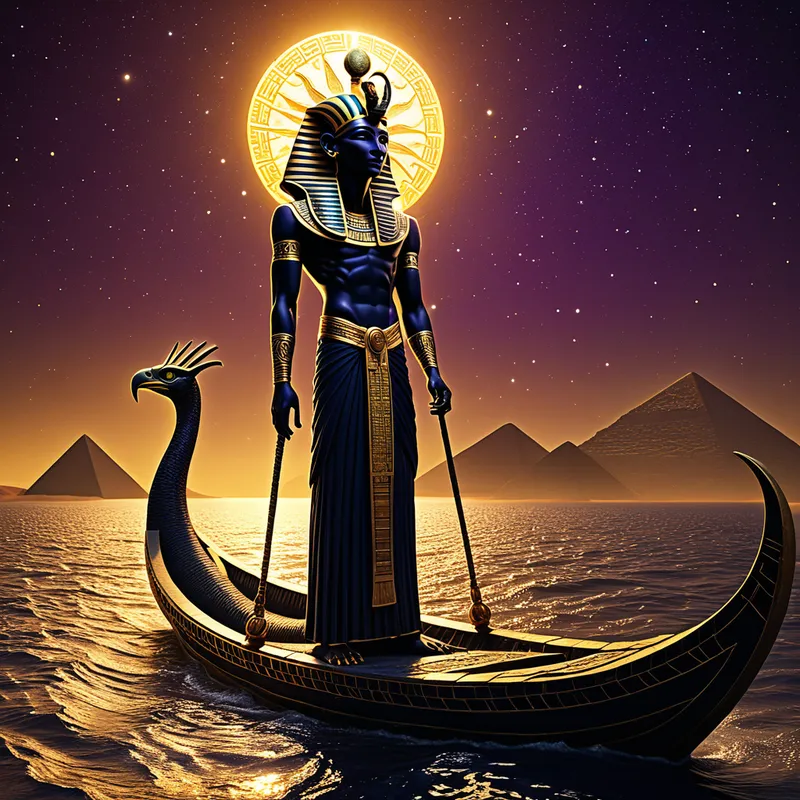
Before the first dawn, when the world was a breath held in the throat of eternity, the great Nun stirred. From its dark, fathomless depths, the Atum-Ra willed himself into being, a burst of light upon the waters. He became the sun, and with his first breath, Maat was established. He sailed his barque of fire across the sky, bringing life to the Two Lands. But as his light touched the western horizon each evening, a deeper truth was revealed: his journey had only begun.
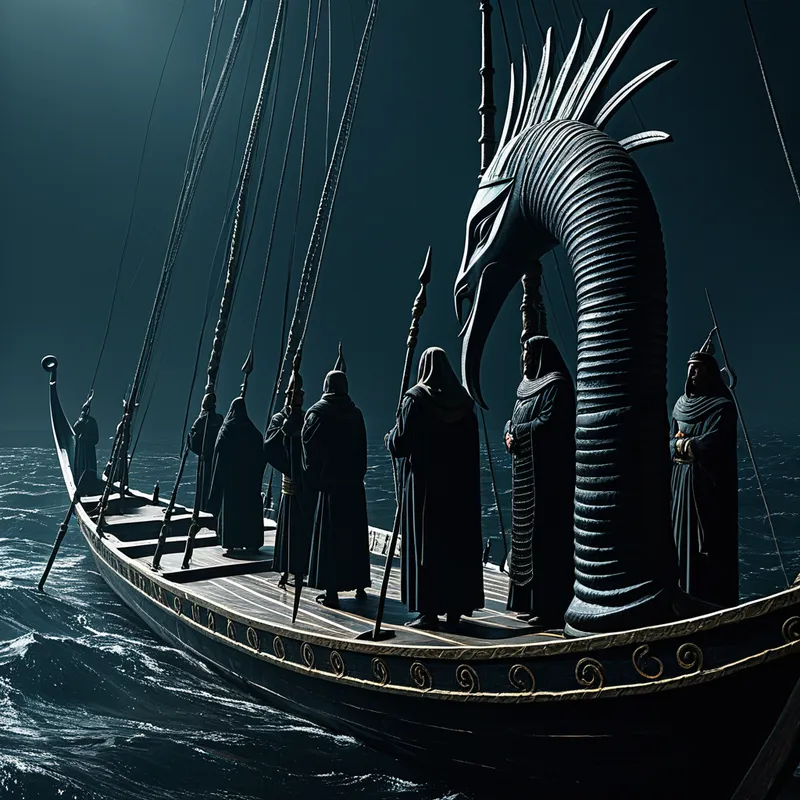
For the sun does not rest. As the eyes of mortals close, Ra’s barque descends into the Duat, the twelve caverns of the night. The golden vessel transforms, its timbers groaning as it enters the realm of shadows. Here, the air is thick with the whispers of the justified dead, who yearn for a glimpse of his light to sustain them. Ra, now in his aged, ram-headed form, sits upon his throne within the barque, surrounded by a crew of gods. Set, the red-haired one, stands at the prow, spear in hand, his fierce gaze piercing the gloom. Isis chants spells of protection, her voice a silver thread in the dark.
But they are not alone in the waters of the Duat. From the deepest, most ancient parts of Nun, where Maat has never reached, it rises. Apophis, the serpent of chaos. He is not a god to be worshipped, but a force to be repelled—a creature of pure negation. He has no eyes to see, for there is nothing he wishes to behold except the end of all things. His body is miles long, a coil of darkness that drinks the light. His roar is the sound of stars going out.
Each night, the confrontation unfolds. Apophis seeks to swallow the Nun whole, to drag the solar barque into his gaping maw and plunge creation back into formless, silent void. He spews venomous darkness and attempts to hypnotize the crew with his coils of oblivion. The battle is titanic. Set drives his spear into the serpent’s hide. The cat-goddess Bastet slashes with her claws. Isis weaves binding spells. The defenders hack the serpent apart, but Apophis is chaos itself; he reconstitutes, endlessly.
The climax comes in the deepest hour, just before the dawn. Apophis, in a final, desperate surge, wraps his immense body around the barque, seeking to strangle the light of the world. The boat shudders. The gods strain. And Ra, the aged king, summons the last of his sovereign power. He speaks a word of such potency that it burns like a white star in the serpent’s mind. The coils loosen. With a collective heave, the serpent is cast back into the abyss, bound by magic and might, defeated for another night.
Wounded but triumphant, the barque sails on. As it approaches the eastern mountain, Ra is transformed. The aged ram becomes the scarab beetle, Khepri, who pushes the sun-disk up into the sky. The first ray of dawn breaks over the horizon. The world breathes again. Maat is restored. But Ra and his crew know, as do the priests who chant the spells, that when the sun sets, Apophis will rise once more. The victory is eternal, but so is the struggle.
Cultural Origins & Context
This myth was not merely a story for the ancient Egyptians; it was the fundamental operating system of their cosmos. It is primarily known from funerary texts like the Book of the Dead, the Amduat, and the Book of Gates, inscribed on tomb walls and papyri to ensure the deceased’s safe passage alongside Ra.
The telling was a sacred, ritual act. Priests in temple sanctuaries would perform daily ceremonies to “help” Ra in his battle, burning wax models of Apophis, reciting execration texts, and spitting upon drawings of the serpent to magically aid the cosmic defense. The Pharaoh, as the living embodiment of Horus and son of Ra, was the chief guarantor of this victory on earth. His role in maintaining law, justice, and temple rites was directly equivalent to Ra’s fight in the Duat. The myth thus functioned as the ultimate justification for social order, kingship, and religious practice—every sunrise was proof that the community’s rituals were effective and that chaos had been held at bay for another day.
Symbolic Architecture
At its heart, the myth maps the psyche’s confrontation with the unconscious. Ra, the solar barque, represents the conscious ego—the “I” that journeys through time, illuminating our known world. The Duat is the vast, uncharted territory of the personal and collective unconscious. Apophis is the embodiment of the Shadow in its most absolute form: not just personal failings, but the terrifying pull toward dissolution, entropy, and the undoing of the self.
The battle is never won because the shadow is not an enemy to be destroyed, but a reality to be engaged. Its nightly return is necessary for the sun’s renewal.
The other gods in the barque—Set, Isis, Bastet—symbolize the various psychic faculties the ego must recruit to navigate the depths: assertive will (Set), nurturing insight and magic (Isis), and instinctual ferocity (Bastet). The journey through the twelve hours of night signifies the necessary, perilous process of introspection. One cannot simply stay in the bright sky of consciousness; to be whole, one must descend into the darkness and face what lurks there. The transformation of Ra into Khepri at dawn is the alchemical prize: the ego, having faced the shadow, is reborn, stronger and renewed, not in spite of the struggle, but because of it.
The Dreamer’s Resonance
When this myth pattern stirs in modern dreams, it often manifests not as literal serpents and sun gods, but as somatic and emotional landscapes. The dreamer may find themselves in a fragile vehicle (a car, a small boat) moving through a terrifying, dark landscape. They may be pursued by a formless, engulfing presence or feel an overwhelming dread of being swallowed or dissolved. The setting is often liminal—a deserted road at night, a basement that descends forever, the edge of a black ocean.
Psychologically, this signals a profound encounter with the shadow. The dream-ego (the Ra-figure) is feeling besieged by aspects of the self it has refused to acknowledge: repressed rage, deep grief, paralyzing fear, or a nihilistic voice that questions the point of one’s entire life structure (the Apophis-force). The somatic feeling is one of contraction, a fight for psychic survival. The dream is the psyche’s dramatic enactment of a crucial process: the conscious self is being forced to acknowledge and engage with the contents of the personal abyss. It is a terrifying but vital initiation into a deeper level of self-awareness.
Alchemical Translation
For the individual on the path of individuation, the myth of Ra and Apophis is a master blueprint for psychic transmutation. It reframes the human struggle from one of achieving permanent peace to one of mastering a sacred, cyclical ritual of engagement.
The first alchemical stage is the Descensio—the voluntary descent into the Duat of one’s own psyche. This is the hard work of therapy, introspection, journaling, or engaging with art: sailing into your own darkness. The confrontation with Apophis is the inevitable meeting with the shadow. Here, the modern “Set” is the courage to assert boundaries and say “this is me, and that is not,” while the “Isis” is the compassionate curiosity that seeks to understand the shadow’s origin and message.
The goal is not to kill the serpent, but to learn its name, to bind it with the cords of awareness, and in doing so, reclaim the energy it holds captive.
The binding of Apophis is the integration of the shadow. When we can say, “This rage, this fear, this despair is also a part of me,” we disarm its autonomous, destructive power. Its energy is then available to the psyche. The final transformation into Khepri is the dawn of a new conscious attitude. The ego, no longer fearing the dark, is reborn. It understands itself as both the ruler of the day and the navigator of the night. The individual realizes that their wholeness depends on this eternal, internal dialogue between light and dark, order and chaos. They become, like Ra, a sovereign capable of containing the totality of their own experience, ensuring the sun rises again within them, day after day.
Associated Symbols
Explore related symbols from the CaleaDream lexicon: