Pythia Myth Meaning & Symbolism
The story of Apollo's conquest of the chthonic serpent Python and his establishment of the Pythia, the divine mouthpiece at the world's sacred center.
The Tale of Pythia
Before the gods of Olympus claimed their dominion, [the world](/myths/the-world “Myth from Tarot culture.”/) was a place of deep, murmuring earth. At the very navel of this world, where the bones of the planet pressed closest to the skin of [the sky](/myths/the-sky “Myth from Persian culture.”/), lay a place of profound power. It was guarded not by a god, but by a creature of the primordial dark: [Python](/myths/python “Myth from Greek culture.”/), a serpent of such immense size and age that its coils were the hills and its breath was [the mist](/myths/the-mist “Myth from Celtic culture.”/) from the sacred spring. This was the oracle of Gaia and her daughter [Mnemosyne](/myths/mnemosyne “Myth from Global/Universal culture.”/), a place where the past, present, and future seeped from a crack in the stone like [water](/myths/water “Myth from Chinese culture.”/).
Then came the golden one, Apollo, newborn and radiant with purpose. He sought a place to speak his truth to mortals. He descended from the heights of Parnassus, his silver bow gleaming. The air grew thick with the smell of damp stone and myrrh. Python, sensing the new order approaching, uncoiled its vast body, its scales scraping like shale against the mountain, and rose to defend the ancient, whispering dark.
The battle was not of brute force alone, but of essence against essence. Apollo, the archer whose arrows were rays of the sun, stood for clarity, form, and light. Python, heaving its bulk from the chasm, was the embodiment of the formless, the chaotic, the unknowable depths. Apollo drew his bow. The string sang a note of piercing purity. The arrow flew, not as wood and bronze, but as a shaft of concentrated reason. It found its mark. With a roar that shook the very roots of the mountains, Python fell, its life bleeding back into [the earth](/myths/the-earth “Myth from Hindu culture.”/) from whence it came.
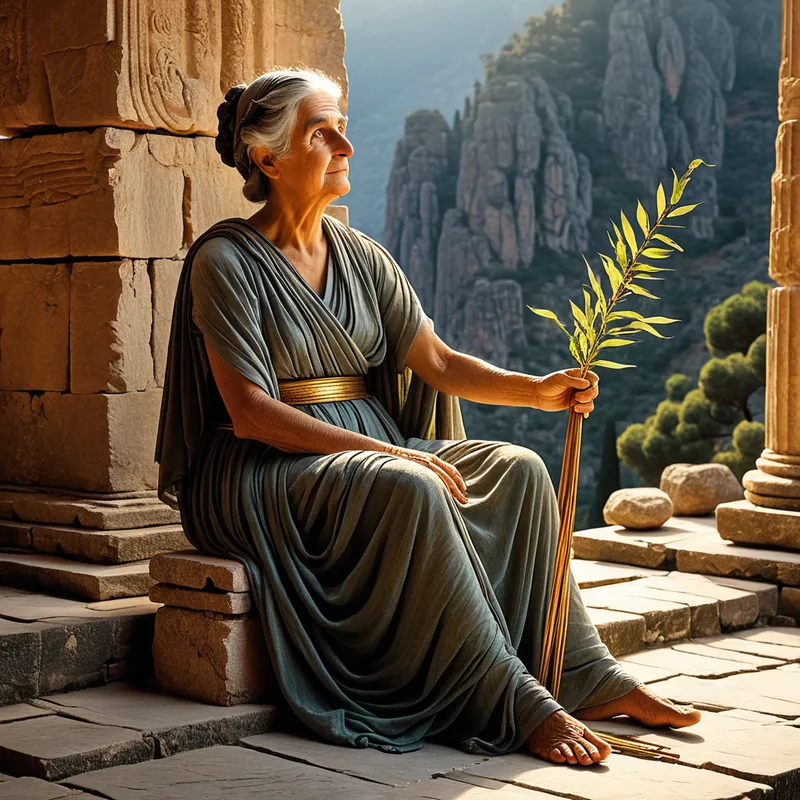
But the god of light was also the god of prophecy. He did not come to silence the oracle; he came to transmute it. He cleansed the land, which he now called Delphi. Over the very chasm where Python fell, where the sacred vapors still rose from the rotting serpent’s body, he built his temple. And to give voice to the vapors, he chose a vessel: a woman from the nearby village. She would be the Pythia.
On the sacred seventh day of each month, she would descend into [the temple](/myths/the-temple “Myth from Jewish culture.”/)‘s innermost sanctum, the adyton. There, seated on a three-legged stool placed over the fissure, she would chew laurel leaves, drink from the sacred spring, and breathe the rising, sweet-smelling [pneuma](/myths/pneuma “Myth from Greek culture.”/). The spirit of Python, mingled with the power of Apollo, would enter her. Her body would tremble. Her eyes would lose focus, seeing not the dark room but the weave of fate itself. Her voice, changed and resonant, would speak the god’s riddles—truths wrapped in enigma, delivered from the meeting place of the deep earth and the far-seeing sun.

Cultural Origins & Context
The myth of Pythia is not merely a story of divine conquest; it is the foundational charter for the most important religious and political institution in the ancient Greek world: [the Oracle of Delphi](/myths/the-oracle-of-delphi “Myth from Global/Universal culture.”/). For over a millennium, from the 8th century BCE onward, city-states, kings, and common pilgrims made the arduous journey to this remote mountain site seeking guidance on matters of war, colonization, religion, and personal destiny.
The myth served a critical societal function by providing a sacred rationale for a profound transition. It acknowledged the pre-Greek, chthonic (earth-based) worship of the site while legitimizing its incorporation into the Olympian [pantheon](/myths/pantheon “Myth from Roman culture.”/) under Apollo. The Pythia herself was always a local woman of good character, often older, living a strictly regulated life. Her prophecies were not her own; she was the medium, the interface where the divine will—a synthesis of Apollonian order and Pythonian chaos—manifested in human language. The priests of the temple, the Hosioi, would then translate her often ecstatic and fragmented utterances into the famed, ambiguous hexameter verses. This process ensured that the oracle’s authority was collective, ritualized, and inseparable from the cultural narrative of Apollo’s sacred right to reveal—but never to fully unravel—the mysteries of fate.
Symbolic Architecture
At its core, the myth of Pythia is a map of [consciousness](/symbols/consciousness “Symbol: Consciousness represents the state of awareness and perception, encompassing thoughts, feelings, and experiences.”/). [Python](/symbols/python “Symbol: The python represents both fear and fascination, as well as transformation through confronting one’s deeper issues.”/) represents the primal, unconscious, instinctual [realm](/symbols/realm “Symbol: The symbol of ‘Realm’ often signifies the boundaries of one’s consciousness, experiences, or emotional states, suggesting aspects of reality that are either explored or ignored.”/)—the chaotic wellspring of [intuition](/symbols/intuition “Symbol: The immediate, non-rational understanding of truth or insight, often described as a ‘gut feeling’ or inner knowing that bypasses conscious reasoning.”/), fear, and raw creative potential that exists before the light of ego-consciousness (Apollo) arrives. Apollo’s slaying of [Python](/symbols/python “Symbol: The python represents both fear and fascination, as well as transformation through confronting one’s deeper issues.”/) is not an annihilation, but a necessary [differentiation](/symbols/differentiation “Symbol: The process of distinguishing or separating parts of the self, emotions, or identity from a whole, often marking a developmental or psychological milestone.”/). [The ego](/myths/the-ego “Myth from Jungian culture.”/) must establish itself, creating order, boundaries, and [identity](/symbols/identity “Symbol: Identity represents the sense of self, encompassing personal beliefs, cultural background, and social roles.”/) by confronting and integrating the overwhelming power of the unconscious.
The oracle exists in the sanctified wound, where the light of consciousness meets the dark breath of the deep.
The Pythia is the living [symbol](/symbols/symbol “Symbol: A symbol can represent an idea, concept, or belief, serving as a powerful tool for communication and understanding.”/) of this [integration](/symbols/integration “Symbol: The process of unifying disparate parts of the self or experience into a cohesive whole, often representing psychological wholeness or resolution of internal conflict.”/). She is not Apollo, nor is she Python. She is the [temenos](/myths/temenos “Myth from Greek culture.”/) (sacred precinct) where they converse. The tripod seat is her stable, [human](/symbols/human “Symbol: The symbol of a human represents individuality, complexity of emotions, and social relationships.”/) form (the three [legs](/symbols/legs “Symbol: Legs in dreams often symbolize movement, freedom, and the ability to progress in life, representing both physical and emotional support.”/) perhaps symbolizing [body](/symbols/body “Symbol: The body in dreams often symbolizes the dreamer’s self-identity, personal health, and the relationship they have with their physical existence.”/), mind, and [spirit](/symbols/spirit “Symbol: Spirit symbolizes the essence of life, vitality, and the spiritual journey of the individual.”/)). The pneuma she inhales is the dissolved essence of the [serpent](/symbols/serpent “Symbol: A powerful symbol of transformation, wisdom, and primal energy, often representing hidden knowledge, healing, or temptation.”/)—the unconscious now made accessible, albeit in an intoxicating and dangerous form. Her possession is a state of hieros gamos (sacred [marriage](/symbols/marriage “Symbol: Marriage symbolizes commitment, partnership, and the merging of two identities, often reflecting one’s feelings about relationships and social obligations.”/)) between rational [structure](/symbols/structure “Symbol: Structure in dreams often symbolizes stability, organization, and the framework of one’s life, reflecting how one perceives their environment and personal life.”/) and irrational inspiration. Her prophecies are never clear because absolute [clarity](/symbols/clarity “Symbol: A state of mental transparency and sharp focus, often representing resolution of confusion or attainment of insight.”/) is the domain of Apollo alone; the truths from the deep always retain a [shadow](/symbols/shadow “Symbol: The ‘shadow’ embodies the unconscious, repressed aspects of the self and often represents fears or hidden emotions.”/) of their chaotic [origin](/symbols/origin “Symbol: The starting point of a journey, often representing one’s roots, source, or initial state before transformation.”/), requiring interpretation—a [metaphor](/symbols/metaphor “Symbol: A figure of speech where one thing represents another, often revealing hidden connections and deeper truths through symbolic comparison.”/) for how we must continually interpret the symbolic messages from our own unconscious.
The Dreamer’s Resonance
When the pattern of the Pythia myth stirs in the modern [psyche](/myths/psyche “Myth from Greek culture.”/), it often manifests in dreams of profound, unsettling communication. One might dream of hearing a voice from a vent or a crack in the wall, speaking in a language that is felt more than understood. Or of being in a cave or basement (the adyton of [the self](/myths/the-self “Myth from Jungian culture.”/)) where a strange mist or scent induces altered states. The dreamer may find themselves forced to serve as a reluctant mouthpiece for a powerful, collective, or ancestral message they do not fully comprehend.
Somatically, this can correlate with a feeling of pressure in the chest or diaphragm—the “breath of the god”—or a sense of being “on the hot seat,” carrying a truth that feels too big. Psychologically, this dream motif signals a moment where contents of the personal or collective unconscious are pressing for recognition and expression. The dream-ego is being asked to play the role of the Pythia: to sit in the uncomfortable, sacred space above [the abyss](/myths/the-abyss “Myth from Kabbalistic culture.”/), to allow the chaotic material to rise and speak through them, without identifying with it. It is a call to develop a capacity for inspired listening to one’s own depths, however disorienting the process may be.

Alchemical Translation
The alchemical journey modeled by the Pythia myth is the opus of becoming a vessel for wisdom. It begins with the [nigredo](/myths/nigredo “Myth from Alchemical culture.”/): the confrontation with the Python, the dark, serpentine chaos of our unexamined depths (shadow, complex, trauma). This “slaying” is the painful but necessary work of bringing light—awareness—to what has been instinctual and automatic.
The albedo is the cleansing and consecration of the space: establishing the disciplined practice (like the Pythia’s rituals) that creates a stable container—a conscious ego-structure—able to host the numinous without being shattered by it. The tripod must be strong.
The goal is not to become the god, but to become the clear channel through which the god and the serpent can converse.
Finally, the [rubedo](/myths/rubedo “Myth from Alchemical culture.”/) is the prophetic act itself. This is the state of individuated wholeness where one can consciously access the deep pneuma of the unconscious (the transformed Python) and translate its symbolic, poetic language into a form that can guide life in the conscious world (Apollo’s gift). The individual becomes their own oracle, not by possessing absolute knowledge, but by developing a lifelong, respectful dialogue between the illuminating clarity of the mind and the fertile, ambiguous darkness of the soul. The vapor from the crack in the earth becomes the breath of authentic, inspired speech.
Associated Symbols
Explore related symbols from the CaleaDream lexicon: