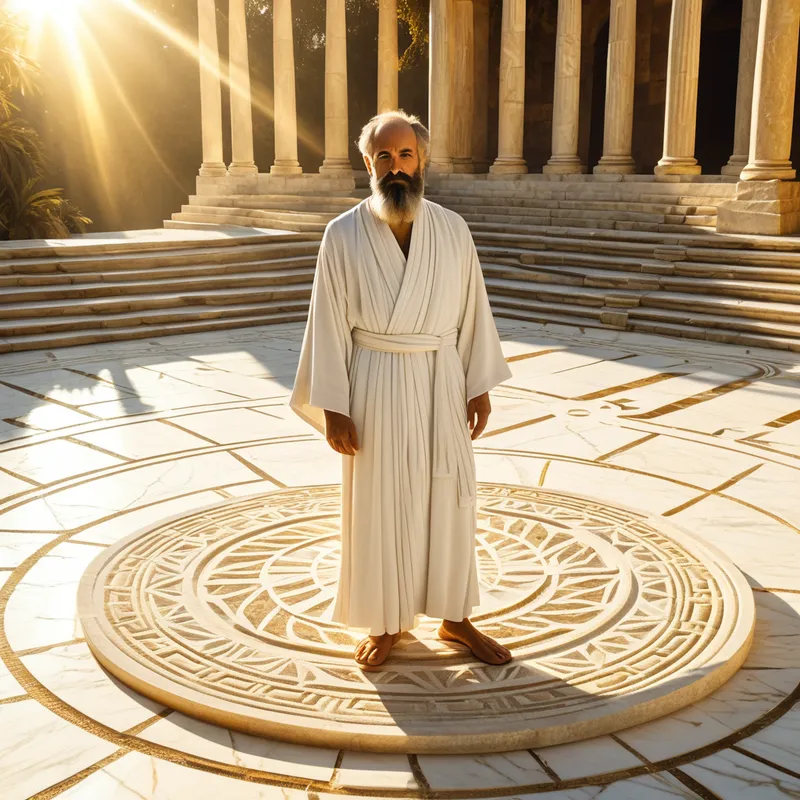
Pythagoras and his followers Myth Meaning & Symbolism
A mystic philosopher forms a sacred brotherhood to uncover the mathematical order of the cosmos, facing persecution for revealing divine secrets.
The Tale of Pythagoras and his followers
Hear now the tale not of a god, but of a man who walked with gods. In the golden haze of the sixth century, when the world was younger and the veil between the seen and unseen was thin as a cicada’s wing, a ship from the east made land at Croton. From it stepped a man whose eyes held the stillness of deep wells and the fire of distant stars. His name was Pythagoras.
He spoke not of war or trade, but of the music of the spheres. He said the cosmos was not chaos, but a divine equation, a living geometry sung into being. His words were like honey and lightning, and they drew to him souls hungry for a truth beyond the marketplace and the temple. They were the young, the brilliant, the disillusioned—the seekers. He did not merely teach them; he initiated them. They gave up their possessions, donned simple white linen, and entered the Brotherhood.
Their days were a sacred rhythm. At dawn, they walked in contemplation, reciting the day’s lessons. They ate simple, pure foods, shunning the sacred bean for reasons known only to the Master. Their studies were not written on papyrus, for the deepest truths were to be heard, not read. They learned of the Tetractys, the holy ten dots that held the blueprint of creation. They plucked lyre strings, discovering that beauty itself obeyed the law of whole-number ratios. The world dissolved into number, and number sang back the name of the divine.
For years, the Brotherhood thrived, a luminous island of intellect and spirit in a sea of mundane politics. They governed themselves, their city, by the principles of harmony. But light casts a long shadow. To the outside, they became an object of awe, then suspicion, then fear. Their secrecy was seen as conspiracy. Their abstentions were seen as arrogance. The whisper began: They deem themselves above us. They know things meant for the gods alone.
The conflict simmered until a man named Cylon, spurned from their ranks, let his humiliation curdle into venom. He stoked the fears of the powerful, whispering of a cabal that threatened the old ways. The spark became a blaze. A mob, fueled by wine and dread, descended upon the house where the Brotherhood gathered.
There was no battle, only a desperate, sacred flight. The disciples, their world of perfect order shattered by the roar of the irrational, scattered into the night. Some were caught. The story tells that, faithful to their vow and the Master’s taboo, they chose to be cut down at the edge of a bean field rather than flee through it, for to trample the bean was to trample a symbol of the soul’s journey. Others escaped, carrying the fragments of the teaching like embers in their hearts, scattering them across the Greek world. Pythagoras himself, some say, perished. Others claim he vanished, becoming one with the universal harmony he had spent his life deciphering. The school was burned, but the numbers endured.

Cultural Origins & Context
The figure of Pythagoras straddles the misty border between history and legend. Emerging in the 6th century BCE in the Greek colonies of southern Italy, the stories about him and his followers were passed down not as a single, canonical myth, but as a fragmented lore by later philosophers like Plato and Aristotle, and biographers like Iamblichus and Porphyry. These accounts are less historical record and more a palimpsest of memory, idealization, and philosophical projection.
The tales functioned in a specific cultural crucible. This was the dawn of Western rational thought, where the mythological explanations of Homer and Hesiod were beginning to be questioned. The Pythagorean mythos served as a bridge. It offered a new, awe-inspiring narrative: that the universe was comprehensible, not through capricious gods, but through immutable, divine principles accessible to the disciplined human mind. The society of the Brotherhood modeled a new ideal—a life ordered by asceticism, intellectual pursuit, and communal secrecy—which stood in stark contrast to the public, agonistic culture of the Greek city-state. The myth was told to explain the origin of philosophical and mathematical truths, to warn of the tension between enlightenment and the uncomprehending populace, and to sanctify the life of the mind as a spiritual path.
Symbolic Architecture
At its heart, the myth is an archetypal drama of the collision between the Nous (Intellect/Spirit) and the Physis (the Unruly World/Populace). Pythagoras represents the incarnated Logos, the human vessel through which the cosmic pattern is perceived. He is the mediator between the transcendent realm of pure form and the immanent world of sensation.
The Brotherhood is the nascent, fragile vessel of consciousness itself, attempting to hold the blinding light of cosmic truth.
The Tetractys is the ultimate symbol of this truth—a mandala of creation where the One becomes the Many through harmonic progression. The strict rules (dietary taboos, silence, communal property) are not mere eccentricities; they are symbolic acts, an alchemical regimen to purify the soul and tune the individual instrument to resonate with the universal frequency. The forbidden bean symbolizes a deep connection to the underworld and the cycle of reincarnation, a threshold not to be crossed lightly.
The violent persecution by Cylon’s mob embodies the inevitable shadow of such an endeavor. It represents the ego’s terror of dissolution, the collective’s fear of the unknown, and the chaotic, irrational forces that rise to annihilate any structure that threatens their dominion. The disciples’ flight and martyrdom symbolize the necessary fragmentation and sacrifice required for a transcendent idea to seed itself in the wider world. The teaching must die as a closed system to be reborn as a living tradition.

The Dreamer’s Resonance
When this myth stirs in the modern psyche, it often manifests in dreams of secret societies, sacred geometries, or being pursued for possessing forbidden knowledge. The dreamer may find themselves in a luminous, orderly academy that is suddenly invaded by chaotic, hostile forces. They might be trying to solve an eternal, beautiful equation while a crowd bays at the gates.
Somatically, this can correlate with a feeling of tension between the head and the gut—a crystalline idea in the mind that causes turmoil in the social body. Psychologically, it signals a critical stage in the individuation process: the point where a deeply realized inner truth, a personal “cosmology” or system of meaning, comes into fatal conflict with external expectations, familial norms, or societal structures. The dreamer is experiencing the terror and isolation of the initiate who has seen the pattern and cannot “unsee” it, yet lives in a world that denies the pattern’s existence. It is the psyche’s dramatization of the cost of consciousness.

Alchemical Translation
The alchemical journey modeled here is the transmutation of chaos into kosmos (ordered world) within the individual, and the subsequent crucifixion of that inner order by the outer world. The prima materia is the raw, unexamined life of sensation and opinion. Pythagoras’s teachings represent the opus—the disciplined work of observation, purification (ascetic practices), and conjunction (uniting mathematics with music, astronomy with soul).
The initiate’s training is the creation of the Vessel: a cohesive, purified psyche capable of containing the revelation of the Self. The discovery of the mathematical harmony is the production of the Lapis Philosophorum—the realization of one’s own core, eternal pattern.
The persecution and scattering is the essential, final stage: the mortificatio and solutio. The integrated consciousness must be “killed” as a private possession and dissolved into the waters of the world.
For the modern individual, this translates to the painful but necessary process of bringing one’s hard-won inner alignment into the messy arena of relationships, career, and society. It will be met with resistance, misunderstanding, and sometimes outright attack (the “Cylon” within and without). The triumph of the myth is not in the preservation of the secluded Brotherhood, but in the scattering of the seeds. The psychic transmutation is complete not when we achieve a perfect, private enlightenment, but when we learn to let that enlightenment be fractured, adapted, and carried forth—even at great personal cost—so that the harmony we discovered within becomes a faint, enduring note in the world’s great, dissonant symphony. We become not rulers of a perfect school, but fugitive carriers of a sacred ratio.
Associated Symbols
Explore related symbols from the CaleaDream lexicon: