Proteus Myth Meaning & Symbolism
The tale of a prophetic sea god who reveals truth only to those who can endure his terrifying, relentless transformations.
The Tale of Proteus
Hear now the story of the one who knows, the one who sees. It begins not in the sunlit halls of Zeus, but in the salt-stained, unknowable deep, where the Tethys breathes and the old powers still hold sway.
Upon a sun-scorched, barren island, far from the wine-dark routes of men, a hero was stranded. This was Menelaus, returning from the ashes of Troy, his ships becalmed by the wrath of gods. Hunger was a claw in his belly, and despair a cold stone in his heart. His men were dying. But in the whisper of the waves, a secret was carried: the Old Man of the Sea, Proteus, shepherd of the seals, came here to rest at noon.
Proteus, son of Oceanus, knew all things—past, present, and the winding paths of what is to come. To learn the way home, to appease the gods, Menelaus must seize this ancient one and hold fast. Not with sword or spear, but with the raw, desperate strength of his own arms.
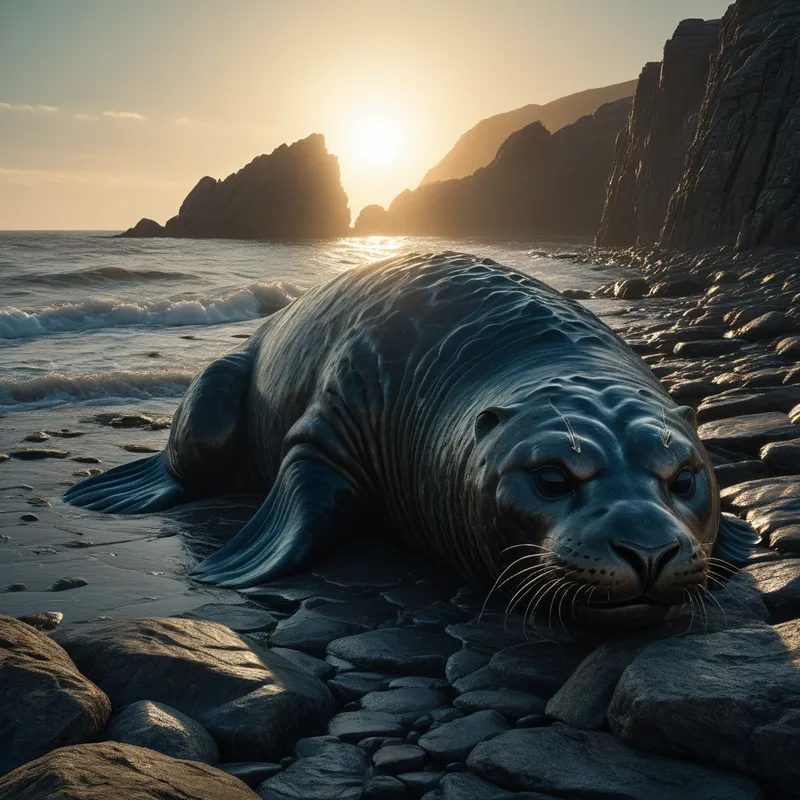
As the sun reached its zenith, the stony shore came alive. From the frothing surf, sleek, wet bodies hauled themselves onto the rocks—a herd of sleeping seals, exhaling the deep scent of brine. And among them, counting his flock, was the god. He appeared first as a venerable sage, bearded with seaweed, his eyes holding the depth of abyssal trenches. He lay down and slept.
This was the moment. With a cry born of necessity, Menelaus leapt. His hands closed on the god’s limbs.
And the world erupted.
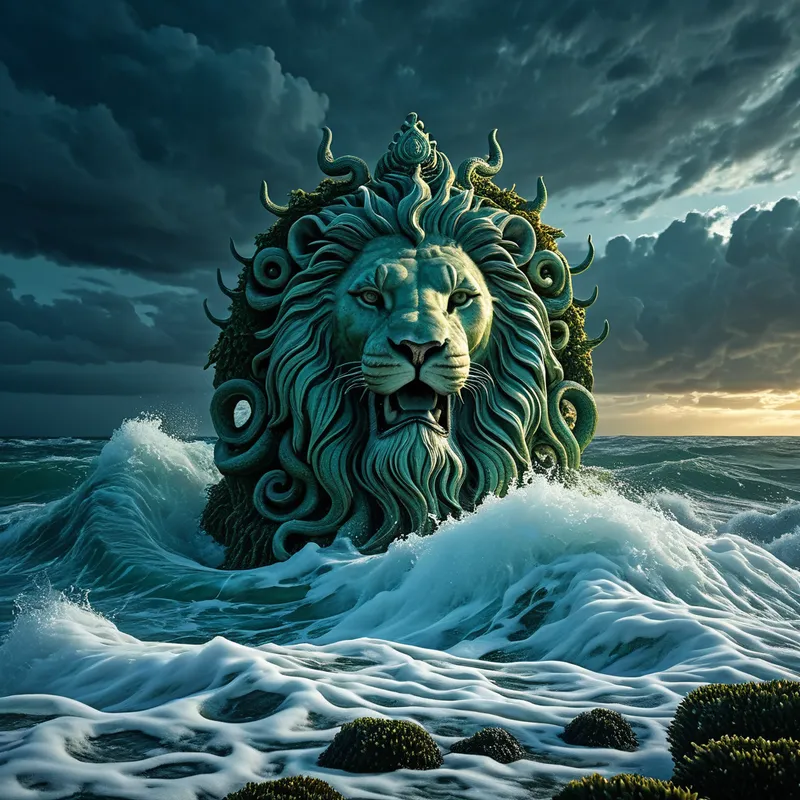
The sage vanished. In his place, a roaring lion, fangs bared, hot breath blasting. Menelaus held on, his muscles screaming. The lion became a coiling serpent, slick and crushing. He held on. Then a panther, a boar, a towering tree with roots like stone. He held on. Fire scorched his skin; a deluge of water threatened to drown him on dry land. Still, he held on, a mortal anchor in a storm of becoming.
The transformations slowed, the fury spent. The god resumed his ancient form, weary and impressed. “Son of Atreus,” the Old Man of the Sea rasped, his voice the sound of tides on a cavern wall, “you have proven your mettle. Ask, and I will answer.”
And so, the truth was given. The reasons for the gods’ displeasure, the sacrifices required, the winds that would carry him home. The secret knowledge flowed like a clear spring, purchased not by cunning, but by unwavering endurance. Proteus slipped back into the welcoming sea, and Menelaus, clutching the hard-won prophecy to his chest, turned to face his fate, no longer lost.
Cultural Origins & Context
The myth of Proteus is a strand of very old thread in the vast tapestry of Greek lore, likely predating the Olympian order. He is a “Halios Geron” (Old Man of the Sea), a type of primordial daemon representing the raw, untamed, and deeply ancient knowledge of the natural world, specifically the sea—the ultimate symbol of the unknown for a maritime culture.
His story is preserved primarily in the fourth book of Homer’s Odyssey, told by Menelaus to Telemachus. This placement is significant. It is a story within a story, a nested lesson on the nature of the heroic journey. It was not a cult myth with widespread public worship, but a poetic and philosophical tool. Bards and poets used Proteus to illustrate a profound truth: that essential knowledge is not freely given. It is guarded by chaos and change, and must be wrestled from it through direct, persistent, and courageous engagement. For a society navigating the literal and metaphorical uncertainties of the sea, Proteus embodied the capriciousness of fate and the rigorous, physical discipline required to divine one’s path through it.
Symbolic Architecture
Proteus is the archetypal spirit of elusive truth. His essence is fluidity itself; he is the principle of perpetual transformation that guards the core of knowing.
To seek truth is to consent to be transformed by the process. The seeker must become as fluid in endurance as the truth is in form.
His transformations are not mere tricks, but a profound symbolic language. The lion represents overwhelming, predatory power; the serpent, hidden wisdom and slippery deceit; the boar, blind, chthonic fury; the tree, rooted, immovable stability; water and fire, the primal, cleansing, and destructive elements. To know the truth, one must confront and endure every facet of reality—the beastly, the elemental, the vegetative, and the divine—without recoiling or losing one’s grip on the intent.
Menelaus represents the conscious ego on a necessary quest. His desperation (the stalled journey, the starving men) is the psychological “stuckness” that forces a confrontation with the deeper, unconscious self (the sea, the ancient god). The act of “holding fast” is the critical, active engagement with the unconscious. It is the ego’s determination to maintain consciousness and purpose while being assaulted by the terrifying, shape-shifting contents of the shadow and the collective unconscious.
The prophecy granted at the end is the reward for this ordeal: integrated knowledge. It is not intellectual trivia, but directive wisdom—a map for the next phase of the journey, earned through somatic and psychological trial.

The Dreamer’s Resonance
When the myth of Proteus stirs in the modern dreamer, it often manifests as a profound experience of somatic and psychic instability. One may dream of chasing or grappling with a figure or animal that constantly changes form. The dreamer’s own body may morph uncontrollably. Environments may liquefy, melt, or shift from one scene to another without logic. There is a pervasive feeling of trying to “get ahold” of something essential—an answer, a feeling, a sense of self—that is maddeningly elusive.
This is the psyche’s enactment of a necessary, if terrifying, process. The dreamer is in a state where an old, rigid structure of identity or belief is breaking down. The unconscious is presenting its contents in rapid, chaotic succession—repressed emotions (rage, fear), instinctual drives, forgotten memories—to be acknowledged and integrated. The anxiety in the dream is the ego’s resistance to this dissolution. The myth instructs the dreamer: the way through is not to analyze from a distance, but to stay present within the chaos. To feel the lion’s roar in your chest, the serpent’s coil around your breath, the flood of water as emotion, and to not let go of the central question: “Who am I, beneath all this?”

Alchemical Translation
The ordeal of Proteus is a perfect model for the alchemical stage of nigredo and the Jungian process of confronting the shadow as a prerequisite for individuation. The seeker (the ego) must descend to the “barren island” of isolation and crisis, where the only source of salvation is the terrifying, ancient power of the unconscious (Proteus).
Individuation begins not with finding oneself, but with consenting to lose every familiar shape one has ever worn, in the faith that a truer form awaits beneath the frenzy.
The gripping and enduring through the transformations is the opus, the work. Each shape shifted through is a complex—a bundle of psychic energy—that must be fully experienced and contained by the conscious mind, rather than repressed or fled from. The fire is the purging of illusion; the water is the dissolution of ego-boundaries; the beast-forms are the raw, unintegrated instincts.
The final, willing revelation by Proteus symbolizes the achievement of a new psychic synthesis. The chaotic, autonomous power of the unconscious becomes an ally, a source of guidance. The prophecy is the emergent wisdom of the Self, providing direction for the continued journey. The individual does not become static but gains the ability to navigate future transformations with purpose, having learned that truth is not a fixed object to possess, but a relationship to be maintained with the ever-changing depths of existence. One learns the protean nature of reality not by becoming a passive observer, but by becoming a steadfast, conscious participant in the great, shifting mystery.
Associated Symbols
Explore related symbols from the CaleaDream lexicon:
- Change
- Role
- Bizarre
- Actor
- Fake
- Shift
- Various
- Perspective
- Cardboard
- Rubber
- Behavior
- Version
- Negro
- Multi
- Actress
- Personality
- Chameleon Color
- Stack of Magazines
- Surreal Jellyfish Jelly
- Jellyfish Sandwich
- Elastic Waistband
- Costume Mask
- Vanishing Limb
- Lengthening Limb
- Stretching Limbs
- Transforming Shapes
- Shifting Colors
- Illusory Landscape
- Shifting Shadows
- Blurring Lines
- Kaleidoscopic Visions
- Yeti
- Shapeshifter
- Shifting Tides
- Mercury Wave
- Dahlia Dream
- Stick Insect Camouflage
- Agile Stickbug
- Lizard-Insect Hybrid
- Harlequin Bug
- Chameleon
- Skink
- Pygmy Chameleon
- Buying Reptiles
- Mosaic Gecko
- Spotted Chameleon
- Oceanic Lizard
- Surreal Caecilian
- Camouflaged Creature
- Translucent Sea Cucumber
- Octopus
- Marine Biologist
- Flounder
- Cuttlefish
- Frogfish
- Morphing Tanager
- Venerable Walrus
- Shapeshifter’s Form
- Bewitched Selkie
- Illusory Kappa
- Selkie’s Skin
- Faded Business Card
- Actor’s Script
- Kaleidoscope
- Holographic Card
- Illusive Still Life
- Fluid Dynamics
- Kaleidoscopic Patterns
- Liquid Brush
- Fleeting Impression
- Digital Mirage
- Ephemeral Design
- Pop Art Collage
- Mixed Media Piece
- Kaleidoscopic Literature
- Mosaic of Genres
- Multi-functional Ottoman
- Stylish Pouf
- Convertible Sofa
- Adjustable Bed Frame
- Sticky Tack
- Ink Blot
- Imposter Paper Shredder
- Kinetic Sand
- Samplers
- Transforming Hallway
- Sidewalk Chalk Art
- Kaleidoscope Vision
- Chameleon Mind
- Kaleidoscopic Image
- Cubist Landscape
- Warped Lines
- Camouflage Patterns
- Optical Illusions
- Tidal Pools
- Decoy Animals
- Yokai Spirits
- Persona
- Pixelated Face
- Software Update
- Online Identity
- Identity Theft
- Distortion
- Modulation
- Quantum Foam
- Atmospheric Distortion
- Wave Function
- Quantum Decoherence
- Quantum Superposition
- Quantum Entropy
- Relativity
- Uncertainty Principle
- Gödel’s Theorem
- Relativistic Space
- Aspect
- Transitivity
- Affix
- Modifier
- Conditional
- Suppletion
- Connotative
- Performative
- Morphology
- Flux
- Mutation
- Facade
- Module
- Prop
- Derivative
- Elasticity
- Transformer
- Ductility
- Reduction
- Shifting
- Swaying
- Stretching
- Parallax
- Aberration
- Elongation
- Gel
- Reef
- Distraction
- Distorting
- Warping
- Phasing
- Soy