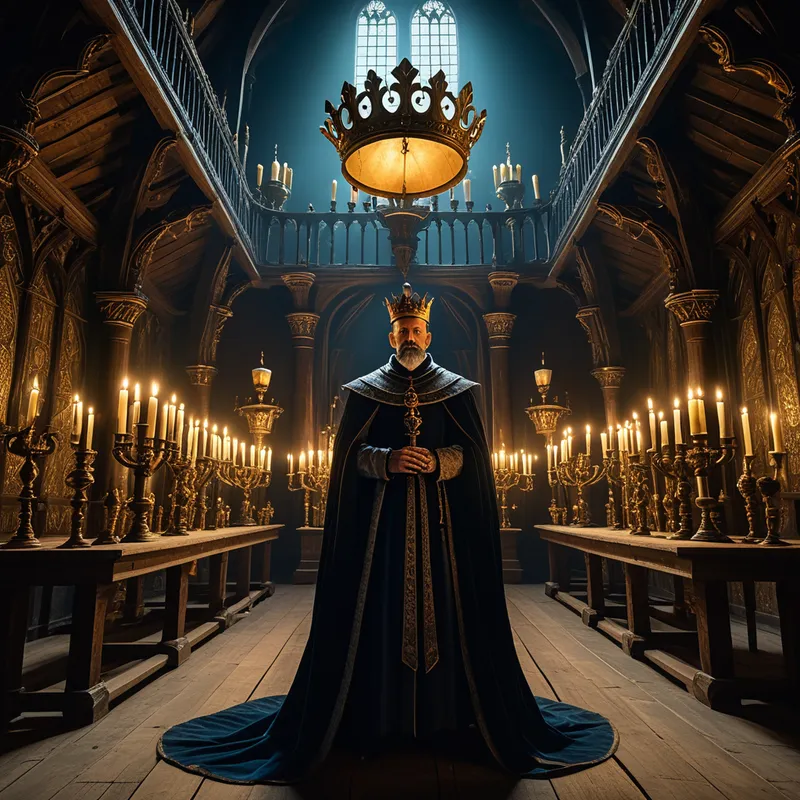
Props in Theater Myth Meaning & Symbolism
A myth of a world where objects hold souls, and a hero must learn that true power lies not in the prop, but in the hand that wields it with truth.
The Tale of Props in Theater
Listen, and I shall tell you of the time before the curtain rose, when the world was but a vast, empty stage. The air was thick with the scent of sawdust and waiting. In this twilight realm dwelt the Keeper of the Tiring-House, an ancient being whose form was woven from velvet shadows and the whispered lines of forgotten plays. His domain was the Limbus of Potential, a cavernous attic where every object that ever was, or could be, in a story, hung suspended in silent expectancy.
Here, a crown dreamed of sovereignty. A skull murmured of mortality. A love letter, its seal unbroken, yearned for a hand to unfold it. Each prop was a soul-in-waiting, brimming with a singular, potent truth, yet utterly inert. They were perfect essences, but they were lonely. They had voice, but no breath; meaning, but no motion.
Into this silent museum wandered a mortal, known only as the Seeker. He was a man haunted by the flatness of his own life, where every action felt like a gesture without consequence, every word an echo. He had heard whispers of a place where objects held the power to make things real. Desperate for substance, he breached the boundary of the Limbus.
The Keeper, a silhouette against a constellation of floating daggers and goblets, did not forbid him. Instead, he spoke in a voice like rustling pages: “All here is truth, but it is a truth that sleeps. You may take one. But know this: the prop does not confer the part. It only asks the question.”
Trembling, the Seeker bypassed the gleaming swords and jeweled scepters. His hand was drawn to a simple, unadorned wooden chair. As his fingers brushed the grain, a shock ran through him—not of power, but of profound, aching weight. It was the weight of rest, of audience, of a throne, of a gallows. It was every chair that ever was.
He carried it onto the great, empty stage. “Now,” he whispered, “make me a king.” He sat. Nothing happened. The chair held only the weight of his body. Despair curdled in his gut. He tried to wield a prop sword as a hero, but it felt like a stick. He held a prop skull and felt no wisdom, only plaster dust.
The Keeper watched from the wings, a patient shadow. “You seek to wear meaning like a costume,” the ancient voice echoed. “The prop is not a mask to hide behind. It is a mirror, held up to the soul of the one who holds it. The crown does not make the king. The true king reveals the crown.”
In a final, furious act of frustration, the Seeker snatched a fragile, painted prop goblet and hurled it against the stage floor. It did not shatter with a theatrical crash of pottery. It broke with the soft, devastating sound of his own heart cracking open—the sound of genuine loss. In that moment of authentic, unperformed grief, as he stared at the broken pieces, a miracle occurred.
The wooden chair beside him began to glow with a gentle, internal light. Not with magic, but with presence. He did not sit on it as a king, but as a tired man. And in that simple, honest act, the chair became. It became the seat by a hearth, the judge’s bench, the place of respite. It became real because he was real with it. The Seeker understood. He was not an actor searching for a prop. He was a life in search of an honest gesture. One by one, the props in the Limbus ceased their dreaming. They turned, not toward him, but toward the world beyond the stage, waiting to be filled, not with fantasy, but with the terrible, beautiful truth of a living hand.

Cultural Origins & Context
This myth finds its roots not in a single text, but in the very atmosphere of the Elizabethan and Jacobean playhouse. It is a Tiring-House Tale, whispered by stagekeepers, props masters, and veteran actors to novices on long, darkening afternoons before a performance. In a culture where “all the world’s a stage,” the question of what is real and what is performed was not mere philosophy—it was a daily tension.
The myth served a crucial societal function. In a rigidly hierarchical world where sumptuary laws dictated what one could wear, and social roles were often performative, the tale offered a subversive consolation. It acknowledged the props of social life—titles, robes, manners—while pointing to the essential self that must animate them, or else live a life of hollow pageantry. It was a story told to ground the actor, reminding them that even as they played a part, the breath in their lungs and the intent in their heart were the only true sources of power that could make an audience believe, and in believing, feel a shared truth.
Symbolic Architecture
At its core, the myth of Props in Theater is a profound exploration of the relationship between essence and appearance, between the Anima Mundi of the object and the Persona of the user. The Limbus of Potential represents the collective unconscious, a psychic repository of all archetypal forms and potentials—the crown of authority, the sword of conflict, the skull of mortality. These are pure symbols, waiting to be constellated into lived experience.
The prop is the question posed by the universe; the authenticity of the user is the only valid answer.
The Seeker embodies the ego initially identified with its own emptiness, seeking to borrow substance from external symbols. His journey is from using to communing. The pivotal moment—the breaking of the goblet—is the necessary shattering of the illusion of control. It is the descent, the Nigredo of the alchemical process, where the false self is broken open to release the genuine feeling within. The Keeper is the archetypal Senex or guide, who does not give answers but holds the space for the right question to be lived.
The Dreamer’s Resonance
When this myth stirs in the modern dreamscape, it often manifests as dreams of searching through endless, warehouse-like spaces for a specific, crucial object—a key, a document, a tool. The object is always just out of reach, or, when found, proves useless or fake. This is the somatic echo of the Seeker’s initial despair. The psyche is signaling a felt disconnect between one’s inner reality and the roles one plays in the world—the parent, the professional, the partner.
Alternatively, one may dream of a familiar, everyday object—a pen, a teacup, a child’s toy—suddenly radiating immense significance, weight, or light. This is the moment of breakthrough, where an aspect of life, previously performed or taken for granted, is suddenly seen and felt in its full depth. The dream is marking an opportunity for what psychologist James Hillman called “seeing through” the literal to the symbolic, animating the world with psychic reality.

Alchemical Translation
The myth models the individuation process as a movement from identification with the Persona (the collection of props we think we need) to a dialogue with the Self (the Keeper within). The first stage is projection: we see all power, meaning, and solution in external objects, statuses, or relationships (the crown, the sword). The alchemical work begins with the withdrawal of these projections back into the psyche.
Transmutation occurs not when we find the right role, but when we bring our raw, unscripted humanity to the role we already have.
The broken goblet is the crucible moment. It represents the voluntary or involuntary dissolution of the ego’s pretensions. This painful breakdown is the prerequisite for the illumination that follows—the humble chair glowing with presence. This is the Albedo. The final stage is not a rejection of the world of “props,” but a redeemed relationship to it. One returns to the stage of life—the office, the home, the community—but now one engages with its forms consciously. The crown may be a job title, the sword a difficult conversation, the chair a moment of quiet. They are no longer empty symbols to hide behind, but vessels waiting to be filled with the gold of authentic engagement. The myth concludes not with an ending, but with a beginning: the props turning toward the world, awaiting the touch of a soul made real through its own courageous, unadorned truth.
Associated Symbols
Explore related symbols from the CaleaDream lexicon: