Prometheus's Stolen Flame Myth Meaning & Symbolism
The Titan Prometheus defies Zeus to steal divine fire for humanity, gifting us knowledge and civilization, and suffering eternal punishment for his act.
The Tale of Prometheus’s Stolen Flame
In the first grey light after the war of [the Titans](/myths/the-titans “Myth from Greek culture.”/), [the world](/myths/the-world “Myth from Tarot culture.”/) was a damp and shivering place. The new king, Zeus, sat upon his cloudy throne, distributing domains to his kin. To humanity, the clay-formed creatures that crawled [the earth](/myths/the-earth “Myth from Hindu culture.”/), he gave nothing but the dark and the cold. They huddled in caves, their bellies empty, their minds shrouded in perpetual twilight, eating their meat raw, knowing no seasons, no arts, no hope.
But one of the old race watched them with a heart that did not match his Titan lineage. His name was [Prometheus](/myths/prometheus “Myth from Greek culture.”/), “Forethinker.” Where his brother Epimetheus acted in haste, [Prometheus](/myths/prometheus “Myth from Greek culture.”/) saw the long arc of consequence. He had aided Zeus in the great war, and he felt a binding kinship with the fragile beings he had helped shape from clay and [water](/myths/water “Myth from Chinese culture.”/). Their suffering was a silent scream in the halls of his mind.
He went to Olympus, his steps heavy on [the star](/myths/the-star “Myth from Tarot culture.”/)-paved paths. “Mighty Zeus,” he spoke, his voice like stones grinding deep in the earth. “The humans freeze. They starve. Grant them a spark, the merest ember of your divine fire, that they might cook their food and ward off the night’s teeth.”
Zeus’s gaze was like a thunderbolt held in check. “Fire is for gods,” he declared, his voice rolling through the clouds. “To give it to them is to give them a piece of our essence. They are creatures of clay and dusk. Let them remain so.” The refusal was absolute, a law etched in the air itself.
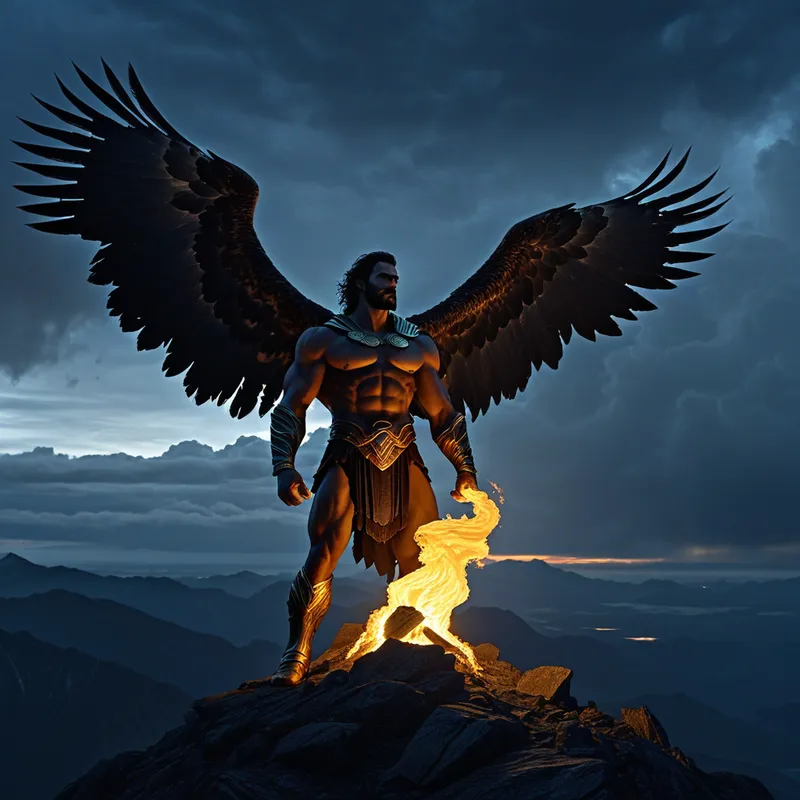
Prometheus descended the mountain, but not in defeat. In his forethought, a plan was already kindling. He knew the fire was kept in [the chariot](/myths/the-chariot “Myth from Tarot culture.”/) of [Helios](/myths/helios “Myth from Greek culture.”/), as it raced across [the sky](/myths/the-sky “Myth from Persian culture.”/). He waited until dusk, when the sun-chariot dipped below the world’s edge. Then, with a stalk of giant fennel—hollow, dry, and quick to catch—he approached. He touched the stalk to a lingering, divine ember caught in [the chariot](/myths/the-chariot “Myth from Tarot culture.”/)‘s wake. A spark leapt. Then a flame.
He did not run. He walked, a solemn procession of one, cradling the stolen sun-seed within the fennel stalk, its light leaking through the seams like a secret too great to be contained. Down to the mud and the cold of the mortal world he came. He knelt before the huddled people and blew upon the spark. A fire bloomed in their midst. Its light did not just push back the dark; it entered their eyes. They saw not just to avoid danger, but to understand. They saw the shape of a tool in a stone, the pattern of stars that guide, the transformation of raw clay into a pot, of raw meat into nourishment.
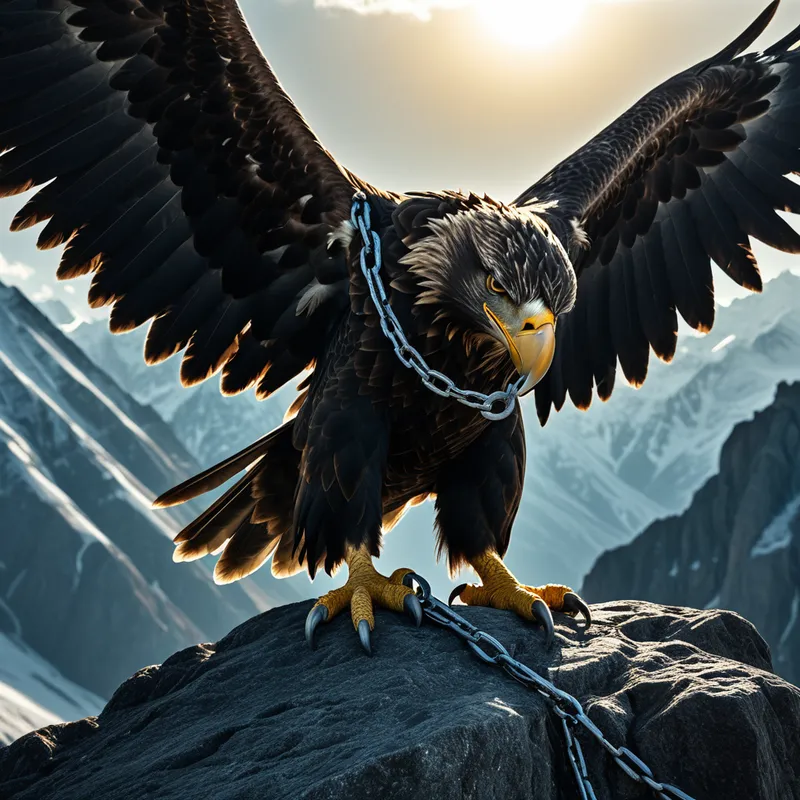
On Olympus, the new light was seen. Zeus’s wrath was a tempest that shook the foundations of the world. The gift was an act of supreme rebellion, a theft of divine prerogative. For his crime, Prometheus was dragged to the most desolate crags of the Caucasus Mountains. Unbreakable, adamantine chains, forged by the smith-god [Hephaestus](/myths/hephaestus “Myth from Global/Universal culture.”/) himself, were driven through his flesh and into the living rock. Zeus sent his eagle, a monstrous bird of vengeance, to feast each day upon Prometheus’s liver—an organ that, by his immortal nature, regrew each night, ensuring an eternity of agonizing renewal. Bound, exposed, and tormented, Prometheus became the eternal cost of the stolen flame, his defiant groans echoing with the crackle of the very fire he had given away.
Cultural Origins & Context
The myth of Prometheus is a foundational narrative from the rich tapestry of ancient Greek mythology, primarily codified in the epic poetry of Hesiod (Theogony, Works and Days) and later dramatized with profound psychological depth by Aeschylus in his tragedy Prometheus Bound. It was not a mere bedtime story, but a sacred narrative that addressed fundamental questions of human existence. Told by bards at symposia, enacted in theaters during religious festivals like the City Dionysia, it served as a cultural mirror.
Its function was multifaceted. It explained the human condition—our possession of technology (techne) and consciousness, juxtaposed with our suffering and mortality. It explored the fraught relationship between humanity and the divine, establishing a paradigm where advancement comes with a price and often through defiance of established, paternalistic order. The myth also reinforced social values, illustrating the consequences of overreaching (hubris) while simultaneously venerating the figure who overreached for the sake of others. It was a story that held the tension between gratitude for civilization and a deep, existential awareness of its costs.
Symbolic Architecture
At its core, the stolen flame is not merely physical fire. It is the [symbol](/symbols/symbol “Symbol: A symbol can represent an idea, concept, or belief, serving as a powerful tool for communication and understanding.”/) of [consciousness](/symbols/consciousness “Symbol: Consciousness represents the state of awareness and perception, encompassing thoughts, feelings, and experiences.”/) itself—the spark of intellect, foresight, culture, and transformative power that separates humanity from a purely instinctual existence.
The flame is the light that allows us to see ourselves seeing, the tool that turns nature into culture, and the dangerous knowledge that liberates us from divine decree while binding us to consequence.
Prometheus represents the rebellious benefactor [archetype](/symbols/archetype “Symbol: A universal, primordial pattern or prototype in the collective unconscious that shapes human experience, behavior, and creative expression.”/), the part of the [psyche](/myths/psyche “Myth from Greek culture.”/) (or the [cosmos](/symbols/cosmos “Symbol: The entire universe as an ordered, harmonious system, often representing the totality of existence, spiritual connection, and the unknown.”/)) that values potential and [compassion](/symbols/compassion “Symbol: A deep feeling of empathy and concern for others’ suffering, often involving a desire to help or alleviate their pain.”/) over rigid law. His “forethought” is the faculty of [human](/symbols/human “Symbol: The symbol of a human represents individuality, complexity of emotions, and social relationships.”/) consciousness that can plan, innovate, and envision a future different from the present. Zeus, in this dynamic, symbolizes established order, [authority](/symbols/authority “Symbol: A symbol representing power structures, rules, and control, often reflecting one’s relationship with societal or personal governance.”/), and the often-arbitrary laws of [reality](/symbols/reality “Symbol: Reality signifies the state of existence and perception, often reflecting one’s understanding of truth and life experiences.”/) or the superego that seek to keep nascent consciousness in a state of dependent ignorance.
The [punishment](/symbols/punishment “Symbol: A dream symbol representing consequences for actions, often tied to guilt, societal rules, or internal moral conflicts.”/) is equally symbolic. The [liver](/symbols/liver “Symbol: Represents emotional processing, purification, and vitality. Often symbolizes anger, toxicity, or life force in dreams.”/) was considered the seat of passions and emotions in ancient thought. The eternal devouring and renewal represents the perpetual cost of consciousness: the cyclical suffering, [anxiety](/symbols/anxiety “Symbol: Anxiety in dreams reflects internal conflicts, fears of the unknown, or stress from waking life, often demonstrating the subconscious mind’s struggle for peace.”/), and passionate turmoil that accompany self-[awareness](/symbols/awareness “Symbol: Conscious perception of self, surroundings, or internal states. Often signifies awakening, insight, or heightened sensitivity.”/), creativity, and the burden of [knowledge](/symbols/knowledge “Symbol: Knowledge symbolizes learning, understanding, and wisdom, embodying the acquisition of information and enlightenment.”/). The chains are the inescapable conditions of our existence—[mortality](/symbols/mortality “Symbol: The awareness of life’s finitude, often representing transitions, impermanence, or existential reflection in dreams.”/), [responsibility](/symbols/responsibility “Symbol: Responsibility in dreams often signifies the weight of duties and the expectations placed upon the dreamer.”/), and the very laws of [nature](/symbols/nature “Symbol: Nature symbolizes growth, connectivity, and the primal forces of existence.”/) we now seek to understand and manipulate.
The Dreamer’s Resonance
When this myth stirs in the modern unconscious, it often manifests in dreams of illicit acquisition or defiant creation. You may dream of stealing a precious, glowing object from a forbidding institution or a powerful, shadowy figure. You may be crafting something revolutionary in a hidden workshop, filled with both exhilaration and dread of discovery. The somatic experience is key: a racing heart (the stolen spark), a feeling of both immense power and profound vulnerability.
This dream pattern signals a psychological process of differentiation—the necessary, often painful, act of stealing “fire” from internalized authorities (parental complexes, societal norms, outdated self-concepts) to fuel one’s own authentic life and consciousness. The eagle’s attack in the dream may translate as a sudden crisis, a bout of anxiety, or a feeling of being “pecked at” by responsibilities and judgments after a bold act of self-assertion. The dream is the psyche’s dramatization of the essential, terrifying, and glorious act of claiming one’s own light, knowing punishment (in the form of anxiety or backlash) may follow.

Alchemical Translation
The myth of Prometheus is a perfect map of the alchemical process of individuation. It models the psychic transmutation required to move from a state of unconscious bondage (humanity in the dark) to one of conscious, though burdened, mastery.
The initial state ([nigredo](/myths/nigredo “Myth from Alchemical culture.”/)) is the primal, undifferentiated murk—the human condition before the flame, ruled by instinct and external gods. The “theft” is the crucial, rebellious act of [separatio](/myths/separatio “Myth from Alchemical culture.”/)—distinguishing [the self](/myths/the-self “Myth from Jungian culture.”/) from the collective, claiming [the divine spark](/myths/the-divine-spark “Myth from Gnostic culture.”/) of individual insight and will from the monolithic “parental” cosmos (Zeus/Olympus). This is the most dangerous part of the work, requiring the “fennel stalk” of cunning and indirect means to transport the volatile spirit.
The binding to the rock is the mortificatio, the necessary suffering and containment that follows illumination. The new consciousness must be fixed, tested, and integrated, not merely enjoyed. The eagle represents the relentless, purifying attack of reality upon the inflated ego that comes with new power.
Finally, the eternal cycle of torment and regeneration is the circulatio—the ongoing, lifelong process of the conscious ego being challenged, dismantled in part, and rebuilt. The gift of fire is not a one-time event but a perpetual condition. The individuated Self is not the unbound Titan, but the bound one—the being who has integrated the light and the chains, the creativity and the cost, the defiance and the responsibility. To carry the stolen flame is to accept the rock and the eagle, understanding that the price of consciousness is the very substance of a meaningful life.
Associated Symbols
Explore related symbols from the CaleaDream lexicon: