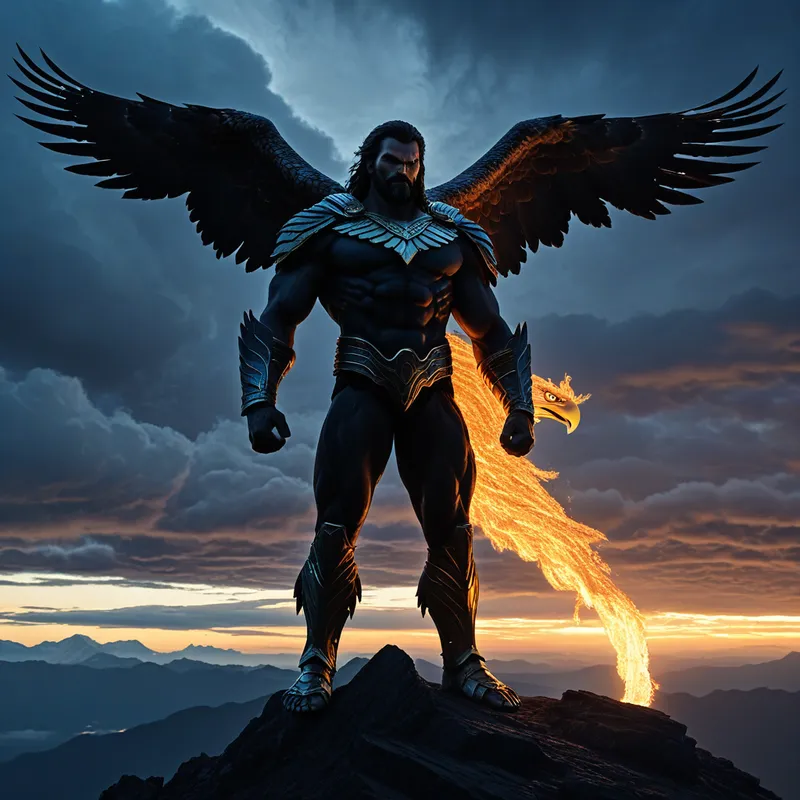
Prometheus's Stolen Fire Myth Meaning & Symbolism
The Titan Prometheus defies Zeus to steal celestial fire for humanity, gifting them knowledge and technology at the cost of eternal torment.
The Tale of Prometheus’s Stolen Fire
Listen, and hear a tale from the age when gods and Titans walked [the earth](/myths/the-earth “Myth from Hindu culture.”/), a tale of a theft that changed the destiny of [the world](/myths/the-world “Myth from Tarot culture.”/). In the beginning, after the great war of the gods, the lot of mortals was a bleak and shivering one. They dwelled in dark caves, their bellies empty, their minds shrouded in mist, utterly subject to the whims of the Olympians. They had no craft, no art, no hope of a future beyond mere survival.
But one being watched them with a heart that did not align with the new cosmic order. This was [Prometheus](/myths/prometheus “Myth from Greek culture.”/), the clever Titan, friend to humanity. He saw in their eyes a spark that deserved to be kindled. At a great gathering in Mecone, where the division of sacrifices between gods and men was to be decided, [Prometheus](/myths/prometheus “Myth from Greek culture.”/) played his first trick. He presented two offerings: one, a pile of rich, succulent meat hidden inside an unappealing ox’s stomach; the other, a gleaming heap of bones artfully concealed beneath a glistening layer of fat. Zeus, choosing the seemingly superior portion, was tricked into selecting the bones. From that day, men would keep the meat for themselves, offering only the smoke and bones to the heavens. Zeus’s fury was cold and deep, a simmering thunder.
In retaliation, [the Sky](/myths/the-sky “Myth from Persian culture.”/)-Father withheld the final, essential gift: fire. Without it, humanity remained in primordial night, unable to cook their food, forge tools, or ward off the deep cold. Their potential was locked in clay. Prometheus could not abide this sentence. His compassion was a fire in itself, burning brighter than fear.
So, he ascended the secret path to the sun-chariot of [Helios](/myths/helios “Myth from Greek culture.”/), or perhaps to the very forge of [Hephaestus](/myths/hephaestus “Myth from Global/Universal culture.”/) on Olympus. The air thinned, charged with divine power. With a heart pounding not with terror, but with purpose, he did the unthinkable. He took a single, glowing ember of celestial fire. Some say he hid it in the hollow stalk of a giant fennel plant, its pith smoldering to conceal the sacred light. Others whisper he carried it in his own cupped hands, the divine heat searing his Titan flesh—a prelude to his fate.
He descended like a falling star back to the mortal realm. On a barren hillside, before the huddled, wide-eyed people, he presented his gift. He breathed upon the ember, and it burst into a crackling, warming, illuminating flame. He showed them how to tend it, how to use it. In that instant, the darkness of the world rolled back. Huts were warmed, metal was softened and shaped, food was transformed. The spark of intellect, of technology, of culture, was lit. Humanity stood upright, not just in body, but in spirit.
On Olympus, Zeus looked down and saw the pinpricks of light spreading across the dark earth. His wrath was absolute, a cataclysm contained. Prometheus had stolen the prerogative of the gods. For his crime, a punishment must be devised that would echo through eternity. The Titan was dragged to the desolate, wind-scoured peaks of the Caucasus Mountains. There, with unbreakable chains forged by Hephaestus, he was bound immovably to the cold rock.
And each day, as the sun rose, Zeus sent his great eagle, the embodiment of his tyrannical will. The bird would descend, its talons like iron, and tear open Prometheus’s immortal liver. Each night, as the stars wept, the liver would regrow, ensuring the agony was as infinite as his life. This was the price of the stolen fire: eternal torment for the giver, for the one who dared to say “no” to divine decree for the sake of a struggling, grateful humanity.

Cultural Origins & Context
This foundational myth comes to us primarily from the epic poetry of Hesiod, in his Theogony and Works and Days, and later from the tragic playwright Aeschylus in his masterpiece, Prometheus Bound. It was not mere entertainment; it was a central narrative in the Greek understanding of their place in the cosmos. Told by bards at feasts and enacted in grand civic festivals in Athens, it served multiple societal functions.
It explained the human condition: our possession of technology (techne) and our separation from the natural, animal state. It justified the practice of animal sacrifice (the Mecone trick), a cornerstone of Greek religion. Most profoundly, it explored the tense relationship between mortal striving and divine authority. In a culture that valued cunning intelligence ([metis](/myths/metis “Myth from Greek culture.”/)) and civic benefaction, Prometheus was a complex, almost tragic figure—a divine rebel who embodied the painful, costly ascent of civilization itself. He was the patron of foresight and craft, a symbol of the human capacity to improve our lot, even against overwhelming power.
Symbolic Architecture
At its [heart](/symbols/heart “Symbol: The heart symbolizes love, emotion, and the core of one’s existence, representing deep connections with others and self.”/), the myth is an [allegory](/symbols/allegory “Symbol: A narrative device where characters, events, or settings represent abstract ideas or moral qualities, conveying deeper meanings through symbolic storytelling.”/) for the awakening of [consciousness](/symbols/consciousness “Symbol: Consciousness represents the state of awareness and perception, encompassing thoughts, feelings, and experiences.”/). The fire is never merely a physical tool.
Fire is the primordial symbol of consciousness, the luminous spark that separates awareness from instinct, culture from nature, the future from an eternal present.
Prometheus represents the [psychopomp](/myths/psychopomp “Myth from Greek culture.”/) or the rebellious [aspect](/symbols/aspect “Symbol: A distinct feature, quality, or perspective of something, often representing a partial view of a larger whole.”/) of [the Self](/myths/the-self “Myth from Jungian culture.”/) that risks everything to bring the light of [knowledge](/symbols/knowledge “Symbol: Knowledge symbolizes learning, understanding, and wisdom, embodying the acquisition of information and enlightenment.”/) (the [logos](/myths/logos “Myth from Christian culture.”/)) to the sleeping, unconscious [mass](/symbols/mass “Symbol: Mass often symbolizes a gathering or collective experience, representing shared beliefs, burdens, or the weight of emotions within a community.”/) of humanity (the latent [psyche](/myths/psyche “Myth from Greek culture.”/)). His theft is the necessary act of individuation—stealing power from the ruling, complacent [authority](/symbols/authority “Symbol: A symbol representing power structures, rules, and control, often reflecting one’s relationship with societal or personal governance.”/) (Zeus, representing the established, often tyrannical, world order or the dominant parental complex) to empower the nascent ego.
His [punishment](/symbols/punishment “Symbol: A dream symbol representing consequences for actions, often tied to guilt, societal rules, or internal moral conflicts.”/) is equally symbolic. The [liver](/symbols/liver “Symbol: Represents emotional processing, purification, and vitality. Often symbolizes anger, toxicity, or life force in dreams.”/) was considered the seat of passions and [life](/symbols/life “Symbol: The symbol of ‘Life’ represents a journey of growth, interconnectedness, and existential meaning, encompassing both the joys and challenges that define human experience.”/)-force in ancient thought. The daily devouring represents the perpetual cost of consciousness: the enduring pain of self-[awareness](/symbols/awareness “Symbol: Conscious perception of self, surroundings, or internal states. Often signifies awakening, insight, or heightened sensitivity.”/), of foresight, of carrying the burden of knowledge and the [responsibility](/symbols/responsibility “Symbol: Responsibility in dreams often signifies the weight of duties and the expectations placed upon the dreamer.”/) it entails. The [eagle](/symbols/eagle “Symbol: The eagle is a symbol of power, freedom, and transcendence, often representing a person’s aspirations and higher self.”/), Zeus’s [instrument](/symbols/instrument “Symbol: An instrument symbolizes creativity, communication, and the means by which one expresses oneself or influences the world.”/), is the relentless, predatory aspect of that supreme authority, ever seeking to reclaim its [dominance](/symbols/dominance “Symbol: A state of power, control, or influence over others, often reflecting hierarchical structures, authority, or social positioning.”/) by destroying the [vessel](/symbols/vessel “Symbol: A container or structure that holds, transports, or protects something essential, representing the self, emotions, or life journey.”/) of rebellion.
The Dreamer’s Resonance
When this myth stirs in the modern unconscious, it often manifests in dreams of profound, costly awakening. You may dream of finding a hidden, forbidden source of light or power. You may dream of stealing something precious from a powerful, wrathful figure (a boss, a parent, an institution). The somatic feeling is one of thrilling risk mixed with deep dread.
Psychologically, this signals a critical stage in the dreamer’s development. It is the process of “stealing one’s own fire”—differentiating from internalized authorities, claiming one’s unique talents and knowledge against an inner voice that says, “You are not allowed.” The chains and the eagle in the dreamscape symbolize the anticipated (or ongoing) punishment: the anxiety, guilt, isolation, or self-sabotage that follows any bold act of self-assertion or truth-telling. The dream is mapping the territory of a necessary, painful rebellion within the psyche.

Alchemical Translation
The journey of Prometheus is a perfect map for the alchemical process of individuation. It begins in the [nigredo](/myths/nigredo “Myth from Alchemical culture.”/), the blackness: humanity’s unconscious, primitive state. Prometheus’s compassionate observation (contemplatio) is the first stirring.
The theft itself is the [separatio](/myths/separatio “Myth from Alchemical culture.”/) and [solutio](/myths/solutio “Myth from Alchemical culture.”/)—the daring separation from the ruling totality (Zeus/Olympus) and the dissolution of old bonds. He extracts [the divine spark](/myths/the-divine-spark “Myth from Gnostic culture.”/) (the scintilla or philosopher’s stone in potentia) from its celestial source. Bringing it to humanity is the coagulatio, the embodiment of that spirit into tangible, worldly form—skills, arts, consciousness.
The ultimate alchemical transmutation is not of lead into gold, but of suffering into meaning. Prometheus’s bound agony is the mortificatio and putrefactio, the necessary dissolution of the old Titan identity. Yet, because he understands his fate (Forethought), his suffering is not meaningless; it is sacrificial, and thus contains the seed of the albedo, the whitening.
His eventual liberation by [Heracles](/myths/heracles “Myth from Greek culture.”/) (foreseen in the myth cycle) represents the final stage: the integration of the rebel into a new, more complex order. For the modern individual, this translates to the painful but liberating process of owning one’s power, enduring the consequent crises of identity and relationship, and ultimately achieving a hard-won sovereignty where one’s rebellious, compassionate spirit is no longer chained, but becomes a reconciled part of a wiser, more complete Self. We are both the grateful humanity, warmed by the gifted fire, and the bound Titan, paying the price for having dared to light it.
Associated Symbols
Explore related symbols from the CaleaDream lexicon: